

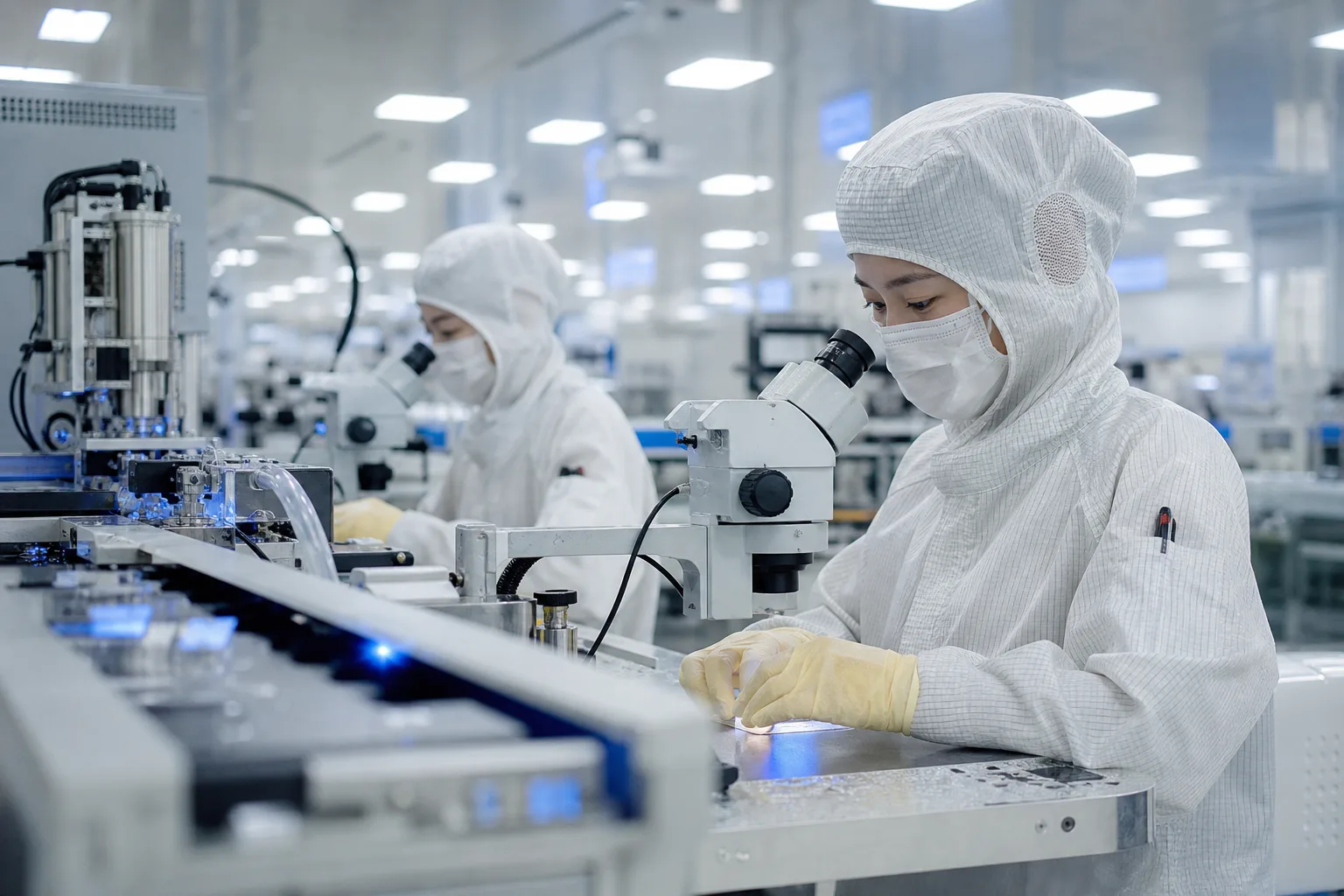
- The Vietnam AI data center fab project has reached volume-production readiness, according to Enablence Technologies and ShunYun Technology.
- A Vietnam AI data center supply base could help customers diversify manufacturing beyond China and Taiwan as infrastructure spending accelerates.
- Production readiness does not guarantee immediate high-volume output, but it marks a meaningful operational test for the partners.
- Optical networking components are becoming a critical constraint as AI clusters require far more bandwidth between servers and accelerators.
Table of Contents
Vietnam AI data center supply chain gets a new manufacturing node
AI infrastructure is eating the technology industry’s supply chain from both ends. At one end, Nvidia-class accelerators remain painfully scarce and expensive. At the other, the less glamorous plumbing of modern computing — switches, cables, optical modules and interconnects — is under serious pressure. That is why a Vietnam AI data center manufacturing announcement from Enablence Technologies and ShunYun Technology deserves more attention than the typical factory milestone.
The two companies say their Vietnam fabrication facility has completed volume-production readiness, positioning the site to support growth in AI data centers. The wording matters. Readiness is not the same as declaring a factory fully ramped, shipping at maximum capacity or turning a profit. It means the manufacturing process, equipment and quality systems have cleared the point where commercial-scale production can begin.
That’s still a consequential step. Building a fab is one thing; getting repeatable yields from it is the part that separates a press release from a real supply-chain asset. Anyone who watched the semiconductor shortages of 2020 and 2021 knows how quickly one missing component can hold up an entire product category.
Enablence has built its business around optical communications technologies, an area that is becoming central to the AI buildout. AI servers consume extraordinary amounts of data internally and across clusters. A rack stuffed with GPUs is useful only if it can exchange data rapidly with the other racks around it. The compute gets headlines. The networking determines whether all that compute actually works as intended.
Why optics matter more than the factory announcement suggests
For a Vietnam AI data center ecosystem, the opportunity goes beyond assembling hardware near demand. It means claiming a place in the global production chain for the components that move information between machines.
Conventional cloud data centers already depend heavily on optical links. AI clusters raise the stakes because large language models and other distributed workloads push constant traffic between accelerators, memory systems and network switches. More GPUs require more interconnect bandwidth. Faster GPUs make the bottleneck even more obvious. It is a bit like adding lanes to a highway while keeping the same narrow on-ramp: eventually, the on-ramp is all anyone notices.
That dynamic has made high-speed networking a major focus for companies including Nvidia, Broadcom, Arista Networks and Cisco, as well as a wide cast of specialist optics suppliers. Industry interest is now moving beyond pluggable optical transceivers toward co-packaged optics and other approaches designed to reduce power use and move data over shorter, denser connections. Not every one of those bets will land commercially, but the demand for bandwidth is not a fad.
The Enablence-ShunYun facility arrives in that context. The companies have framed the plant as an answer to AI data center growth, and that is plausible. Still, the important questions are the boring ones: What products will the site make first? What are the production yields? Which customers have qualified the output? And how fast can capacity expand if orders arrive? The announcement does not provide those details.
Frankly, those details will determine whether this becomes a meaningful Vietnam AI data center supply-chain story or simply another manufacturing ambition attached to the AI label.
Vietnam’s manufacturing moment is real, but it is not automatic
Vietnam has spent years becoming a more important alternative manufacturing base for electronics companies looking to reduce concentration in China. Samsung’s vast operations in the country helped establish the playbook. Apple suppliers have expanded there, Intel has long operated a major chip assembly and test presence in Vietnam, and a wider network of electronics manufacturers has followed.
A Vietnam AI data center component operation fits that broader pattern. Customers want geographic options. The Covid-era shutdowns, trade tension between Washington and Beijing, and persistent concerns over a Taiwan Strait disruption have made single-country sourcing look less like efficiency and more like a gamble.
But diversification has costs. A production location needs skilled technicians, dependable utilities, specialized suppliers, logistics capacity and customers willing to spend time qualifying a new line. For optics and semiconductor-adjacent manufacturing, consistency is everything. A component that works beautifully in a lab but varies from batch to batch is no use to a hyperscale operator trying to keep thousands of servers online.
Vietnam has made clear progress, yet it is competing with established ecosystems in Taiwan, China, Malaysia, Singapore, South Korea and Thailand. It cannot simply announce its way into the top tier. The test is whether facilities such as this one can repeatedly manufacture specialized products at the quality and volume global customers require.
The companies’ volume-production readiness claim suggests they believe that work has been done. Readers should view it as the starting gun, not the finish line.
A small company signal inside a colossal AI spending cycle
The biggest AI infrastructure announcements tend to involve absurdly large numbers: multibillion-dollar data center campuses, GPU orders measured in the hundreds of thousands, and power demands that utilities struggle to accommodate. A factory readiness update can seem tiny beside that spectacle.
Yet this is how the physical AI economy actually gets built. Not through one miraculous product, but through thousands of suppliers making the parts that prevent a data center from becoming a very expensive room full of idle silicon. The Vietnam AI data center factory announcement is a reminder that the next phase of AI spending will reach far beyond model developers and chip designers.
For Enablence, a successful ramp could provide a practical foothold in a market with unusually strong structural demand. The company’s official website provides company information. For ShunYun Technology, the partnership offers exposure to the same infrastructure wave while anchoring production in a country eager to move up the electronics value chain.
There is also a less cheerful possibility. AI data center spending is enormous today, but it is concentrated among a relatively small group of cloud giants and well-funded model companies. If those buyers slow capital expenditures, suppliers further down the chain will feel it quickly. The industry has seen this movie before: telecom equipment makers built aggressively during the dot-com boom, then faced a brutal hangover when demand expectations outran real deployments.
My read is that today’s AI buildout has more tangible demand behind it than that era did. Enterprises are using these systems, cloud providers are reporting real capacity constraints, and the biggest buyers have the balance sheets to keep building. Still, a Vietnam AI data center factory needs orders, not vibes.
The next milestone is customer-qualified output
Enablence and ShunYun have crossed an operational threshold, and that should not be dismissed. Manufacturing readiness takes time, money and engineering discipline. But the more revealing update will be the next one: confirmed shipments, named or unnamed customer wins, capacity figures, and evidence that the Vietnam line can meet demanding reliability requirements at scale.
If that happens, the Vietnam AI data center project will stand for more than one facility’s launch. It will show that AI’s supply chain is spreading into new geography precisely as the world’s appetite for computing power becomes harder to satisfy. And if the factory struggles to ramp? That would be an equally useful lesson: in AI infrastructure, the hidden components are often the hardest ones to scale.

