

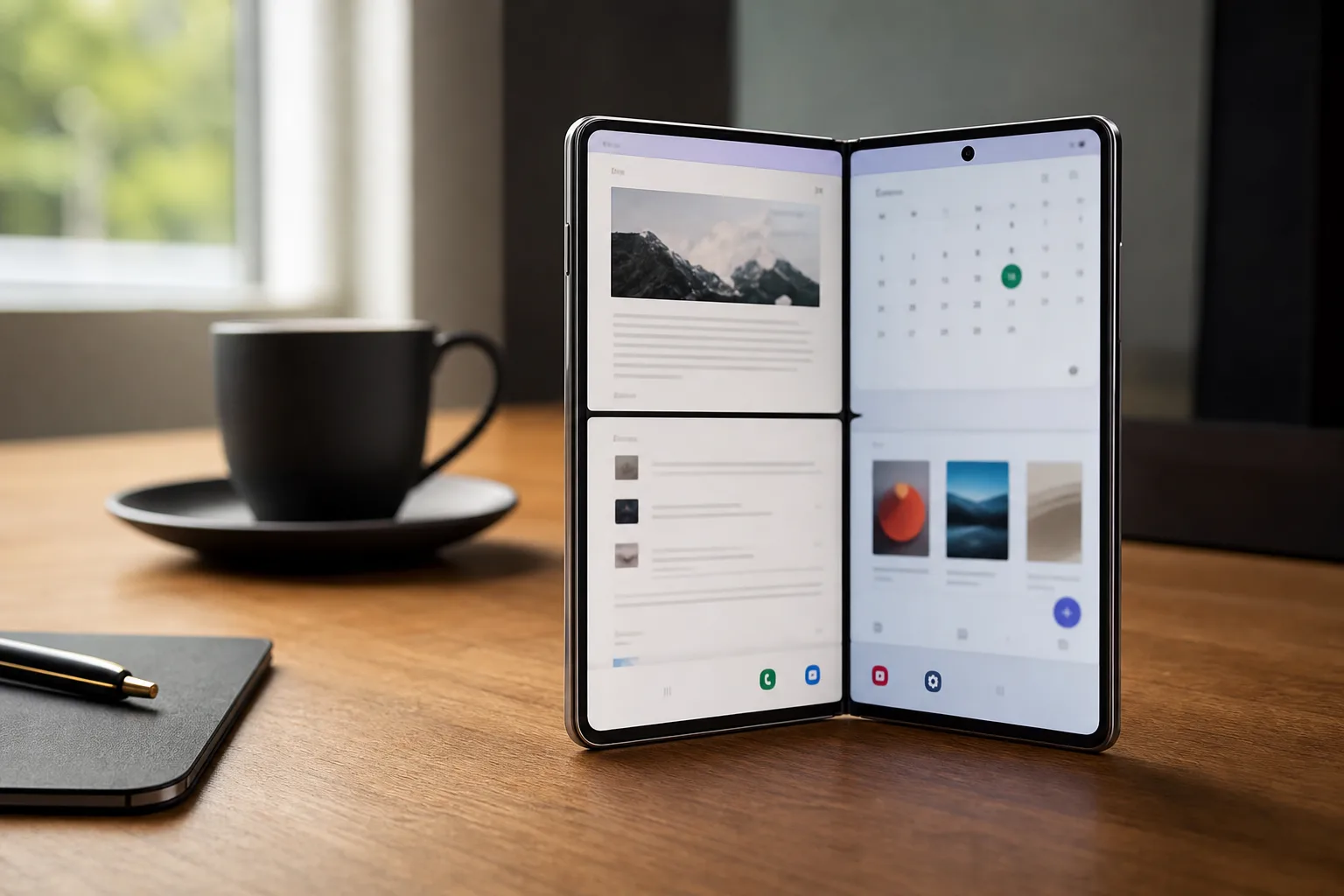
- The Galaxy Z Fold 8 Ultra with 512GB storage is listed on Amazon for $2,048.39.
- This Galaxy Z Fold 8 configuration pairs 16GB of RAM with two 120Hz displays, targeting buyers who want tablet-scale multitasking.
- The discount softens Samsung’s foldable premium, but buyers should still compare the listing’s seller, warranty terms, and return policy.
- Foldables remain expensive because buyers are paying for a niche form factor, not merely flagship processor and camera specifications.
Table of Contents
Galaxy Z Fold 8 pricing finally looks a little less absurd
The Galaxy Z Fold 8 has the familiar foldable-phone problem: it asks shoppers to spend laptop money on something that also has to survive a pocket, a commute, and the occasional encounter with a kitchen counter. Amazon’s current listing takes some of the sting out of that equation. The Galaxy Z Fold 8 Ultra with 512GB of storage is listed for $2,048.39.
That remains an enormous amount of money for a phone. Let’s not pretend otherwise. But premium foldables don’t get judged solely against a conventional $800 or $1,000 slab handset. They sit awkwardly between phone, small tablet, e-reader, travel screen, and productivity gadget. For the right person, that overlap has real value. For everyone else, it’s an expensive party trick with a hinge.
The Amazon configuration is particularly high-end on paper: 512GB of storage, 16GB of RAM, and 120Hz refresh rates on both displays. Those are the details that matter if the buyer’s actual plan involves keeping several apps open, editing documents, reading large PDFs, or carrying less gear on a trip. The extra storage is also less frivolous than it sounds when a device becomes the place where photos, downloaded video, games, and work files all pile up.
Still, a lower price does not automatically make a foldable a bargain. It makes it a conversation worth having.
What the Galaxy Z Fold 8 deal actually changes
A price cut on a device above $2,000 is meaningful, though it doesn’t transform the Galaxy Z Fold 8 into an impulse purchase. Think of it more like an airline upgrading you from an awful middle seat for a fee that’s finally tolerable. You’re still buying the ticket; the experience simply begins to make more financial sense if you already wanted the upgrade.
At $2,048.39, the Galaxy Z Fold 8 Ultra remains firmly above Samsung’s standard flagship phones and above most premium tablets. The math only works if its larger internal screen replaces another device, or if the ability to unfold a tablet-sized canvas several times a day genuinely makes work or entertainment better. A person who lives in Gmail, Slack, Chrome, Microsoft 365, and Google Docs may notice the difference. Someone who mainly messages, scrolls social feeds, and watches short videos almost certainly won’t.
The 16GB RAM figure deserves attention. Android flagships have steadily moved upward on memory, partly because heavier apps, camera processing, and background multitasking demand it. On a book-style foldable, RAM is more than a spec-sheet trophy: Samsung’s whole pitch relies on running multiple apps at once without turning the device into a stuttering mess. If the listed configuration is accurate, it is built for that workload rather than merely presenting a big screen for Netflix.
The same goes for the dual 120Hz panels, which should help the device feel responsive whether it is closed or open. High refresh rate displays are now common in expensive phones, but a foldable is especially unpleasant when its two screens feel mismatched. Moving from the narrow outer display to the inner panel should feel like one device, not like switching from a modern phone to an airport kiosk.
The unresolved cost of buying a foldable
Even with the discount, the Galaxy Z Fold 8 carries compromises that conventional flagships largely avoid. Foldables have more moving parts, a visible crease to varying degrees, different aspect ratios, and repair concerns that are tougher to shrug off when the initial purchase is north of two grand. The industry has made serious progress here, but physics has not signed a peace treaty with thin glass and mechanical hinges.
Samsung has been the most persistent major player in this category, and that persistence matters. It has had years to improve software behavior, app continuity, hinge design, and the strange little frictions that emerge when a phone tries to become a tablet. Google’s Pixel Fold line and OnePlus Open showed there is room for different takes on the format, while Chinese manufacturers have often pushed thinner hardware. Yet Samsung still has the broadest consumer recognition in the US foldable market, along with an established retail and service footprint.
Before clicking buy, shoppers should examine the precise Amazon offer rather than trusting a price card at a glance. Confirm who is selling and shipping the unit, whether it is new rather than refurbished or international-market stock, what warranty applies, and how returns work after activation. Samsung’s own warranty information is worth reading before spending this much. A few minutes of boring checkout-page scrutiny can save a wildly expensive headache later.
Carrier compatibility is another practical check. A foldable at this price should work cleanly with the network a buyer already uses, including the bands that matter in their area. And if trade-in value is part of the plan, get a firm quote before ordering. Trade-in estimates have a way of looking generous until the inspection email arrives.
Who should consider the Galaxy Z Fold 8 Ultra
The Galaxy Z Fold 8 makes the strongest case for people who repeatedly hit the limits of a phone-sized screen. Maybe you review contracts on the train, manage dashboards between meetings, read comics, use remote desktop tools, or want a compact travel device without carrying a tablet. Those are not edge cases anymore, but they are still not most people.
It is also sensible for a buyer who already intended to purchase this exact 512GB model. Discounts on premium electronics can create a false sense of urgency, as if a lower price means spending $2,048 is suddenly prudent. It doesn’t. The saving is real only when the product was already the right fit.
For buyers choosing between storage tiers, 512GB provides a useful cushion without forcing constant file management. That matters more on the Galaxy Z Fold 8 than on a basic phone because a device positioned as a mini workstation tends to accumulate more locally stored material. But cloud-first users who stream everything and keep photos backed up may find a cheaper storage option perfectly adequate when it appears.
My read is that the sale is less a signal of a mass-market foldable breakthrough than a reminder of where this category is heading. Samsung and its rivals need prices to come down if foldables are ever going to be ordinary purchases rather than executive-toy purchases. Until then, deals like this one are the pressure valve: enough to tempt enthusiasts, not enough to erase the premium.
Don’t confuse a discount with maturity
The Galaxy Z Fold 8 sale is a good deal by the standards of ultra-premium foldables, especially for buyers who value the 512GB and 16GB configuration. But it also exposes the category’s central tension. The hardware has become more polished, the screens have become more useful, and software has improved. The price still requires a justification most phones never ask for.
Samsung’s next big task is not simply making the next Fold thinner or adding another camera upgrade. It is proving that a folding phone can become mundane enough to buy without a spreadsheet. At $2,048.39, the Ultra is closer. It is not there yet.