

- A possible early universe black hole appears to have grown faster than the young galaxy surrounding it.
- The early universe black hole finding challenges the usual assumption that galaxies and their central black holes grow in lockstep.
- Astronomers are weighing whether unusually rapid feeding or a massive initial seed can explain billion-solar-mass black holes.
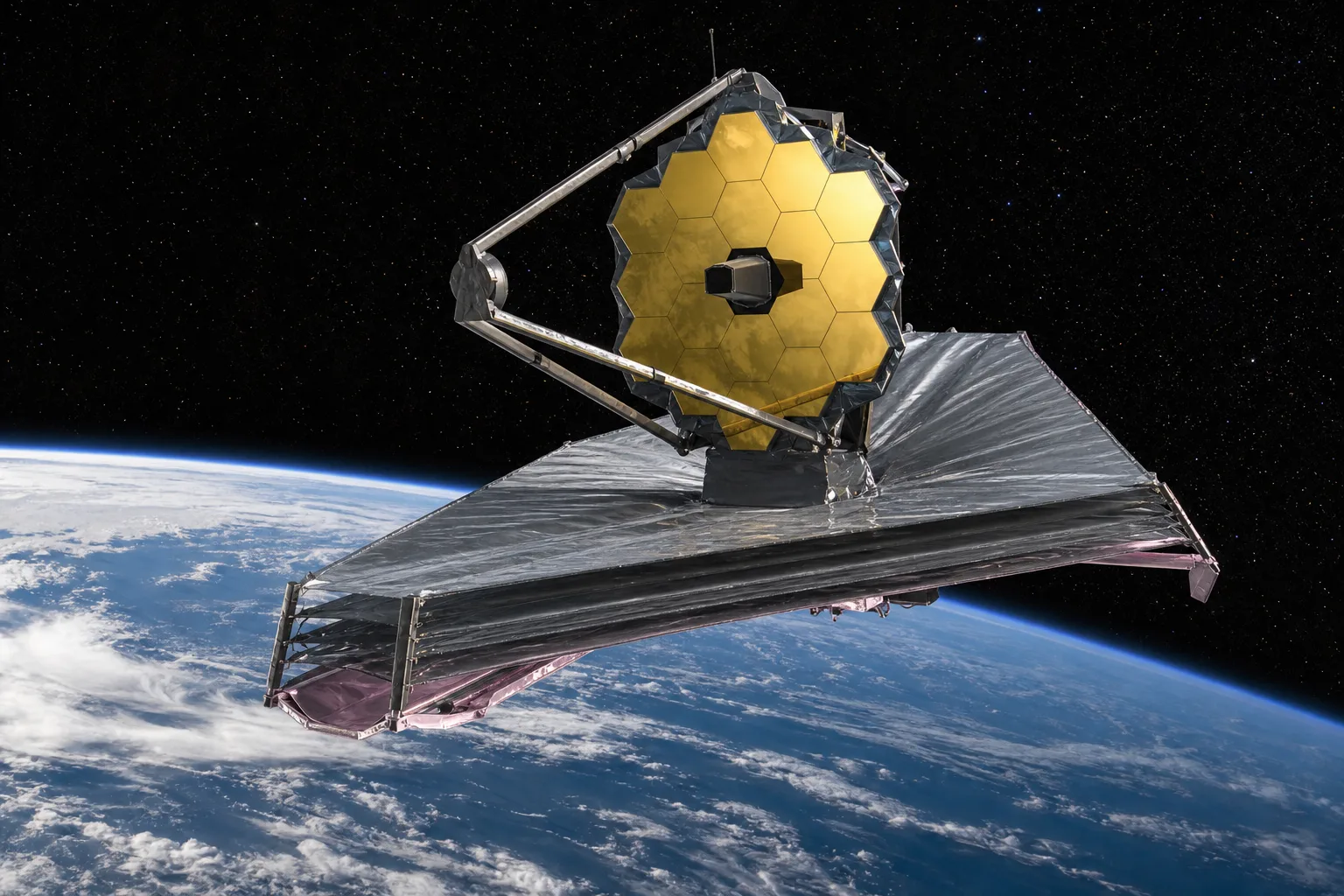
- JWST’s infrared observations are exposing an era of cosmic history that earlier telescopes could barely inspect.
Table of Contents
The early universe black hole problem is getting harder to ignore
An early universe black hole that gained mass faster than its host galaxy would be a serious complication for one of astronomy’s tidy assumptions: that galaxies and the monster black holes at their centres largely build themselves together. The James Webb Space Telescope is now looking far enough back in time to test that story rather than simply infer it from the modern universe.
This story was first reported by Phys.org.
Researchers are trying to reconstruct how black holes and young galaxies grew in the early universe. The reporting is appropriately cautious. A single observation does not rewrite cosmic history, and estimating the masses of distant black holes and faint host galaxies is brutally difficult. Still, this is exactly the kind of mismatch astronomers have been hunting for.
The puzzle has been sitting in plain sight for years. Observations have found quasars, powered by actively feeding supermassive black holes, less than a billion years after the Big Bang. Some appear to contain black holes with masses around a billion times that of the Sun. That is an absurdly short deadline by cosmic standards. It is like discovering a fully grown redwood in a newly planted garden and being told it began as an ordinary seed.
Why this early universe black hole matters
In the nearby universe, there is a broad relationship between the mass of a galaxy’s central bulge and the mass of the black hole in its core. It is not a perfect rule, but it has encouraged a powerful idea: stars, gas, galactic structure and black-hole growth regulate one another over long periods. A growing black hole releases energy; that energy can heat or expel gas; less gas means fewer new stars. The galaxy, in turn, supplies the gas the black hole needs.
A possible early universe black hole growing ahead of its host suggests that this relationship may be an outcome of cosmic maturity, not a rule written into the first galaxies. In the chaotic young universe, gas was denser, mergers were more frequent, and galaxies were still assembling their basic structure. There may have been little resembling the orderly feedback loop astronomers often model at later times.
That distinction matters because black holes are not passive cosmic drains. An actively accreting black hole can shine across vast distances as gas heats up while spiralling inward. Its radiation and outflows may alter when, where and whether nearby gas can form stars. If the black hole gets large first, it could shape its host galaxy’s future rather than merely reflect it.
Frankly, this is a much more interesting possibility than another data point confirming a familiar correlation. The biggest scientific payoff from JWST may not be prettier pictures of early galaxies. It may be finding the cases where our clean explanations stop working.
Two routes to making a cosmic heavyweight
To explain an early universe black hole with extraordinary mass, astronomers usually turn to two broad possibilities. One starts with a smaller black-hole seed, which then needs a relentless supply of gas to grow.
The other begins with a much larger seed. Under particular conditions, a dense cloud of primordial gas may collapse directly into a black hole, bypassing the normal stellar stage and potentially creating a much more massive object. These so-called direct-collapse scenarios are appealing because they give the growth process a substantial head start. They are also demanding: the early environment has to prevent the gas from fragmenting into ordinary stars.
Then there is a third wrinkle. A black hole may sometimes consume material above the long-assumed steady limit known as the Eddington rate, at least for periods of time. The physics is complicated, and radiation pressure should push back on incoming gas. But simulations and observations have left room for brief or obscured episodes of rapid feeding. If such bursts were common, a modest seed could become a giant much sooner than older models allowed.
No one should pretend current observations select one answer yet. Measurements at these distances depend on interpreting faint infrared light, separating a galaxy from the glare of its active nucleus, and translating spectral features into masses with models that carry real uncertainty. But an early universe black hole that is genuinely overgrown relative to its host would make the heavy-seed and rapid-feeding theories far more than academic alternatives.

JWST is changing the kind of questions astronomers can ask
Before JWST, the first generation of galaxies was largely a realm of sparse detections and heroic extrapolation. Its infrared instruments are designed for the problem because cosmic expansion shifts the ultraviolet and visible light emitted by young galaxies into infrared wavelengths before it reaches Earth. For more on the telescope, see the Webb mission overview.
A distant red source is not automatically a settled discovery. Researchers must distinguish actively feeding black holes from intense star formation, account for dust, and obtain better spectroscopy. Follow-up observations will be the decisive stage: are there broad emission lines associated with gas moving at extreme speeds around a black hole? Does the inferred black-hole mass remain high after alternative models are tested? Is the host galaxy really underweight, or merely difficult to measure against a bright central source?
What matters next is frequency. One anomalous early universe black hole could be an unusual growth spurt. A population of them would say something larger: the earliest galaxies may have routinely created black holes before they created much of the stellar mass we associate with mature galaxies. That would force theorists to reconsider which came first in the formative relationship between galaxies and their central engines.
The real test is whether this becomes a pattern
It is tempting to treat every JWST result from the early universe as a crisis for cosmology. That is premature, and sometimes counterproductive. New instruments expose blind spots; the first samples are often biased toward objects bright enough to detect; and extraordinary claims need independent confirmation. Astronomers have been through this cycle before.
But the possible early universe black hole scenario points at a problem that was already real. Massive black holes appeared remarkably early, and the universe has never supplied an easy explanation. If Webb keeps finding black holes that outweigh expectations for their hosts, the field will have to move beyond the comforting picture of galaxies and black holes keeping pace. The first cosmic giants may have been built less like partners and more like predators arriving before the ecosystem was ready.
Frequently Asked Questions
What is an early universe black hole?
An early universe black hole is a black hole observed when the cosmos was still very young, often within its first billion years. These objects matter because some became enormously massive before standard growth models would seem to allow enough time.
Why are early supermassive black holes difficult to explain?
Black holes grow by pulling in gas, merging with other black holes, or both, but those processes have physical limits. Reaching masses near a billion Suns in under a billion years may require exceptionally heavy starting seeds or periods of unusually fast accretion.
How does JWST find distant black holes?
JWST observes infrared light, which is crucial because light from very distant galaxies has been stretched into infrared wavelengths as the universe expanded. Astronomers can then study a galaxy’s spectrum for signatures associated with hot gas around an actively feeding black hole.