

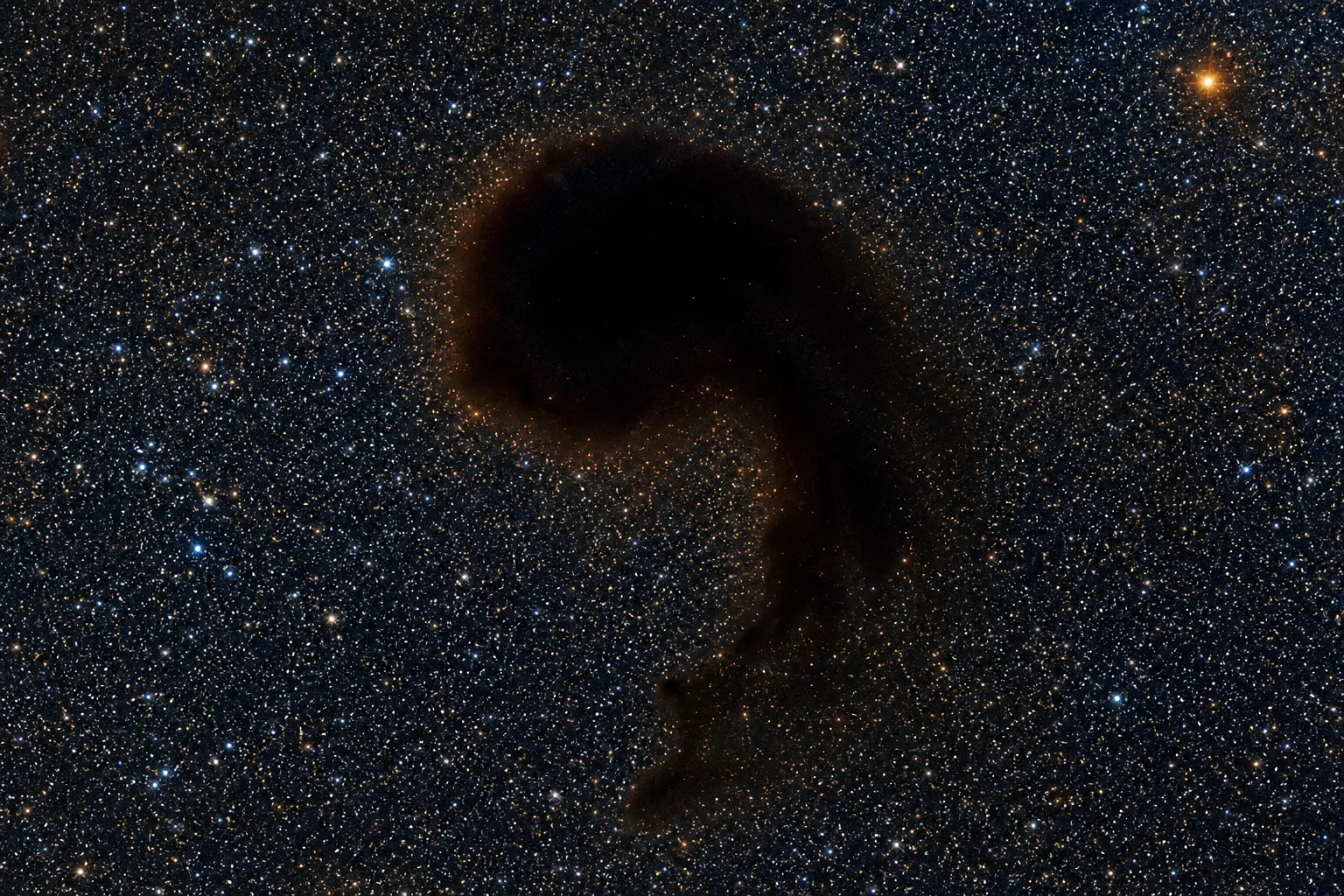
- Barnard 68 blocks nearly all visible background starlight, creating an unusually crisp dark patch in the Ophiuchus constellation.
- At roughly 500 light-years away, Barnard 68 offers astronomers a relatively nearby laboratory for studying cold molecular gas and dust.
- Infrared observations can see through the cloud’s obscuring dust, revealing information optical telescopes cannot capture.
- Scientists think the cloud may collapse under gravity and begin forming a new stellar system over astronomical timescales.
Table of Contents
Barnard 68 turns missing starlight into a scientific clue
At first glance, Barnard 68 looks like someone punched a clean, dark hole through a crowded field of stars. That visual trick is the whole story: the black shape is not empty space at all, but a compact cloud packed with dust and molecular gas, sitting between Earth and the brighter Milky Way behind it.
According to NASA Science, the cloud lies roughly 500 light-years away in the direction of Ophiuchus, the Snake Bearer, and spans about half a light-year. It absorbs practically all visible light from background stars. The result is one of astronomy’s clearest demonstrations that darkness in a telescope image can carry as much information as light.
The object appears as a dark shape. Unlike a distant dust lane, where countless stars may still peek through, its core is so opaque at visible wavelengths that no background stars show through. That hard edge helps astronomers place the cloud in front of the star field rather than somewhere far beyond it.
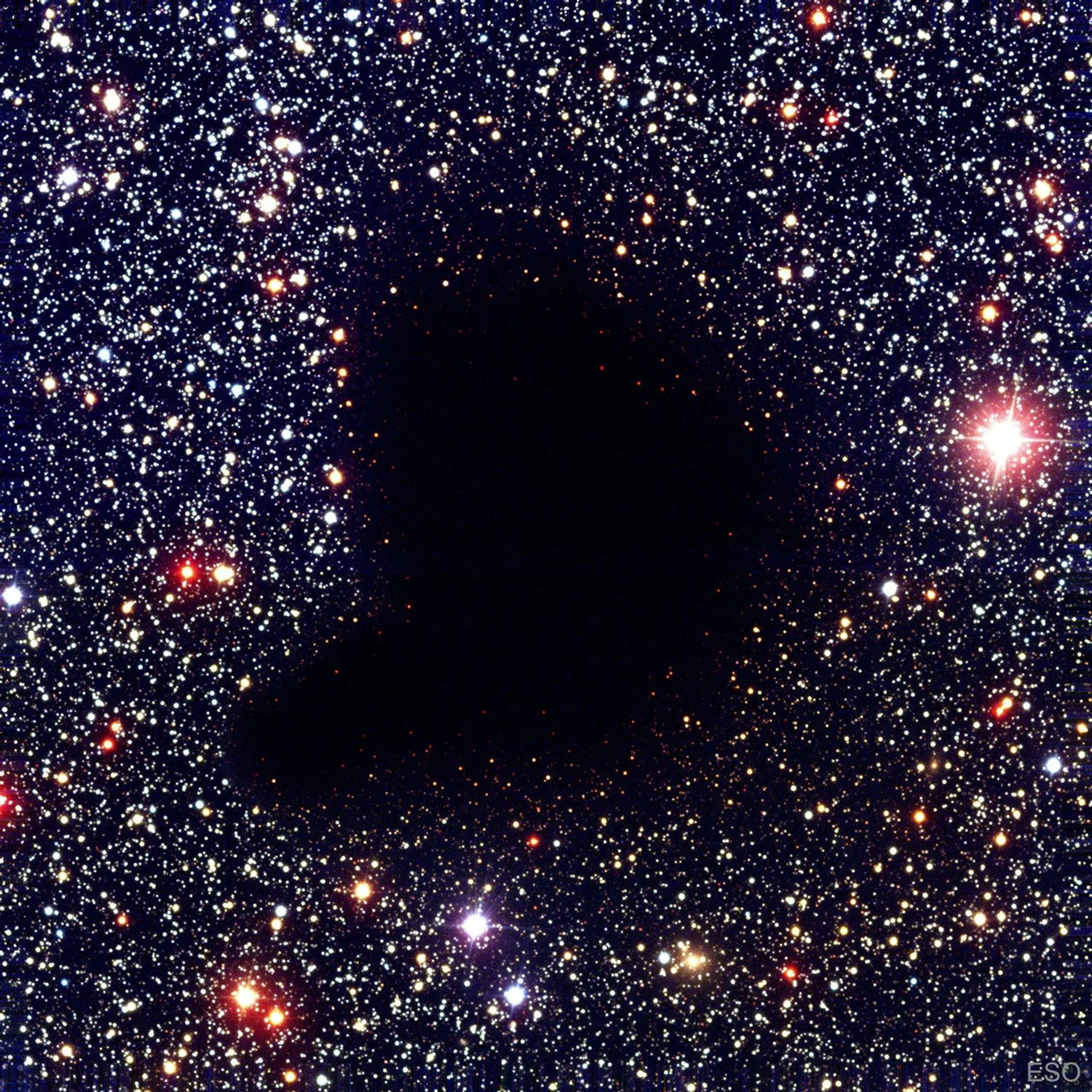
The old idea of a literal hole in the sky was understandable, if wrong. Before astronomy had a working picture of interstellar dust, a starless patch could look like an opening into nothingness. We now know the universe is messier than that. Space between stars contains gas, dust, radiation, magnetic fields and, occasionally, an object such as Barnard 68 that happens to arrange itself like a celestial blackout curtain.
Why Barnard 68 matters to star formation research
Dark molecular clouds are among the coldest, most isolated environments in the galaxy. Their basic ingredients are familiar enough: hydrogen-rich gas and tiny grains of dust. But under the right conditions, gravity begins to win a slow contest against internal pressure, turbulence and magnetic fields. The cloud contracts, denser pockets emerge, and a protostar can ignite at the center.
That is why Barnard 68 deserves more attention than a particularly photogenic black blob. NASA says the cloud has been found likely to collapse and form a new star system. The timeline is not remotely human-scale, and astronomy should resist turning every gas cloud into a guaranteed future solar system. Still, a nearby object caught around this stage gives researchers a clean target for asking the fundamental question: what tips a quiet cloud into stellar birth?
This is the unglamorous but essential side of space science. The public understandably follows rocket launches, Mars landings and the latest James Webb Space Telescope portrait. Yet the origin story of stars begins in places where ordinary optical images show almost nothing. A cloud such as Barnard 68 is closer to a sealed construction site than a finished building: the visible exterior is opaque, while the consequential activity is hidden behind it.
Researchers need measurements of temperature, density, chemical makeup and motion to judge whether a cloud is stable or falling inward. Small differences matter. A cloud can look calm in a single still image while gas inside moves in ways that alter its future. That is why a beautiful image should be treated as an entry point, not a final answer.
Infrared changes what astronomers can see
Visible light hits the dust in Barnard 68 and largely loses. Infrared light has a better chance of getting through because its longer wavelengths interact differently with the small dust particles. In practical terms, infrared astronomy can turn a seemingly impenetrable patch of sky into something that can be measured and mapped.
That principle has shaped modern astronomy for decades. It guides observatories from ground-based infrared facilities to NASA’s James Webb Space Telescope, which observes the universe primarily in infrared wavelengths. Webb is often associated with early galaxies and dramatic nebulae, but dusty star-forming regions are also exactly the kind of environment where infrared capability earns its keep.
Here’s a useful consumer-tech analogy. Looking only in visible light is like trying to inspect a sealed package using a standard camera app: you get the label and the silhouette, but not the contents. Infrared instruments do not magically reveal everything, but they provide another layer of evidence. For Barnard 68, that means astronomers can investigate stars behind the cloud and constrain what is going on within the obscuring material.
NASA’s continuing skywatching coverage is a reminder that the universe offers targets at wildly different scales, from easy-to-spot planets to objects requiring dedicated instruments and careful wavelength choices. Dark clouds fall firmly into the latter camp.
A nearby cloud with big unanswered questions
The formation of molecular clouds themselves remains unsettled in all its details. Galactic gas is shaped by stellar winds, supernova shocks, gravity and magnetic fields; none of those systems operates in isolation. Scientists can model pieces of the process, compare those models with observations, then revise them when the universe refuses to cooperate. That is science working properly, not a gap to be papered over with a confident headline.
Barnard 68 is valuable partly because its simple visual profile makes it easier to study than crowded, chaotic regions where multiple bright stars, clouds and feedback effects overlap. It is not a perfectly isolated lab experiment — nature rarely supplies those — but it offers a more legible case than many distant star nurseries.
Its distance matters too. At around 500 light-years, Barnard 68 is in our broader cosmic neighborhood, even though getting there remains far beyond any plausible human mission. For comparison, light from the cloud began its journey toward us centuries before today’s electronics industry existed. The object’s apparent stillness can obscure that reality: every observation is a historical record, and every inferred future collapse concerns an event that would unfold far beyond civilization’s planning horizon.
Frankly, that is what makes images like this more than desktop wallpaper. They correct our instinct that black means blank and that useful data must arrive as a bright, colorful spectacle. In astronomy, the missing starlight behind Barnard 68 is the signal. As infrared surveys and new observatories refine the view of nearby molecular clouds, the bigger question is whether astronomers can connect these quiet pre-stellar objects to a fuller, predictive account of how galaxies keep making stars.
Frequently Asked Questions
What is Barnard 68?
Barnard 68 is a dark molecular cloud in the direction of the Ophiuchus constellation. Dense dust and molecular gas inside it absorb visible light from stars behind the cloud, making its center appear almost completely black in optical images.
How far away is Barnard 68?
Measurements place Barnard 68 at approximately 500 light-years from Earth.
Can telescopes see through Barnard 68?
Visible-light instruments mostly see Barnard 68 as an opaque cloud because dust blocks the light from background stars. It is possible to look right through the cloud in infrared light.
Will Barnard 68 form stars?
Barnard 68 has been found likely to collapse and form a new star system.