

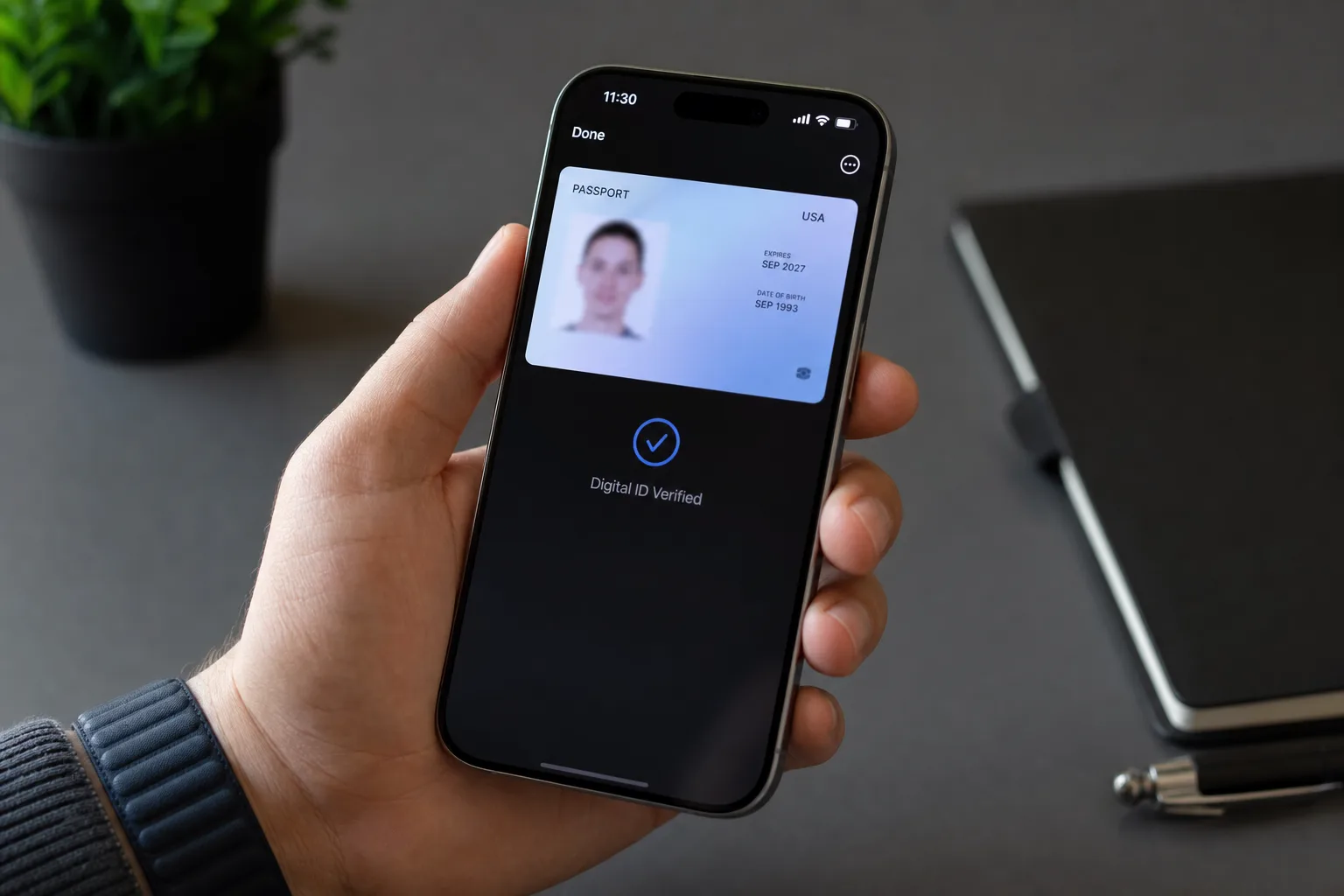
Apple Wallet digital ID has had a quiet but steady rise since Apple debuted passport support for US travellers. TSA checkpoints were the obvious first act. But there’s a more pressing, and frankly more interesting, use case taking shape right now — one that sits at the intersection of AI safety, government regulation, and the question of who gets to use the most powerful models on the market.
- Apple Wallet digital ID could let Anthropic verify US citizenship for Claude without relying on shady third-party services.
- The Apple Wallet digital ID system already has precedent at Anthropic, which used Apple’s age verification API previously.
- US export controls forced Anthropic to disable Fable 5 and Mythos 5 models after a jailbreak was reportedly discovered.
- Drivers license support covers only 14 US states, so Apple Wallet digital ID access would require a passport for full coverage.
Table of Contents
The Problem: Anthropic’s Models Are Now Geofenced
If you’ve been tracking AI news closely, you’ll know that Anthropic recently disabled two of its models — Fable 5 and Mythos 5 — for all customers outside a narrowly defined group. The trigger was a combination of a reported jailbreak and subsequent US government export controls that restricted access for foreign nationals, regardless of whether they’re physically inside the United States or not.
That’s a significant restriction. Fable 5 in particular was released under an explicit understanding that the model would be safeguarded against potentially dangerous outputs. When a jailbreak surfaced, that promise looked shaky, and regulators apparently agreed. Whether the threat was serious enough to warrant a full pull is genuinely debatable — AI jailbreaks are discovered and patched constantly — but the regulatory response happened fast, and Anthropic had little choice but to comply.
The question now is: what’s the path back? For Fable 5 and Mythos 5 to return to broader availability, Anthropic would need a credible way to verify that users are US citizens or at least US nationals. That sounds simple. It isn’t.
Apple Wallet Digital ID as a Verification Layer
Here’s where Apple Wallet digital ID enters the picture. Apple’s system — built around US passports and, in supported states, driver’s licenses — was designed from the ground up with privacy in mind. Rather than handing over a document scan to some third-party service, the verification happens through a cryptographically secure channel. The app or service learns only what it needs to know: in this case, whether the person is a US national. The raw document data doesn’t transfer.
For Anthropic, that’s a meaningful distinction. Claude’s privacy policy was updated earlier this year to include references to identity verification using Persona, a third-party identity verification platform. An Anthropic employee clarified that Persona-based checks are currently scoped to accounts flagged for fraudulent behaviour, not standard users. But if nationality verification becomes a precondition for accessing restricted models, the scope of that policy could expand considerably — and quickly.
The appeal of routing that through Apple Wallet digital ID rather than Persona or a comparable service is straightforward: Apple doesn’t monetise the data, the verification is device-side, and users don’t end up handing a passport scan to a company they’ve never heard of. In an era where data brokers and identity verification firms have had some genuinely alarming breaches, that matters.
Anthropic Has Done This With Apple Before
This wouldn’t be Anthropic’s first foray into Apple’s identity infrastructure. The company was among a small cohort of developers who adopted Apple’s built-in age verification API — a system that lets apps confirm whether a user meets an age threshold without the developer ever seeing the underlying date of birth. It’s a clean model: Apple handles the sensitive data, the developer gets a yes or no, and the user doesn’t have to hand over documents.
Extending that same logic to nationality verification is a natural step. The Apple Wallet digital ID framework already supports the kind of attribute-based disclosure that would make this work. You don’t need to share your full passport details to confirm citizenship — you just need to confirm the relevant attribute. Apple’s architecture is built to handle exactly that.
That said, there’s no confirmation from Anthropic that this is the route they’re considering. This is inference from available signals, not a leak or an announcement. But the precedent is real, and the timing of the need aligns uncomfortably well with what Apple Wallet digital ID can technically deliver.
The Gaps Are Real — And Worth Talking About
None of this is without friction. The most glaring problem is platform exclusivity. Apple Wallet digital ID is, by definition, an iPhone feature. Android users — who make up the majority of the global smartphone market — would be excluded from any verification flow built around it. For a US-only access restriction that’s specifically about nationality rather than device preference, that’s a clumsy fit.
Driver’s license support in Apple Wallet is also patchier than the passport headline suggests. As of now, only 14 states plus Puerto Rico support digital driver’s licenses in Wallet. Everyone else would need a passport to participate. That’s a real barrier for users who simply don’t own one — a population that skews younger and lower-income, which raises fairness questions worth taking seriously.
There’s also the broader discomfort of tying identity to AI usage at all. The idea that your nationality — or any personal attribute — becomes a prerequisite for using a commercial AI product is a relatively new development, and it’s not a comfortable one. Even if the mechanism is privacy-respecting, the principle is a shift. Today it’s nationality for a specific model under export controls. What does the precedent look like in two years, when the controls might be broader, or when other governments start demanding their own verification gates?
A Pragmatic Answer to a Messy Situation
Stepping back: the situation Anthropic finds itself in is largely not of its own making. Export controls on AI models are a policy instrument that’s still being figured out in real time. The US government’s application of them to Fable 5 and Mythos 5 is part of a wider pattern — the same instinct that produced the chip export restrictions targeting Nvidia’s H100 and H20 GPUs, just applied to software and model weights instead of silicon.
Within those constraints, Anthropic needs a verification solution that’s fast to ship, minimally invasive, and credible enough to satisfy regulators. Apple Wallet digital ID checks more of those boxes than most alternatives. It’s already built, it’s already tested at scale by TSA checkpoints across the US, and Anthropic has a working relationship with Apple’s identity APIs.
The alternative — building out a full Persona-style verification flow for every user who wants access to a restricted model — is slower, more expensive, and puts sensitive data in more hands. That’s not a good look for a company that has positioned trust and safety as core to its identity.
Whether Anthropic moves in this direction or not, the broader question it raises won’t go away: as AI models become subject to the same export control logic as weapons systems and advanced semiconductors, the infrastructure for verifying who gets to use them needs to catch up fast. Apple Wallet digital ID is one piece of that puzzle. It won’t be the last.
Frequently Asked Questions
How would Apple Wallet digital ID work for Claude verification?
Apple’s Digital ID feature lets users present a US passport or supported driver’s license through the Wallet app. Anthropic could tap this as a nationality check, confirming a user is a US citizen before granting access to restricted models like Fable 5, without directly handling sensitive identity documents themselves.
Why did Anthropic disable Fable 5 and Mythos 5?
The US government imposed export controls on the models after a jailbreak was reportedly found. Anthropic pulled both Fable 5 and Mythos 5 for foreign nationals — whether inside or outside the US — to comply with those directives.
Does Anthropic already use Apple’s identity tools?
Yes. Anthropic was among a small group of developers to adopt Apple’s built-in age verification API, which lets apps confirm a user’s age without handling raw personal data. That history makes an extension to nationality verification via Apple Wallet digital ID plausible.
What are the limitations of using Apple Wallet digital ID for this?
The biggest limitation is platform exclusivity — anyone without an iPhone would be locked out entirely. Driver’s license support in Apple Wallet is also limited to 14 US states plus Puerto Rico, meaning passport ownership would effectively be the baseline requirement for those in unsupported states.

