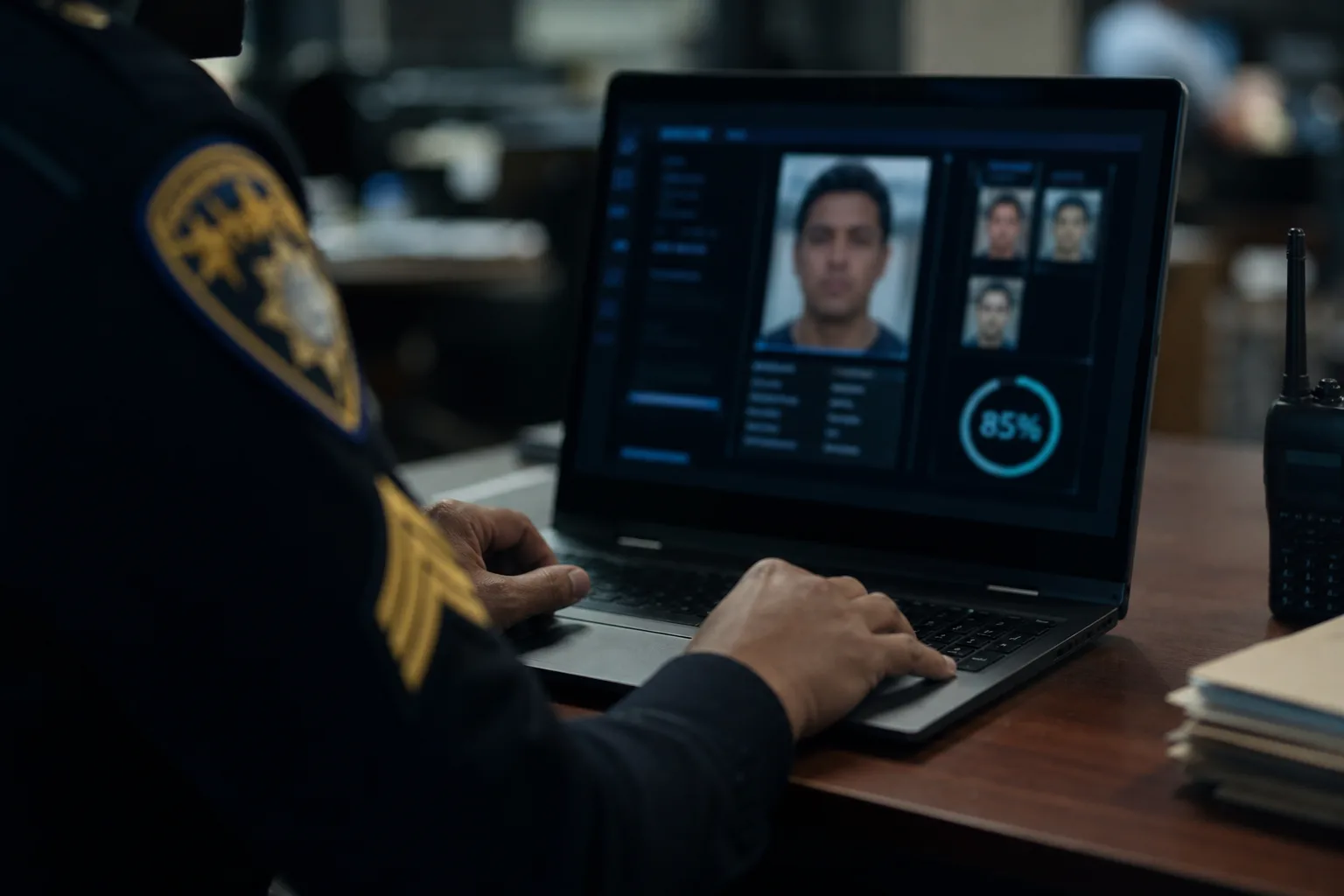
- Robert Dillon’s facial recognition lawsuit claims Florida police arrested him based on a 93% AI match from a blurry surveillance photo.
- The facial recognition lawsuit alleges officers ignored license plate reader data showing Dillon was never near the crime scene.
- Dillon lives over 300 miles from Jacksonville Beach and had no evidence placing him at the McDonald’s location.
- The FACES database, run by Pinellas County Sheriff’s Office, produced the flawed match that triggered the arrest and prosecution.
Table of Contents
A 93% Match, a Wrong Man, and a Ruined Life
A new facial recognition lawsuit filed in US District Court for the Middle District of Florida is putting a spotlight on something civil liberties advocates have been warning about for years: what happens when police treat an algorithm’s answer as the end of an investigation rather than the beginning of one. Robert Dillon, a 52-year-old resident of Fort Myers, is suing Florida law enforcement after he was arrested in August 2024 on a charge of attempting to lure a child — a charge that, according to the facial recognition lawsuit, was built almost entirely on a faulty AI identification and a pattern of ignored evidence.
The facts, as laid out in the complaint, are damning. A child luring incident was reported at a McDonald’s in Jacksonville Beach. Investigators pulled surveillance footage, then — and this is where things get troubling — photographed a computer screen displaying that footage rather than exporting the original digital file. That degraded image was fed into the Face Analysis Comparison and Examination System, known as FACES, which returned a 93% match to Dillon. Officers apparently took that number and ran with it.
What the FACES Database Actually Is
FACES is the centralized facial recognition database maintained by the Pinellas County Sheriff’s Office. It isn’t some niche local tool — the Jacksonville Sheriff’s Office has access to it and runs searches on behalf of partner agencies, including the Jacksonville Beach Police Department. According to the facial recognition lawsuit, Sergeant James Walters of the Jacksonville Sheriff’s Office was responsible for conducting or overseeing those searches and transmitting results to other agencies. That kind of hub-and-spoke arrangement means a single flawed match in one county can set off a chain of enforcement actions across multiple jurisdictions, with each agency further down the chain increasingly likely to treat the result as validated fact.
What makes the 93% figure particularly misleading here is the source image. Investigators weren’t working from a clean export of surveillance footage. They were working from a photograph of a screen — a doubly-degraded image that introduces compression artifacts, glare, and distortion before the algorithm even starts. Facial recognition systems are notoriously sensitive to image quality, and research from the National Institute of Standards and Technology (NIST) has consistently shown that accuracy drops sharply as image resolution and lighting quality decrease. A 93% match from a clean, high-resolution image is a different thing entirely from a 93% match derived from a photo of a screen showing grainy CCTV footage.
The Evidence That Should Have Stopped This
Here’s where the facial recognition lawsuit moves from a story about bad technology to a story about bad policing. Dillon lives in Fort Myers — more than 300 miles from Jacksonville Beach. That alone isn’t exculpatory on its own, but investigators apparently ran a check of license plate reader databases and found no record of Dillon’s vehicle anywhere near Jacksonville Beach around the time of the incident. That’s not ambiguous. That’s a direct, digital record — the same kind of surveillance infrastructure that law enforcement routinely uses to build cases — pointing away from Dillon.
The facial recognition lawsuit states plainly that officers didn’t just fail to weigh this evidence adequately; they allegedly concealed it. The complaint’s framing is pointed: “rather than test the machine’s answer against the evidence that would have cleared him, the officers built a case to confirm it.” That’s a description of confirmation bias made operational, and it’s exactly the scenario that critics of police facial recognition use have long argued is the technology’s most dangerous failure mode. The algorithm doesn’t just produce false positives — it can anchor an entire investigation around the wrong person, and motivated reasoning does the rest.
The Defendants and the Legal Road Ahead
The defendants named in the facial recognition lawsuit read like a list of every agency that touched this case. They include the City of Jacksonville Beach, Jacksonville Beach Police Corporal Scott O’Connell, Jacksonville Sheriff T.K. Waters, Pinellas County Sheriff Bob Gualtieri, and Sergeant James Walters of the Jacksonville Sheriff’s Office. The breadth of the defendant list reflects the distributed nature of the FACES system — when multiple agencies share infrastructure and pass results to one another, liability becomes similarly distributed.
For Dillon, the stakes were about as high as they get in the American criminal justice system. The facial recognition lawsuit notes that being arrested and prosecuted for attempting to lure a child under 12 is “one of the most stigmatizing crimes a person can face.” Even if charges are eventually dropped, the reputational damage from an arrest like this can be permanent. That’s a cost that no algorithm accuracy rating accounts for.
Facial Recognition in Law Enforcement: A Pattern, Not an Outlier
Dillon’s case doesn’t exist in isolation. It follows a well-documented pattern of facial recognition misidentifications leading to wrongful arrests, most of them involving Black men. Robert Williams in Detroit, Nijeer Parks in New Jersey, and Randal Reid in Georgia are among the most widely reported victims of facial recognition errors that resulted in arrests. What makes the Florida facial recognition lawsuit notable is the explicit allegation that officers were aware of exculpatory evidence and pressed forward anyway — adding a layer of alleged misconduct on top of the underlying technology failure.
There is still no federal law governing how police can use facial recognition. A handful of cities — San Francisco, Boston, and others — have banned the technology outright for law enforcement use, but Florida has no such restrictions. The FACES system operates across multiple counties with, apparently, limited procedural safeguards requiring investigators to corroborate algorithmic results before making an arrest. That’s the policy gap this facial recognition lawsuit is now forcing into public view.
What This Means for Policing and AI Accountability
The Dillon facial recognition lawsuit is, at its core, an accountability story. It’s asking courts to answer a question that legislatures have largely avoided: when an AI system produces a result that leads to a wrongful arrest, who is responsible — the vendor that built it, the agency that deployed it, or the officer who acted on it without adequate verification?
Law enforcement agencies have been expanding their use of AI-assisted tools — license plate readers, predictive policing systems, gunshot detection — with limited independent oversight. Facial recognition is arguably the most consequential of these tools because it can directly identify, and therefore directly implicate, specific individuals. The fact that a 93% match from a degraded image was apparently sufficient to arrest a man 300 miles from the scene, despite contradicting license plate data, suggests that the procedural guardrails around FACES are nowhere near adequate. Whether a federal judge agrees — and whether the outcome of this facial recognition lawsuit forces Florida agencies to raise the evidentiary bar before making an AI-assisted arrest — may shape how dozens of similar systems operate across the country.
Frequently Asked Questions
What is the facial recognition lawsuit filed by Robert Dillon about?
Robert Dillon is suing Florida police after he was arrested in August 2024 for allegedly attempting to lure a child. He claims officers relied on a faulty facial recognition match from the FACES database rather than investigating evidence that would have cleared him, including license plate data showing he was never near the scene.
What is the FACES database used by Florida police?
FACES stands for Face Analysis Comparison and Examination System. It’s a centralized facial recognition database maintained by the Pinellas County Sheriff’s Office and shared with partner agencies, including the Jacksonville Sheriff’s Office and Jacksonville Beach PD, for conducting suspect identification searches.
How accurate does facial recognition need to be for police to use it as evidence?
The source does not address federal standards for police use of facial recognition results. In Dillon’s case, the lawsuit alleges that a facial recognition match derived from a low-quality image was used in place of a proper investigation, rather than being tested against available evidence.
Has facial recognition led to wrongful arrests before?
The source does not address prior wrongful arrest cases or civil liberties advocacy. It focuses specifically on Robert Dillon’s lawsuit alleging that a faulty facial recognition match led to his arrest and prosecution.