

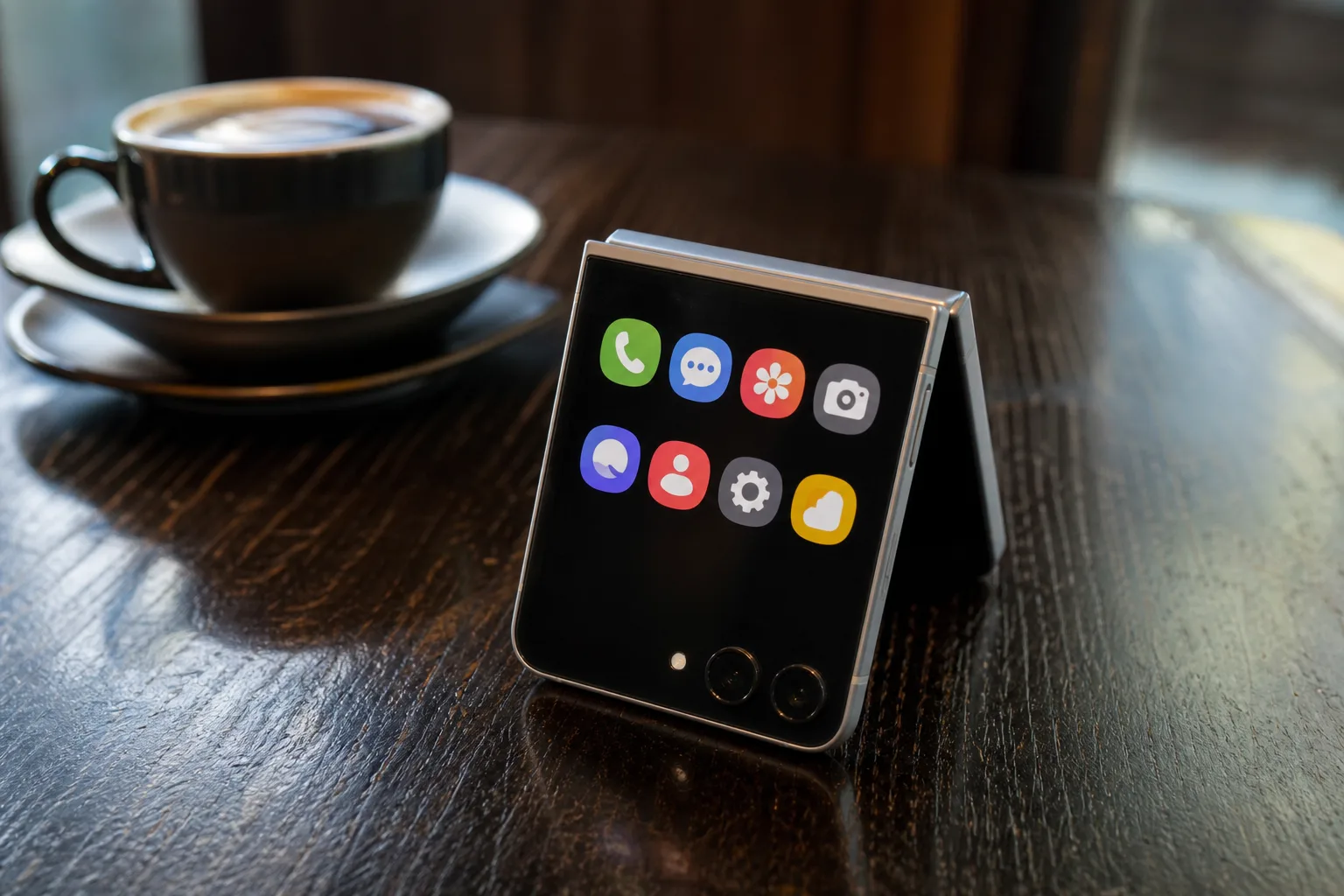
- The Galaxy Z Flip 8 finally makes nearly any Android app accessible on its outer display through a more visible Good Lock route.
- Galaxy Z Flip 8 software is genuinely useful for messages and tasks, while its awkward layout discourages the social-media spirals most phones invite.
- Samsung changed little beyond the cover-screen experience, retaining familiar cameras, displays, charging speeds, and a dust-vulnerable IP48 rating.
- At $1,199.99, the phone is difficult to recommend over a discounted Z Flip 7 unless Samsung keeps the new software exclusive.
Table of Contents
The Galaxy Z Flip 8 works best when it says no
The Galaxy Z Flip 8 has finally done the thing Samsung spent years resisting: it treats its cover display like a small Android phone rather than an unusually handsome notification panel. You can pull down notifications, open a proper quick-settings shade, browse an app drawer, and—after a short detour through Samsung’s Good Lock tools—run almost whatever you want without unfolding the device.
That sounds like Samsung catching up to Motorola. In a narrow technical sense, it is. Motorola’s recent Razr phones have been far more relaxed about putting full apps on their external screens, while Samsung made owners jump through obscure settings and enthusiast forums to do the same. But after looking at how these tiny screens actually work, I’d argue Samsung’s former reluctance had more wisdom in it than the spec-sheet crowd wanted to admit.
A closed flip phone should be useful. It should not be an even more efficient machine for losing half an hour to Instagram Reels while standing in a grocery-store queue.
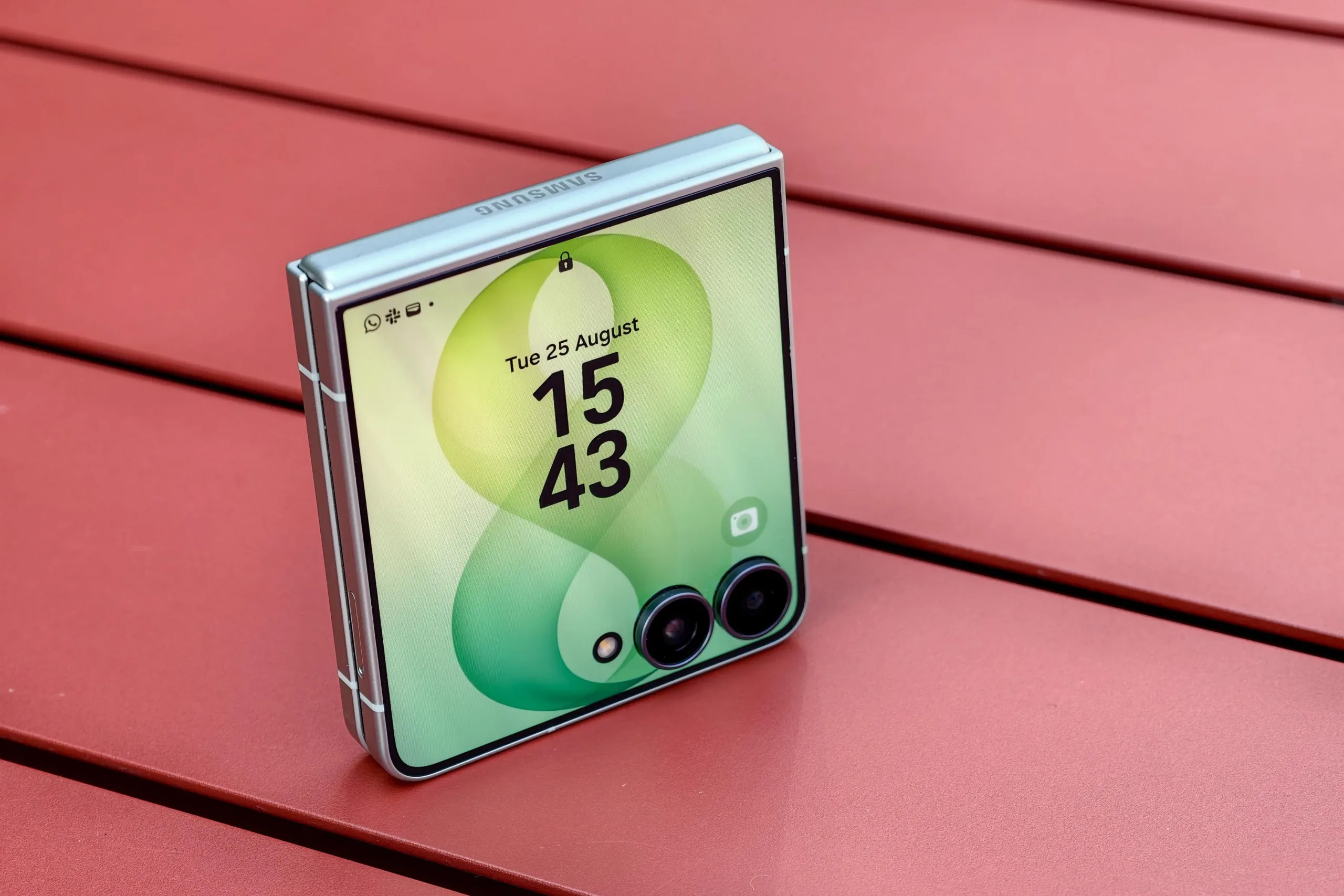
The redesigned outer-screen software brings the Galaxy Z Flip 8 much closer to a conventional handset. Swipe from one upper corner for notifications and the other for quick settings. Swipe upward and there is an app launcher, populated first by Samsung’s square-screen-friendly apps and a Labs selection for supported third-party software. Crucially, Samsung now points people toward MultiStar, the Good Lock component that unlocks broader app support.
That is still a slightly odd arrangement. Good Lock is Samsung’s enthusiast customization suite, not a feature most people buying a $1,200 phone should need to discover after checkout. Yet it is far better than pretending the option does not exist. Samsung has moved from a locked side door to a signposted alleyway. Progress, even if the front entrance remains unnecessarily fussy.
Galaxy Z Flip 8 cover-screen apps have a useful problem
Apps can be displayed in three modes: sprawling across the available panel and around the camera cutouts, restricted to a square above the cameras, or squeezed into a tall narrow frame. None of those options is a clean answer. That is not a software bug Samsung can simply patch away; the physical geometry is what it is. A 4-inch square-ish screen with two cameras taking a bite out of it will never resemble a normal phone display.
Some apps fail the common-sense test immediately. Maps, for example, sounds ideal on a closed phone: glance down, check the next turn, keep walking. But mapping interfaces tend to layer buttons, search fields, labels, and controls over the map itself. On this panel, that can become a cluttered little traffic jam. Health apps built around charts and dense dashboards are similarly poor fits. Streaming a film on the outer display is possible, but so is eating soup with a fork.
Where the Galaxy Z Flip 8 earns its keep is in short, intentional interactions. Reply to a WhatsApp message. Mark something complete in Todoist. Log a snack in MyFitnessPal. Check a calendar item. These are the small administrative chores that normally prompt someone to unlock a regular phone, only to emerge 20 minutes later having absorbed a stranger’s vacation slideshow.
The cover display puts a little resistance between the user and the apps designed to hold attention. Not enough resistance to stop you sending a message, but enough to make casually browsing a feed feel silly. Frankly, that may be the most compelling argument for a flip phone. Hardware makers keep selling digital wellbeing features as settings panels and weekly reports; the flip form factor does something more tangible. It makes distraction mildly inconvenient.
The irony is that Samsung’s decision to support more apps does not destroy that benefit. It reveals it. The apps that matter in a hurry tend to remain usable. The apps that want every spare second of your day tend to look cramped, compromised, and not quite worth the effort. That is a surprisingly healthy division of labor.
Hardware restraint becomes a pricing problem
Beyond that outer display, the Galaxy Z Flip 8 is a familiar device in a new suit. Samsung has reportedly shaved 0.6mm from its thickness and eight grams from its weight. Those are welcome changes—foldables benefit from every gram lost—but nobody will mistake this for a wholesale hardware rethink. The internal screen remains broadly the same, including a crease that is visible off-angle and easy to feel under a finger.
The company has apparently reserved its thinner, tougher titanium display stack for the Galaxy Z Fold line. That may be a sensible product-tier decision, but it leaves the Flip looking a little under-served. Samsung has had years to prove that folding glass can survive ordinary life, and it has made progress. Still, an IP48 rating means water is less frightening than dust. Sand, pocket grit, and workshop debris remain enemies. For a device built around a mechanical hinge, that caveat matters.
Performance should be ample. US models use Qualcomm’s Snapdragon 8 Elite Gen 5, while some regions receive Samsung’s Exynos 2600. Exynos has carried a reputation for uneven results in past Galaxy generations, though smooth everyday behavior is what people will actually notice. Samsung is also using silicon-carbon battery technology, reportedly keeping capacity at 4,300mAh while using smaller cells to reduce the phone’s overall bulk.
Battery life sounds dependable rather than spectacular: a full day with room left over. The charging story is less flattering. Wired charging tops out at 25W and wireless charging at 15W, while Qi2 magnetic convenience still requires a compatible case. At this price, that feels dated. Samsung can point to the engineering demands of a foldable, and those demands are real, but buyers do not experience engineering tradeoffs; they experience a battery percentage crawling upward.
Galaxy Z Flip 8 cameras are good, not $1,200 good
The camera package also appears unchanged: a 50-megapixel primary camera, 12-megapixel ultrawide, and 10-megapixel camera inside the fold. The main sensor benefits from the format because it can double as a selfie camera when the phone is closed. That is one of the enduring joys of flip phones—you can use the better camera to frame yourself on the cover display rather than accepting a lesser front-facing sensor.
Still, the Galaxy Z Flip 8 faces a harsh comparison at $1,199.99. A conventional flagship for that money will commonly offer stronger zoom hardware, more camera flexibility, faster charging, and no crease or hinge to worry about. Samsung is asking customers to pay a $100 premium over the Z Flip 7 for a phone whose biggest advance is fundamentally software.
That creates an obvious question: will the new cover-screen features remain exclusive? Samsung has not given buyers much reason to assume so. Good Lock and One UI features often travel across generations, particularly when the underlying screens and hardware are so similar. If the company brings this app-drawer approach to the Z Flip 7, the older phone could become the smarter purchase at a discount.
My conclusion is less complicated than the feature list suggests. The Galaxy Z Flip 8 is not the foldable to buy because it can run every app while closed. It is the foldable to buy if you want a phone that helps you do the useful bits quickly, then makes the time-wasting bits just annoying enough to abandon. Samsung may have stumbled into the most honest version of digital wellbeing yet: a screen that occasionally asks whether you really need to open that app.
Whether that insight can justify $1,199.99 is another matter. Samsung’s next move should be less about adding more apps to the outside and more about giving people a better reason to pay flagship money for the hardware wrapped around them. Samsung’s official Galaxy Z Flip page is the place to watch for the company’s foldable lineup and software announcements.
Frequently Asked Questions
Can the Galaxy Z Flip 8 run all Android apps on its cover screen?
It can run any Android app on the outer display after users install Samsung’s MultiStar module through Good Lock. Apps can appear full-screen, in a square area above the cameras, or in a narrow portrait layout, though compatibility and usability vary widely.
How much does the Galaxy Z Flip 8 cost?
Samsung has priced the Galaxy Z Flip 8 at $1,199.99 in the US, which is $100 more than the previous model’s starting price. That increase is hard to ignore because the hardware changes are modest and last year’s model shares much of the same foundation.
Is the Galaxy Z Flip 8 dust resistant?
The phone carries an IP48 rating. It has meaningful water protection, but it remains vulnerable to dust.

