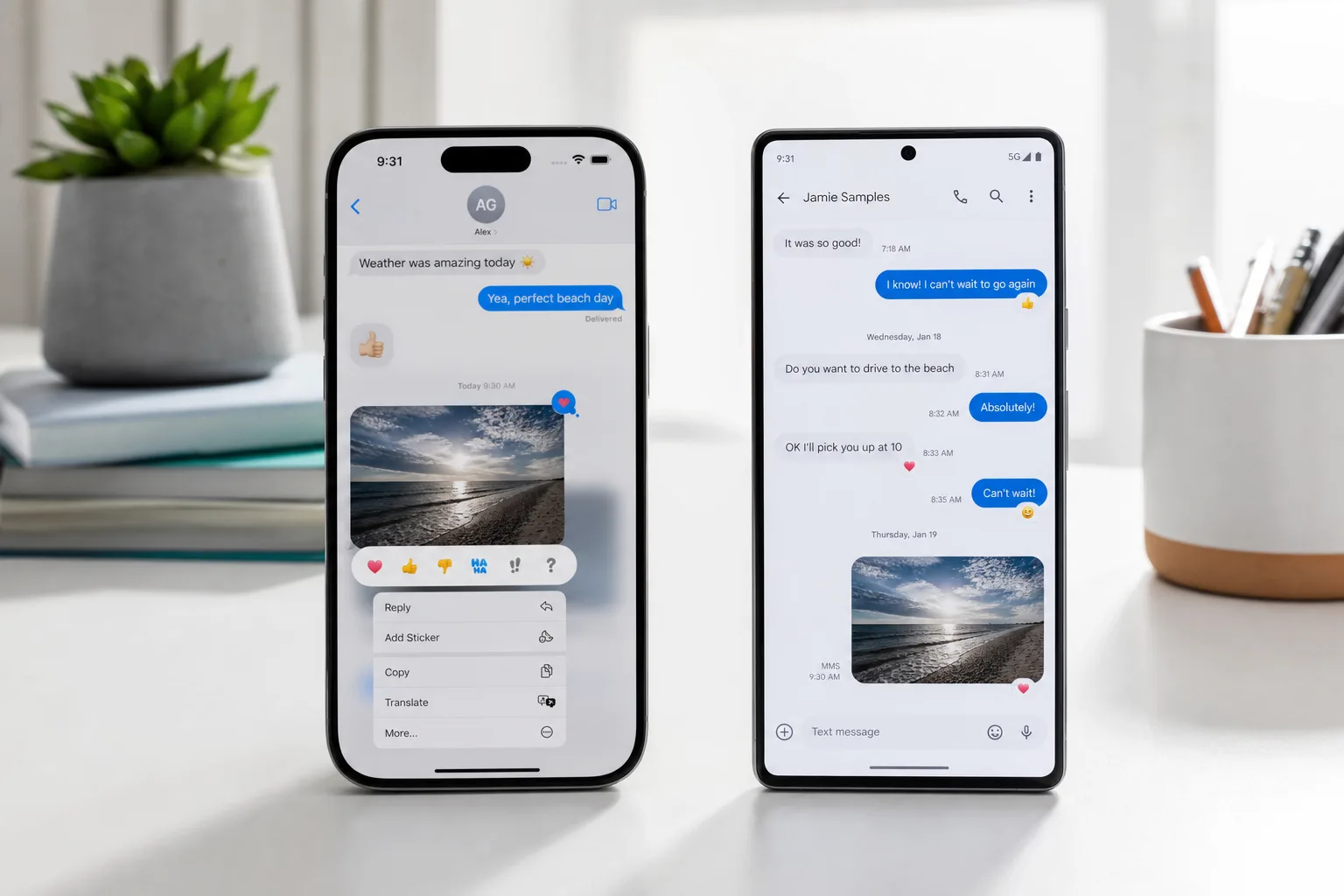
Apple’s cross-platform messaging story just got a meaningful upgrade. With the second beta of iOS 27, iOS 27 RCS conversations between iPhones and Android devices now support inline threaded replies and proper emoji photo reactions — two features that Android users have taken for granted in Google Messages for some time, and that iPhone users have enjoyed within iMessage for years. It’s a small but genuinely satisfying step toward parity in the notoriously fragmented world of mobile messaging.
- iOS 27 RCS support now includes inline threaded replies between iPhone and Android users, spotted in beta 2.
- iOS 27 RCS conversations also gain emoji photo reactions, replacing the clunky text descriptions Android users saw before.
- These features were defined in RCS Universal Profile 2.7 back in June 2024 — Apple is catching up nearly two years later.
- End-to-end encryption for cross-platform RCS arrived with iOS 26.5 in May, making iOS 27 the next major messaging milestone.
Table of Contents
What’s Actually Changing in iOS 27 RCS
The headline feature is inline replies. On an iPhone running iOS 27 beta 2, long-pressing a message in a cross-platform RCS chat now surfaces a ‘Reply’ option that creates a proper threaded response — the kind of interaction that’s been standard in iMessage, WhatsApp, and Telegram for years. On the Android side, users running the latest Google Messages beta will see the reply with the original message quoted above it, giving the conversation real context rather than a disjointed stream of responses.
Screenshots shared on Reddit — showing one participant on iOS 27 beta 2 and another on the Google Messages beta — demonstrate just how clean the implementation looks. It’s not a hacked-together workaround; it appears to render correctly on both ends, which matters more than people might realise. Cross-platform messaging features have a long history of displaying correctly on one side and breaking on the other.
The second improvement is photo reactions. Previously, when an iPhone user reacted to a photo in an RCS thread, Android recipients saw a text description of the reaction — something like ‘Loved an image’ — rather than the actual emoji. That’s now fixed. Reactions on photos display as emoji on both platforms, which sounds minor until you remember how jarring and weirdly formal those text descriptions felt in what’s supposed to be a casual messaging context.
Why iOS 27 RCS Is Behind the Spec — And Why That’s Complicated
Here’s the thing that’s easy to gloss over: these features aren’t new to the RCS standard. The GSMA’s RCS Universal Profile 2.7, published in June 2024, explicitly added support for replies, reactions including custom emoji reactions, and the ability to edit, recall, and delete sent messages for all parties in a conversation. That was nearly two years ago. The spec has since moved on to version 4.0.
So Apple is implementing features that the industry standardised almost two years back, against a spec that’s already two major versions ahead. That’s not a knock on the iOS 27 RCS implementation — it works, and it works cross-platform, which is genuinely hard — but it does put the pace of Apple’s RCS adoption in perspective. Google and other Android vendors had to wait for Apple to implement RCS at all before any of this could even be attempted cross-platform, and now that it’s here, the catch-up is still ongoing.

It’s also worth placing this in the context of what came before. Edit, recall, and delete for sent messages in cross-platform RCS threads — also part of Universal Profile 2.7 — haven’t surfaced in iOS yet as of these betas. Apple tends to roll features out incrementally rather than all at once, which keeps individual releases focused but means the gap between the spec and Apple’s implementation can stretch wide.
Building on the iOS 26.5 Encryption Foundation
The timing of these iOS 27 RCS improvements makes more sense when you remember what happened in May. Apple shipped iOS 26.5 with end-to-end encryption for cross-platform RCS — a genuinely significant moment for mobile messaging security. For the first time, a message sent from an iPhone to an Android device could be encrypted in transit in a standardised, interoperable way, without requiring both users to be on the same proprietary platform like WhatsApp or Signal.
That encryption work had to come first. You don’t layer rich messaging features on an insecure foundation and then retrofit encryption later — or at least you shouldn’t. Apple got the security right before adding the convenience, and iOS 27 is now the first release where those two layers are working together. The result is a cross-platform messaging experience that’s both more secure and more functional than it was even six months ago.
For everyday users, the practical shift is significant. The green bubble stigma — that long-running cultural shorthand for the inferior messaging experience Android users got when texting iPhone contacts — has been eroding for a couple of years now, and iOS 27 RCS accelerates that erosion. Threaded replies and emoji reactions aren’t luxury features. They’re baseline expectations in 2026 for anyone who uses messaging apps regularly.
What to Expect When iOS 27 Ships
Apple is targeting a public release of iOS 27 in September, which aligns with the company’s usual autumn release cadence tied to new iPhone hardware. A public beta is expected to open in July, and reports from developers testing the early builds suggest the release is unusually stable for this stage in the cycle — which is either a sign of disciplined engineering or a relatively light feature load, possibly both.
What remains to be seen is how much further Apple pushes iOS 27 RCS before the final release. The betas still have months to run, and Universal Profile 2.7’s remaining features — particularly message editing and deletion across platforms — haven’t been confirmed for this release yet. Whether Apple gets there by September or saves them for a point update later in the year will say a lot about how seriously it’s treating RCS as a long-term platform rather than a checkbox it’s ticking for regulators.
The EU’s Digital Markets Act has applied real pressure on Apple to open its messaging ecosystem, and RCS adoption is one visible response to that pressure. But the best version of this story isn’t Apple doing the minimum to satisfy Brussels — it’s Apple genuinely building toward a world where sending a message from an iPhone to an Android phone is as full-featured as anything you’d get inside a single ecosystem. iOS 27 RCS moves that needle. The question is how fast Apple decides to keep turning it.