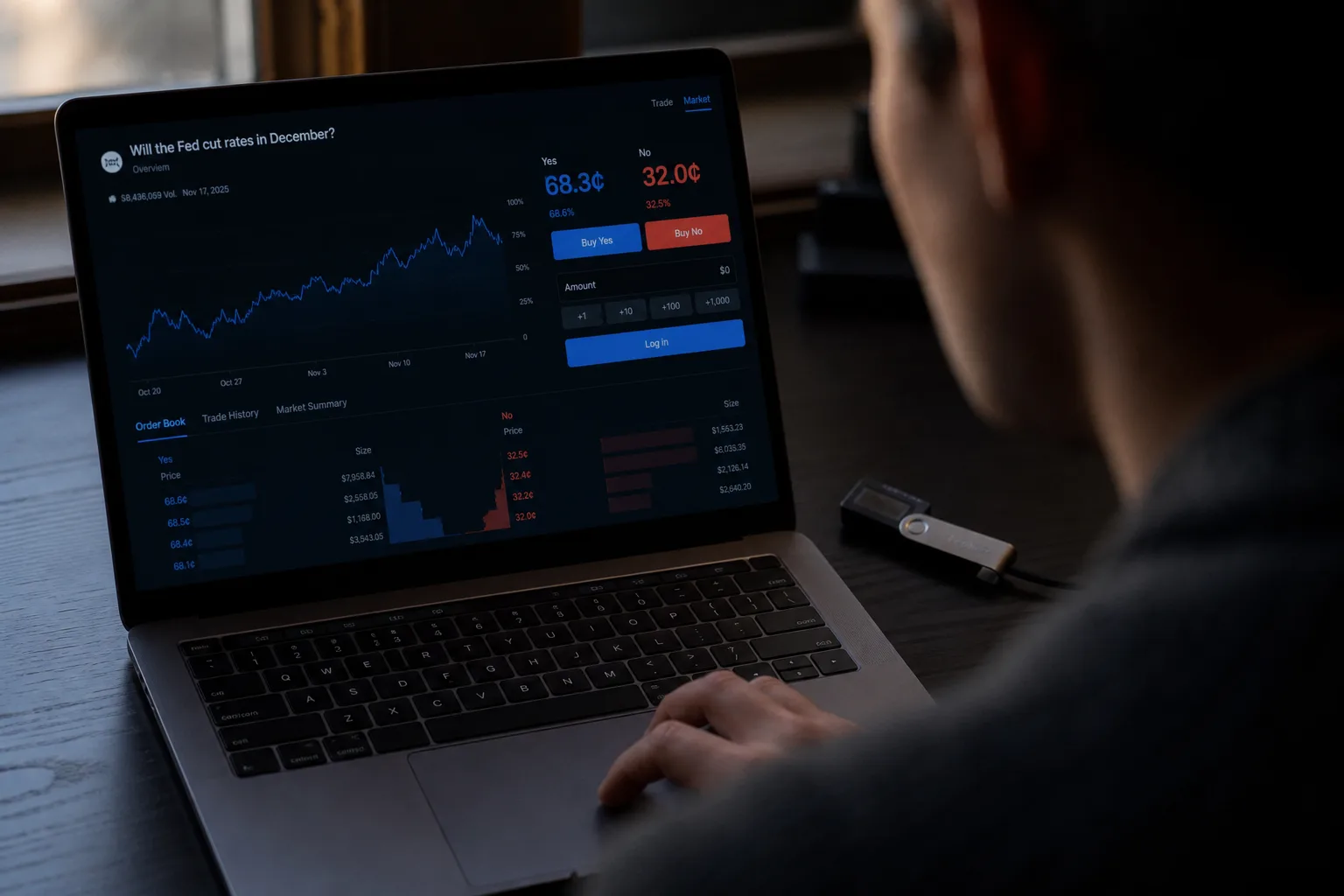
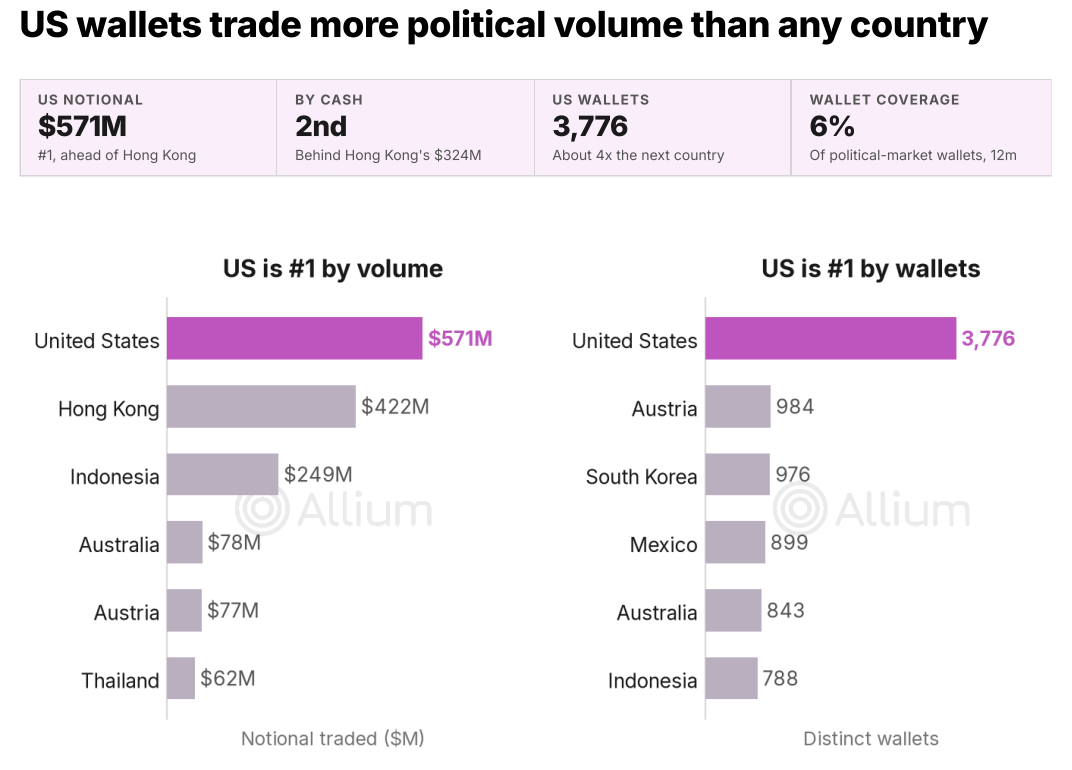
Polymarket US bets are dominating the platform’s global political trading volumes — and the kicker is that Americans aren’t even supposed to be there. New blockchain data published this week makes it increasingly hard to ignore: the geoblock isn’t working, and the US is now the single largest country on Polymarket by both contracts traded and wallet count.
- Polymarket US bets lead the platform globally by volume and wallet count, despite active geoblocking of American users.
- Blockchain firm Allium estimates US users account for Polymarket US bets worth potentially tens of billions of dollars since mid-2025.
- US traders on Polymarket show far more interest in foreign conflict markets — especially Iran — than election-related ones.
- Spain has become the latest country to block Polymarket, joining over 34 nations where the platform is fully restricted.
Table of Contents
The Geoblock That Didn’t Block Anyone
Blockchain analytics firm Allium released a report on Thursday estimating that US-based wallets outpace every other country on Polymarket’s global prediction market platform. That’s a remarkable finding given that Polymarket US bets are legally prohibited — the platform has been barred from serving American users since 2022, when it settled with the US Commodity Futures Trading Commission for $1.4 million and agreed to cut off domestic access.
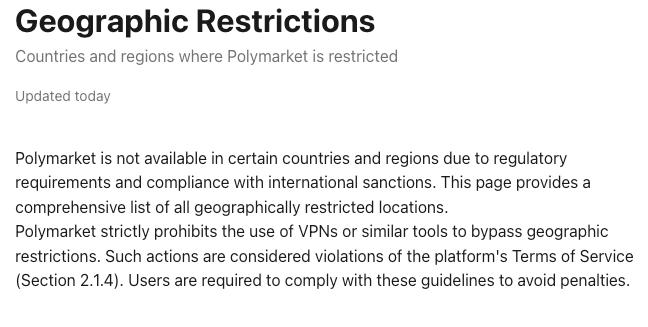
The platform blocks US IP addresses. It blocks known VPN exit nodes. It has, by The Information’s reporting in May, been actively tightening the net on VPN-connected users. And yet, here we are.

Allium’s methodology is important to flag: the firm was able to tag roughly 6% of wallets with a country of origin, so these numbers are directional estimates rather than hard counts. But even as a directional signal, the finding is striking. The report states plainly: “Blocking access did not end US participation; it made the US the largest single political market on Polymarket by volume.” That’s a damning sentence for any compliance team.
Polymarket US Bets by the Numbers
Allium isn’t alone in reaching this conclusion. Rutgers University statistician Harry Crane published a separate study in June using a different methodology — examining the time-of-day patterns and market preferences of traders to infer their geographic location. His estimate puts Polymarket US bets in an eye-opening range: US users may have sent somewhere between $10.6 billion and $26.7 billion through the platform between May 2025 and April 2026 alone.
That’s not a rounding error. That’s a substantial portion of a platform’s entire trading activity flowing from a jurisdiction the platform is legally prohibited from serving. Crane’s range is wide, which reflects the genuine difficulty of attribution in pseudonymous crypto markets, but the floor figure alone represents billions in regulated-market-adjacent activity happening entirely outside US oversight.
What makes the Allium data particularly interesting isn’t just the volume — it’s what Americans are actually betting on. Of the top 12 markets by notional volume among US users, five relate to the conflict involving Iran. Election markets, meanwhile, are notably underrepresented. As Allium put it: “US money pours into foreign wars, lately Iran, and largely skips the elections the global crowd trades.”
That’s a counterintuitive finding. Election prediction markets were the category that made Polymarket a household name in the US during the 2024 presidential race — and they’re the exact category available on regulated US alternatives like Kalshi and the separately regulated Polymarket US, which launched in December. If US users wanted election exposure, they could get it legally. Instead, Polymarket US bets from the offshore crowd are gravitating toward geopolitical risk markets that simply don’t exist on the domestic-regulated platforms.
Why the Geoblock Keeps Failing
This is a structural problem, not a technical one. Prediction markets built on public blockchains are, by their nature, accessible to anyone with a crypto wallet and an internet connection. Geoblocking at the IP layer is a reasonable compliance gesture — and courts have generally treated it as meaningful — but it was never going to stop determined traders who understand how VPNs work.
The deeper issue is that the demand Polymarket helped create doesn’t disappear because regulators drew a line around a country. It migrates. Polymarket US bets move offshore. The capital goes with it. And as Allium’s report notes, it moves “beyond US oversight” — which is arguably a worse outcome than letting Americans participate in a regulated domestic framework.
This is a tension regulators in multiple sectors have wrestled with for decades, from online poker in the 2000s to offshore sports betting before PASPA was overturned in 2018. Prohibition without a viable legal alternative rarely suppresses demand — it just redirects it somewhere less visible. Polymarket US bets are simply the latest illustration of that pattern.
Polymarket’s Expanding List of Headaches
The geoblock compliance problem arrives alongside a string of other challenges for the prediction market company. Earlier this year, Polymarket was hit with a $2.9 million theft — the company said affected users would be refunded. That kind of security incident, combined with regulatory heat and now evidence that its geographic restrictions are being systematically bypassed, paints a complicated picture for a platform that’s simultaneously trying to grow and stay on the right side of global financial authorities.
On the regulatory front, Polymarket is completely blocked in more than 34 countries. Spain became the most recent addition, blocking both Polymarket and Kalshi as a precautionary step while authorities investigate whether either company holds the necessary local licensing to operate. Four more jurisdictions — Singapore, Thailand, Taiwan, and Poland — are in what Polymarket calls “close only” mode, where existing positions can be wound down but no new trades can be opened. There are also restricted sub-regions: Ontario in Canada, and the Ukrainian territories of Crimea, Donetsk, and Luhansk.
That’s a significant and growing chunk of the world where Polymarket either can’t operate or operates under severe restrictions. For a platform whose value proposition is global liquidity and unrestricted market access, each new blocked jurisdiction is a hit to the network effect that makes prediction markets useful in the first place — and each new restriction pushes more Polymarket US bets further outside any regulatory framework.

What This Means for the Prediction Market Sector
The broader prediction market space is at a genuinely interesting inflection point. Platforms like Kalshi have fought hard — including winning in court — for the right to offer election markets in the US under CFTC oversight. Polymarket US launched its regulated domestic product in December. The regulatory pathway exists. There’s a real question now about whether the offshore-crypto model and the regulated-domestic model will eventually converge, or whether they’ll continue to serve different audiences with different risk tolerances and different interests.
The Allium data suggests those audiences are already diverging in meaningful ways. Regulated US platforms attract election bettors. Polymarket US bets from the offshore crowd target geopolitical flashpoints — Iran, conflict zones, markets that no US-regulated exchange is going to list anytime soon. That’s not a market that a CFTC-approved product can easily capture.
Polymarket didn’t respond to a request for comment from Cointelegraph at the time of publication. Whether the company addresses its geoblock failures publicly or continues tightening technical restrictions, the fundamental dynamic revealed by Allium’s report is hard to engineer away: when demand exists and the product works, people find a way in. The question for Polymarket — and for US regulators — is whether the current arrangement, where Polymarket US bets worth billions flow through a platform nominally off-limits to Americans, is actually preferable to bringing that activity inside a regulatory framework.
Frequently Asked Questions
Why are Polymarket US bets happening if Americans are blocked from the platform?
Polymarket blocks US IP addresses and VPN services following a 2022 CFTC settlement, but research from Allium and Rutgers University’s Harry Crane suggests many US users bypass these restrictions. Demand clearly hasn’t gone away — it’s just moved offshore and outside US regulatory oversight.
How much money have US users sent through Polymarket despite the ban?
Rutgers statistician Harry Crane estimated US-based users sent between $10.6 billion and $26.7 billion through Polymarket between May 2025 and April 2026 — a staggering figure that illustrates just how porous the platform’s geographic restrictions have proven to be.
What markets are US users on Polymarket most interested in?
According to Allium’s data, five of the US cohort’s top 12 markets by notional volume relate to the Iran war. Election markets — the one category legally available on regulated US platforms like Kalshi — are notably less popular among the offshore US crowd.
Is there a legal version of Polymarket for US users?
Yes. Polymarket US launched in December as a separately regulated platform with a narrower range of markets available to American users. It’s a distinct product from the global Polymarket platform where geoblocking is in place.