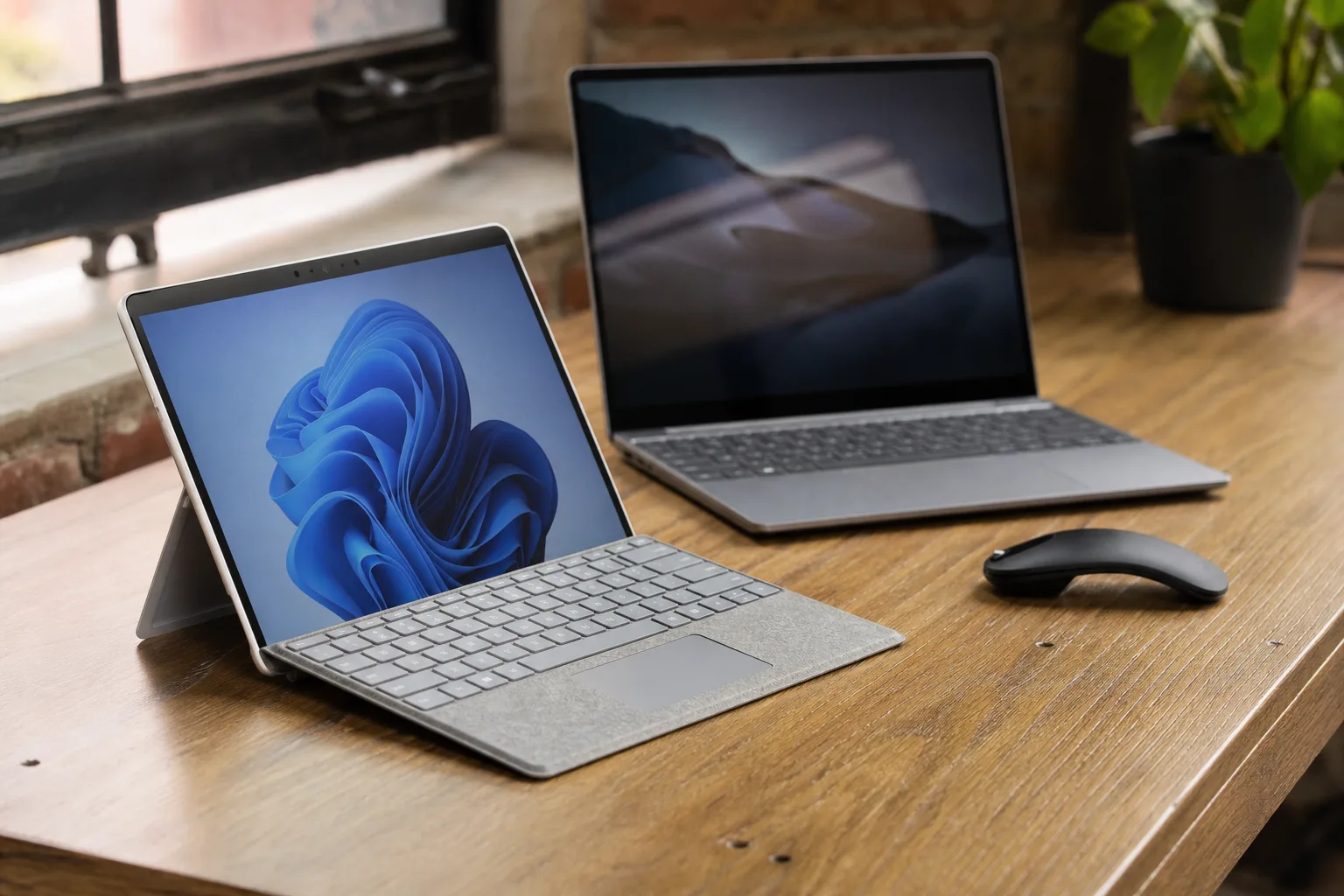
- The Surface Pro 12 starts at $1,149.99 with 16GB of RAM, up sharply from last year’s $799.99 entry model.
- Microsoft says the Surface Pro 12 gains an hour of browsing battery life through Qualcomm’s six-core Snapdragon X2 Plus processor.
- The Surface Laptop 13 also receives the new chip, brighter display and a $1,199.99 starting price.
- Microsoft’s refresh fixes the embarrassing 8GB baseline, but leaves several hardware compromises untouched.
Table of Contents
Surface Pro 12 gets the chip it needed — at a much less friendly price
Microsoft’s new Surface Pro 12 is the sort of refresh that looks sensible on a specification sheet and painful in a checkout cart. Qualcomm’s Snapdragon X2 Plus processor should make this compact detachable meaningfully quicker, while 16GB of memory is finally the floor rather than an upgrade. But the starting price has jumped from $799.99 to $1,149.99. That is not a gentle nudge upward. It’s a different product bracket.
The updated model, formally called the Surface Pro 12-inch Second Edition, is due on October 13 alongside a refreshed Surface Laptop 13-inch. Both retain the chassis and much of the component list from their predecessors, with Microsoft putting its energy into Qualcomm’s newer Arm silicon and a brighter panel. If you liked the smaller Surface hardware last year, you’ll know exactly what you’re getting. The awkward part is deciding whether the new internals justify a roughly $350 higher admission fee.
Microsoft says the six-core Snapdragon X2 Plus brings up to 18 percent better battery efficiency, graphics performance exceeding the prior generation by more than 60 percent, and local AI inference gains of up to 95 percent on its neural processing unit. As always, those percentages need a large asterisk: synthetic workloads and carefully selected AI tasks are not daily life. Still, a newer Qualcomm platform matters because Windows on Arm has steadily become less of a science project and more of a viable mainstream option.

Microsoft has not attached those claims to a grand redesign. The Surface Pro 12 keeps its 12-inch, 2,196 by 1,464 LCD touchscreen with a 90Hz refresh rate. The useful upgrade is brightness, rising from 400 nits to 500 nits. That will help outdoors and near bright windows, which sounds mundane until you have tried to work from a train seat with sunlight pouring across the display.
Better baseline memory explains some of the increase
Last year’s prices are harder to compare because Microsoft has eliminated the 8GB configuration. Every new Surface Pro 12 and Surface Laptop 13 begins with 16GB of RAM and can be configured with up to 24GB. Frankly, that was overdue. An $800 Windows machine with 8GB of memory made little sense in 2025, especially when browsers, Teams calls, photo editing tools and Windows itself all compete hungrily for RAM.
But better base specifications do not erase the sticker shock. The Surface Pro 12 now begins at $1,149.99, while the Surface Laptop 13 starts at $1,199.99, compared with $899.99 previously. Memory supply constraints have pushed prices across the PC business, and Microsoft is hardly alone in passing costs along. Yet this also reflects a familiar Surface pattern: the machines increasingly ask buyers to pay premium money for industrial design and portability, even where the feature set has visible gaps.
For the Surface Pro, Microsoft estimates up to 13 hours of web browsing, one more hour than the previous model. The Surface Laptop 13 gets the better headline, with a claimed 18 hours of browsing, two hours ahead of its predecessor. Those figures are useful as a comparison between generations, not a promise of a full workday under every workload. Video meetings, external displays, native versus emulated applications and screen brightness can all turn battery estimates into confetti.
Surface Laptop 13 gets brighter, but still stops at 60Hz
The Surface Laptop 13 carries a 1,920 by 1,280 display that remains locked to 60Hz, although its brightness also climbs to 500 nits. That is a defensible choice for battery life, but it feels stingy at $1,199.99 when smoother 90Hz or 120Hz panels are common in premium laptops. Microsoft’s own Surface Pro offers 90Hz. The difference is immediately noticeable when scrolling through long documents or moving around Windows, and once you get used to it, going back is hard.
Ports are unchanged. Both machines have two USB-C 3.2 connections, while the laptop adds USB-A 3.2 and a 3.5mm headphone jack. That USB-A port is genuinely practical, not nostalgic; anyone who has arrived at a meeting room with an older receiver or presentation clicker knows why. Wi-Fi 7 and Bluetooth 5.4 are included on both systems.
Commercial buyers will get versions of each machine, and Microsoft plans an optional 5G configuration for the Surface Pro 12. That matters more than it may sound. A detachable PC with cellular connectivity has a clear role for field workers, sales staff and people who actually work away from a desk rather than merely fantasize about doing so from a café.
Microsoft still leaves easy hardware wins on the table
The omissions are just as revealing as the upgrades. There is no mention of a haptic trackpad for these smaller systems, even as Windows 11 is beginning to use subtle haptic feedback and Microsoft’s more expensive Surface Laptop Ultra has embraced the technology. Apple has made excellent haptic trackpads feel ordinary for years; once properly implemented, they are one of those small quality-of-life features that makes a device feel considered rather than assembled from a parts list.
Microsoft is at least expanding color options, bringing black back beside platinum silver and violet. It is also releasing a second-generation Surface Mouse with integrated haptics. The irony is hard to miss: the peripheral gets a feature the laptop apparently cannot.
The real test for the Surface Pro 12 is whether consumers will pay a premium for a machine that looks largely unchanged. Qualcomm’s X2 Plus may deliver the speed, battery life and local AI headroom Microsoft needs to keep its Copilot+ PC story moving. For final configuration details when orders open, check Microsoft’s Surface product pages. At $1,149.99, though, this Surface has to stand up against every excellent ultraportable, not merely last year’s cheaper Surface.