

- A 19-year-old Pakistani student used GitHub Copilot to build a full production e-commerce platform in just three months.
- GitHub Copilot generated or heavily scaffolded roughly 78% of the backend code across 80 PHP files and 136 commits.
- The project includes enterprise-grade security features like Argon2id hashing, CSRF protection, and a CI security gate.
- The build challenges the idea that serious software requires large teams or well-funded institutional backing.
Table of Contents
GitHub Copilot as a Co-Founder, Not Just a Shortcut
When Syed Ahmer Shah set out to build GitHub Copilot-assisted software serious enough to show a real employer, he wasn’t thinking about weekend hackathons or toy apps. He wanted something production-grade — the kind of platform that looks like it came out of a funded startup, not a student dorm room. Three months later, he had exactly that. The result is Commerza, a full-stack e-commerce platform built on raw PHP and MySQL, complete with a customer storefront, admin panel, Stripe payments, OAuth login via Google and Facebook, Redis caching, ClamAV upload scanning, and a CI security gate that runs on every single push to the repo.

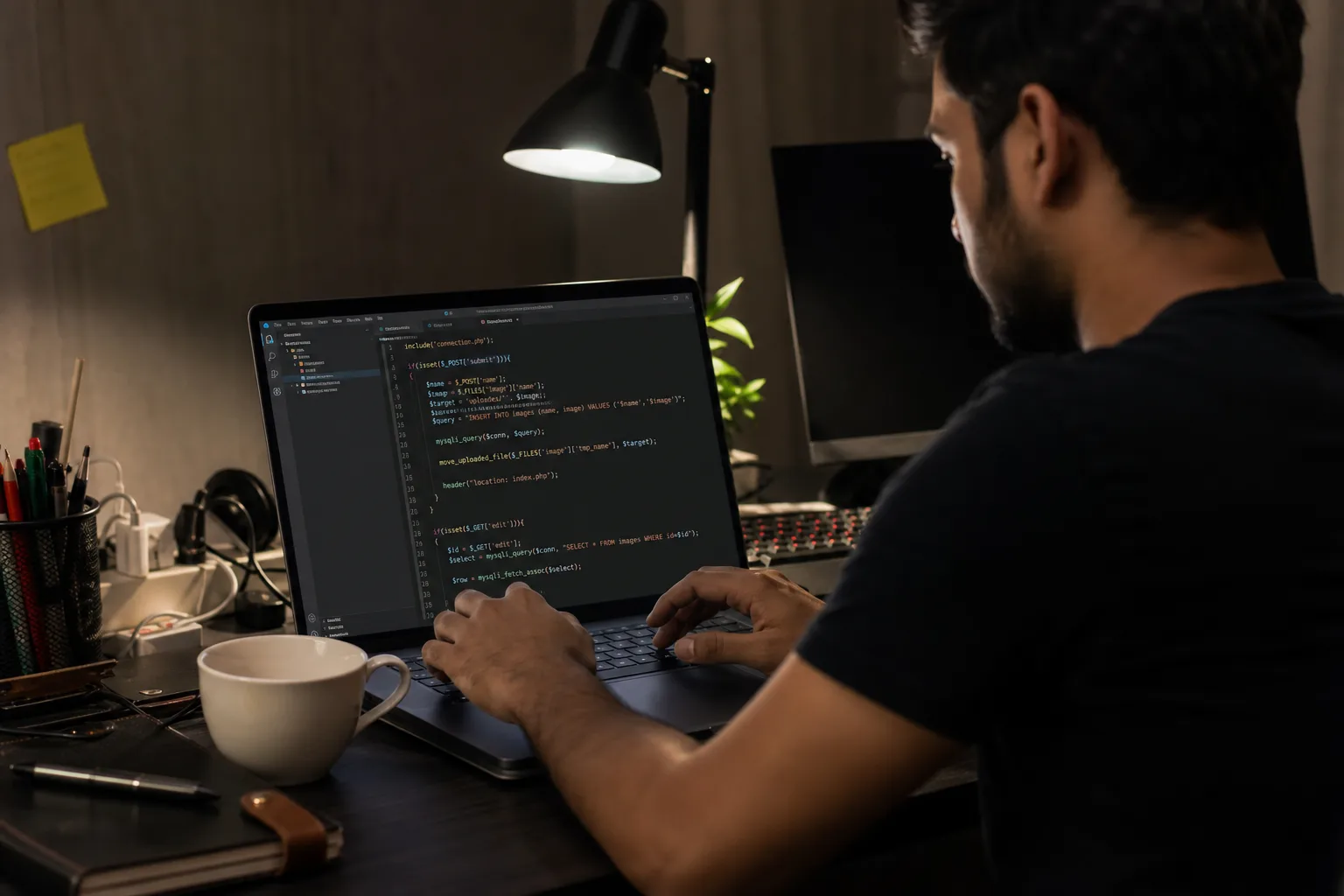
Shah is 19 years old and based in Pakistan. He’s simultaneously enrolled in a four-year Bachelor’s in Software Engineering at HITMS and a three-year Advanced Diploma at Aptech Pakistan. No Silicon Valley bootcamp, no institutional research budget, no team. Just a student coding at 2am — and an AI that, by his own estimate, wrote or heavily scaffolded around 78% of the backend.
What Commerza Actually Is
It’s easy to be skeptical when someone claims their side project is “production-grade.” So let’s look at the specifics. Commerza spans 339 tracked files, 80 PHP files, and 136 commits. The codebase breaks down to PHP at 62.6%, JavaScript at 20.8%, and CSS at 15%. It has both a dark mode (OrangeRed and Black) and a light mode (NavyBlue and White), Cloudinary integration for media, sub-admin role management with session revocation on deletion, a product trash bin with restore workflows, coupon campaign management, and review eligibility tied to actual delivery status.

On the security side, Shah didn’t cut corners. The platform uses Argon2id for password hashing — a deliberate choice over bcrypt that reflects real awareness of OWASP’s current password storage guidance. There’s Google reCAPTCHA v2 and v3 with score thresholds, CSRF tokens on every mutation path, SQL injection defenses across all user-facing inputs, rate limiting, audit logs, and stock locking to prevent overselling under concurrent load. That last one — stock locking — is the kind of detail that junior developers almost always miss and that causes real production incidents at scale.
How GitHub Copilot Changed the Build
Shah describes the first month as mostly frontend work — HTML structure, CSS design systems, Bootstrap grid, jQuery interactions. All written by hand, methodically, one component at a time. Then he hit the backend, and everything slowed down. He knew PHP basics. Production PHP is something else entirely. PDO vs. mysqli. Prepared statements everywhere. CSRF token placement. The right password hashing algorithm. SMTP failover logic. He estimates that without AI assistance, the project would have taken six to eight months, maybe more.
The shift happened in early February 2026 when he stopped using GitHub Copilot purely for code completion and started actually talking to it. Agent mode. Full context. Entire systems described and then generated. The difference, he says, was dramatic.
One early example makes the point well. Shah needed SMTP failover — a primary email transport with a fallback if the first failed. His original plan was simple: try primary, fail gracefully if it’s down. GitHub Copilot proposed something more sophisticated: a dual-route architecture with a duplicate-suppression check that detects when both transport configs point to the same underlying server, preventing the same email from firing twice if both routes happen to be responsive simultaneously. Shah had never encountered this pattern before. He learned it not from a tutorial or a Stack Overflow thread, but by watching the tool write it and then asking it to explain the reasoning.
That distinction matters. This wasn’t just autocomplete on steroids. Shah was using GitHub Copilot the way a senior engineer mentors a junior one — writing code, yes, but also teaching the why behind architectural decisions that would otherwise take years of production experience to accumulate.
The Full Scope of What AI Generated
Shah is specific about what GitHub Copilot built versus what he built. The frontend — HTML, CSS, the design system — was his. The backend is where the AI did the heavy lifting. That includes the entire email automation system: SMTP primary and fallback routing, OTP generation with 15-minute expiry for two-factor auth and password resets, cart and wishlist expiry reminder emails, monthly profit report emails, and weekly analytics digests. It includes the full admin panel systems: coupon management, review moderation, the trash bin workflow, sub-admin lifecycle management with email verification and role assignment, and the security event monitoring UI. It includes the reCAPTCHA v3 implementation with strict score thresholds and per-action validation.
Reviewing, testing, and iterating on all of that was still Shah’s responsibility. He’s clear that GitHub Copilot wasn’t a magic button — it was a collaborator that dramatically compressed the time between having an idea and having working, defensible code. The 136 commits in the repo tell the story of someone who was engaged throughout, not someone who pasted generated code and called it done.
What This Tells Us About AI-Assisted Development
The conversation around AI coding assistants tends to split into two camps. One camp says tools like GitHub Copilot are productivity multipliers for experienced developers. The other worries they let inexperienced developers ship code they don’t fully understand — a recipe for security holes and maintenance nightmares. Shah’s project complicates both narratives.
He’s not an experienced developer, but the security architecture of Commerza is genuinely thoughtful. He’s not a senior engineer, but he made deliberate choices — raw PHP over Laravel specifically to understand every layer — that reflect real engineering discipline. And the AI didn’t obscure those layers for him. It taught him things he then internalized. The SMTP duplicate suppression pattern. The Argon2id decision. The stock locking logic. These aren’t cargo-culted from generated code. They’re things he can now explain and defend.
That’s a different relationship with AI tooling than the “vibe coding” trend that’s been generating concern in developer communities. Shah used GitHub Copilot the way the best developers use any resource — as a way to learn faster, not as a way to avoid learning altogether.
It’s also worth watching what Microsoft does with Copilot from here. The tool has evolved significantly from its early days as a basic code completion engine. Agent mode, multi-model support — Shah’s build used Claude Sonnet, Claude Opus, and GPT-5.2-Codex through the Copilot interface — and the ability to reason about system architecture rather than just syntax are capabilities that are still maturing. If a 19-year-old student in Pakistan can ship something this complete in three months, the ceiling for what a small team of experienced developers can produce is genuinely higher than most engineering managers currently assume.
The more interesting question isn’t whether AI wrote Commerza’s backend. It’s what happens when the developers who grew up learning this way — using AI as a collaborator from day one — start entering the industry at scale. The gap between what one person can build and what required a team two years ago is closing fast, and Commerza is a concrete data point in that direction.

