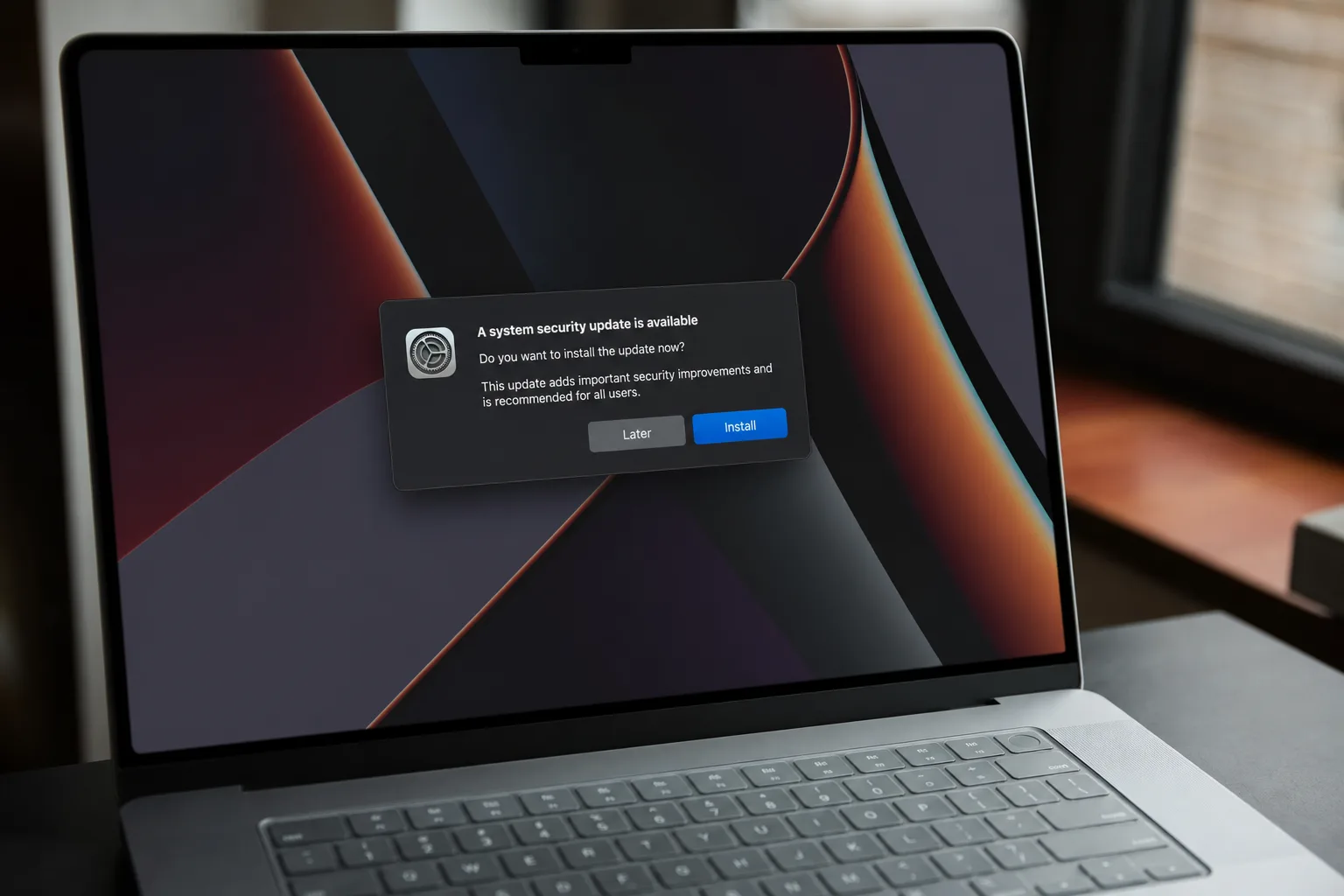
- macOS Tahoe security flaws patched in version 26.5 include a kernel memory disclosure bug and multiple sandbox escapes.
- The macOS Tahoe security flaws affect core subsystems including APFS, HFS, GPU drivers, and the CUPS printing stack.
- An AI-assisted vulnerability discovery engine called Atuin contributed to finding at least one sandbox escape in the Installer component.
- Google’s Threat Analysis Group reported a kernel memory layout leak via IOHIDFamily, suggesting active threat-actor interest in the platform.
Table of Contents
Apple Drops macOS Tahoe 26.5 — and the Patch List Is Long
The macOS Tahoe security flaws addressed in Apple’s May 11, 2026 release of macOS 26.5 stretch across more than twenty distinct subsystems, from the kernel itself down to image parsing libraries and the CUPS printing stack. It’s one of the more substantial security updates Apple has shipped in a single macOS point release, and the diversity of affected components tells its own story about just how wide an attack surface a modern desktop operating system carries.
Apple, as is customary, kept quiet about these issues until patches were ready. The company confirmed the release covers macOS Tahoe and published the full CVE list via its official security releases page. The sheer breadth of what’s listed here deserves more attention than a routine update notification. Reviewing the macOS Tahoe security flaws in full makes clear that this is not a minor maintenance drop.
macOS Tahoe Security Flaws: What’s Actually in the Kernel
The headline vulnerability — at least in terms of sheer severity — sits in the kernel itself. A memory handling issue could allow an app to disclose kernel memory contents, which is exactly the kind of primitive that sophisticated attackers use to bypass Address Space Layout Randomisation and stage further exploitation. Apple hasn’t credited a specific researcher for this one publicly, which occasionally signals internal discovery or a more sensitive disclosure process.
Nearby in the driver stack, things get worse before they get better. IOKit carries a use-after-free vulnerability — credited to Mihalis Haatainen, Ari Hawking, and Ashish Kunwar — that could allow an app to cause unexpected system termination. Use-after-free bugs in kernel-adjacent code are perennially dangerous; they’ve formed the backbone of iOS and macOS privilege escalation chains for years. IOHIDFamily shows up twice: once for a memory corruption issue that could terminate apps, credited to Johnny Franks, and once for a logging flaw that leaked kernel memory layout information. That second one was reported by Google’s Threat Analysis Group — a team that typically tracks nation-state actors and advanced persistent threats. Their involvement is a signal that the macOS Tahoe security flaws in this kernel subsystem attracted serious threat-actor interest.
IOSurfaceAccelerator, the subsystem that handles GPU-accelerated surface sharing between apps, has an out-of-bounds read that could let an app read kernel memory or cause a system crash. Somair Ansar and an anonymous researcher are credited. GPU memory reads from userspace code are a well-documented escalation path, particularly on Apple Silicon where the CPU and GPU share unified memory.
Sandbox Escapes and Privilege Escalation
Three separate macOS Tahoe security flaws could allow a malicious app to break out of its sandbox entirely. That’s notable. Sandbox escapes are considered high-severity on Apple platforms because the App Sandbox is supposed to be the last line of defence after code execution — if an attacker can escape it, they have significantly broader access to user data and system resources.
The App Intents framework has a logic issue patched with improved restrictions, credited to Vamshi Paili and Tony Gorez of Reverse Society. GPU Drivers carry a logging flaw — redacted data wasn’t being scrubbed properly — that Kun Peeks discovered and reported. And the Installer component has a permissions issue that Atuin, an automated vulnerability discovery engine, and researcher wdszzml flagged together. Each of these macOS Tahoe security flaws represents a meaningful erosion of the sandbox boundary.
That last credit is worth pausing on. Atuin describes itself as an AI-assisted tool for automated security research. Its appearance in an official Apple CVE credit list alongside a human co-discoverer is a small but telling sign of where vulnerability research is heading. AI-assisted fuzzing and code analysis tools have been maturing fast; their presence in serious security disclosures is becoming less surprising and more routine.
CUPS — the open-source printing system that Apple bundles with macOS — has a path parsing issue that could allow an app to gain root privileges. Andreas Jaegersberger and Ro Achterberg of Nosebeard Labs found it. Root escalation via the printing stack sounds almost retro, but CUPS has a long history of serious vulnerabilities, and last year’s wave of remotely exploitable CUPS bugs served as a reminder that legacy printing infrastructure is genuinely dangerous territory. This particular macOS Tahoe security flaw is especially worth noting given the severity of root-level access it could grant.
Media Parsing: The Perennial Attack Surface
If there’s one theme that runs through every major operating system security update, it’s this: parsing untrusted media files is hard, and developers keep getting it wrong. macOS Tahoe 26.5 patches five separate macOS Tahoe security flaws in image and media handling alone.
AppleJPEG has two separate vulnerabilities. One is a memory corruption bug in Apple’s own code, found by researcher impost0r. The other is an upstream flaw in open-source code — CVE-2026-1837 — where the CVE-ID was assigned by a third party and Apple is simply one of many affected projects. That’s an increasingly common pattern as Apple’s software pulls in more open-source dependencies; the company patches the component but the vulnerability lives upstream.
ImageIO, Apple’s image import framework, accounts for three more bugs: two buffer overflows and a bounds-checking failure, credited to researchers including Suresh Sundaram, Jiri Ha, and Arni Hardarson. CoreMedia and CoreServices round out the media-adjacent fixes, with an information disclosure issue and a file-parsing crash respectively.
File Systems, Race Conditions, and Privacy Bypasses
HFS — yes, the legacy HFS file system that Apple has been quietly maintaining since the days of spinning-disk Macs — has a buffer overflow that could allow kernel memory writes or unexpected system termination. Aswin Kumar Gokula Kannan and Dave G. reported it. The fact that HFS is still present and exploitable in a 2026 macOS release is the kind of thing that makes security researchers quietly exhausted.
APFS, the modern replacement, also has a buffer overflow in 26.5, found by researcher Dave G. Two different file systems, two different buffer overflows, one update — both qualifying as macOS Tahoe security flaws with kernel-level consequences. The FileProvider framework carries a race condition that could expose sensitive user data — fixed with additional validation, per Apple’s notes, and credited to Alex Radocea.
The Accounts framework has a privacy preferences bypass — meaning an app could potentially access data the user had explicitly restricted — fixed with additional permission restrictions. CoreSymbolication has an out-of-bounds access issue that could crash apps during file parsing, flagged by Niels Hofmans and an anonymous researcher working with the TrendAI Zero Day Initiative.
Who’s Finding These Bugs — and What That Tells Us
The researcher credits in this update are a window into the current state of the security ecosystem. You’ve got independent researchers, university-adjacent teams, corporate threat intelligence groups like Google TAG, boutique research outfits like Nosebeard Labs and Beryllium Security, organised programmes like the TrendAI Zero Day Initiative, and now AI-assisted tooling like Atuin. The diversity of sources is genuinely healthy — it means the macOS Tahoe security flaws catalogued in 26.5 are being scrutinised from many different angles simultaneously.
What it also means is that attackers have the same visibility. Every CVE that gets patched in a public release is, by definition, a public disclosure. Researchers and threat actors alike read these lists and work backwards. Users who delay updating give that window of exposure real teeth.
Apple’s cadence of releasing security updates alongside OS point releases has historically meant that users on older macOS versions sometimes lag on critical patches. With the volume and severity of what’s in 26.5, this is one update where dragging your feet carries genuine risk. The kernel memory disclosure, the root privilege escalation via CUPS, the sandbox escapes — individually each is serious. Together they represent a meaningful set of primitives that a determined attacker could chain. Update promptly.