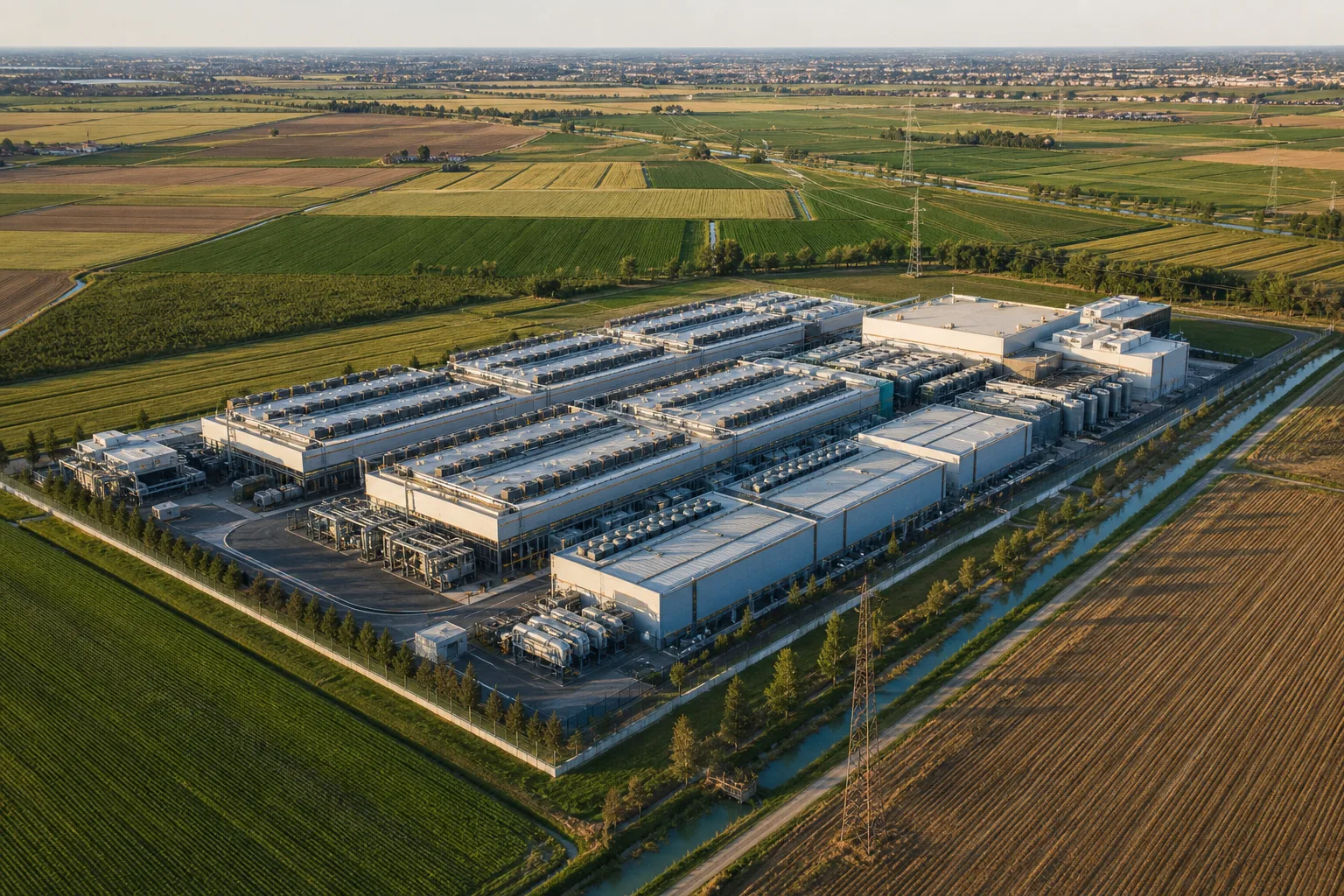
- The Italy data center tax imposes a 200% surcharge on building in parks and protected green areas, effective from May 2026.
- Lombardy’s Italy data center tax is the first regional law of its kind, reflecting the area’s outsized share of national data center projects.
- Construction charges in agricultural zones will double, pushing developers toward disused industrial brownfield sites instead.
- The law passed with cross-party support, though amendments steepened penalties well beyond the original 50–75% proposal.
Table of Contents
Lombardy Draws a Line in the Soil
The Italy data center tax just got very real. On 26 May 2026, Lombardy’s regional council approved legislation that slaps a 100% surcharge on data center construction in agricultural areas and a staggering 200% surcharge on builds inside parks and other protected green zones. It’s the first law of its kind passed by any Italian region — and given that Lombardy hosts more data center projects, completed or in the pipeline, than anywhere else in the country, the timing is no coincidence.
This isn’t a blanket ban. The region isn’t telling hyperscalers and colocation providers to pack up and leave. What it is doing is making the economics of grabbing cheap greenfield land dramatically less attractive, while nudging developers toward the thousands of hectares of derelict industrial land that dot the Po Valley. The message from the regional administration is blunt: if you want to build in Lombardy, build smart — or pay a steep premium for not doing so.
How the Italy Data Center Tax Actually Works
Italian construction law already requires developers to pay oneri di urbanizzazione — urbanisation charges — whenever they put up a new building. Lombardy’s new rule doesn’t invent a new category of tax; it multiplies the existing charges. In agricultural zones, those charges now double. In parks and environmentally sensitive green areas, they triple. That’s the Italy data center tax in practice: not a flat levy, but a punishing multiplier applied at planning permission stage.
What makes this particularly significant is how it ended up steeper than anyone expected. The original draft proposed increases of 50% in rural areas and 75% in parks — already notable, but manageable for a large operator with deep pockets. Then Lega group leader Alessandro Corbetta tabled an amendment, and the final numbers jumped to 100% and 200% respectively. That last-minute escalation caught some in the industry off guard and signals that the political appetite for stricter controls is stronger than the initial draft suggested.
The vote itself was revealing. Centre-right parties pushed it through, but three centre-left Democrats abstained and three others walked out rather than vote against it outright — a posture that reads less like opposition and more like reluctant acknowledgment that the underlying concern is legitimate, even if the specific mechanism is debatable.
Why Lombardy? Why Now?
To understand why the Italy data center tax originated here and not in Rome, you need to look at a map of where the country’s digital infrastructure is actually concentrating. Lombardy — Milan in particular — has become the de facto hub for Italian and, increasingly, southern European data center capacity. Major operators including several global colocation and hyperscale players have either opened facilities in the Milan metro area or announced plans to do so. The region’s fibre connectivity, its proximity to financial services and manufacturing industries, and its relatively stable power grid have made it a magnet.
That concentration creates a specific problem. Unlike, say, the Irish Midlands or the Swedish countryside — where data center expansion has also prompted regulatory pushback — Lombardy is densely populated and intensively farmed. Green space is genuinely scarce and politically sensitive. When developers started quietly acquiring agricultural plots and park-adjacent land, often without clear construction timelines or detailed plans, it set off alarm bells in the regional government. Officials noted publicly that some acquisitions appeared to be speculative land-banking: buying now, building later, with no firm commitment on when or exactly what.
That practice — common in real estate development worldwide — is particularly galling when the land in question feeds people or provides urban green space. The Italy data center tax is partly a response to that dynamic: make speculative greenfield acquisition expensive enough that it stops being a default strategy.
The Brownfield Incentive Hidden Inside the Penalty
There’s a secondary story embedded in this legislation that deserves more attention than it’s getting. By making green-area construction prohibitively expensive, Lombardy is implicitly subsidising the alternative: repurposing old industrial sites. The region has no shortage of them. Decades of deindustrialisation have left former factories, warehouses, and logistics facilities sitting vacant across towns like Sesto San Giovanni, Dalmine, and Vigevano.
Data centers are, in some respects, an ideal adaptive reuse for heavy industrial buildings. They need large floor plates, high power capacity, strong foundations, and security perimeters — all things that former manufacturing sites often already have, or can be retrofitted to provide at lower cost than building from scratch. The Italy data center tax doesn’t say any of this explicitly, but the incentive structure it creates points squarely in that direction.
Whether operators will take the hint is another question. Brownfield sites come with their own complications: contamination surveys, complex ownership histories, planning constraints tied to heritage or remediation requirements. For a hyperscaler trying to turn a site live within 18 months, those uncertainties can be dealbreakers. But at 200% surcharge on the greenfield alternative, the calculation is changing fast.
Italy Data Center Tax Sets a Precedent for the Rest of Europe
Lombardy is explicitly ahead of the Italian national government on this. No equivalent federal framework exists. That’s not unusual in Italy, where regions retain significant autonomy over planning and construction law, but it does mean there’s a patchwork risk: operators could simply shift projects to neighbouring regions like Piedmont or Emilia-Romagna, which haven’t yet moved. Whether other regions follow Lombardy’s lead — or whether Rome eventually steps in with a national standard — will define whether this Italy data center tax is a genuine inflection point or a local anomaly that gets arbitraged away.
The broader European context matters here too. Ireland has been wrestling with data center electricity consumption for years, with EirGrid warning that new facilities risk destabilising the national grid. The Netherlands imposed a moratorium on new data center construction around Amsterdam in 2019, later partially lifting it with strict energy-efficiency conditions. Denmark and Sweden have had their own debates. What Lombardy has done differently is tie the deterrent specifically to land type rather than energy consumption — a more planning-focused, less utility-focused approach that could prove influential precisely because it’s simpler to administer.
The Italy data center tax won’t stop the buildout. Europe’s demand for cloud infrastructure, AI compute, and edge capacity is structural and growing, and no regional surcharge is going to reverse that. But it might — and this is the realistic ambition — redirect where that buildout happens. If it works, expect to see similar legislation proposed in regions across southern Europe within the next two to three years. Lombardy has effectively handed other regional governments a template.