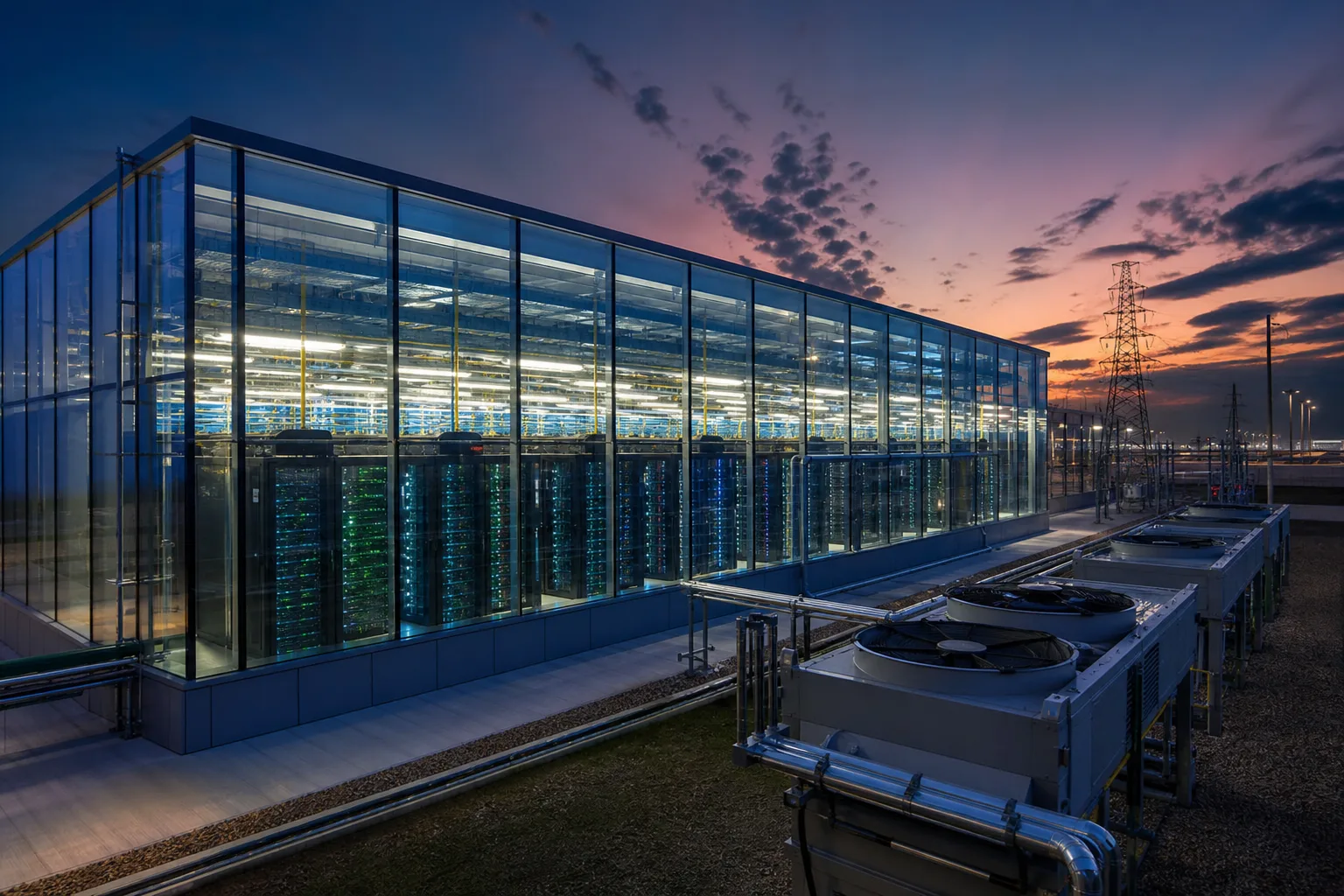
Wall Street is starting to pay serious attention to IREN’s pivot toward artificial intelligence infrastructure. Jefferies has put out a bullish call on the company, arguing that the IREN AI cloud business isn’t just a side project — it’s poised to become the company’s most important growth engine, and one that could leave traditional data center leasing well behind.
- Jefferies has put out a bullish call on IREN’s stock, driven largely by its IREN AI cloud business outperforming data center leasing.
- The IREN AI cloud segment has the potential to generate strong returns relative to traditional colocation or leasing arrangements with hyperscalers.
- Only around 10% of IREN’s massive 6 gigawatt global power portfolio is currently being utilized, leaving enormous room to scale.
- IREN’s strategic shift from bitcoin mining toward AI infrastructure reflects a broader industry trend reshaping crypto-native companies.
Table of Contents
Why IREN AI Cloud Is the Real Story
IREN started life as a bitcoin miner. That framing still dominates how many investors think about the company, and the market may be applying a mining-company valuation to what is rapidly becoming an AI infrastructure play — and that mismatch is where the opportunity lives.
The IREN AI cloud model is fundamentally different from leasing data center space to a hyperscaler like Microsoft or Amazon. When you lease, you’re essentially a landlord — you get a contracted rate, your upside is capped, and you’re largely dependent on the tenant’s own growth plans. When you operate your own cloud service and sell GPU compute directly to enterprise customers or AI developers, you capture far more of the value chain. The margins are better, the relationships are stickier, and the revenue profile looks more like a tech company than a real estate trust.
That distinction matters enormously right now. Demand for AI compute capacity is outpacing supply across virtually every segment of the market. Companies that can actually deliver GPU hours at scale — not just promise future capacity — are in a structurally strong position. Jefferies appears to believe IREN is closer to that reality than its current stock price implies.
6 Gigawatts, Only 10% Used
Here’s the number that really anchors Jefferies’ thesis: the firm estimates that only about 10% of IREN’s roughly 6 gigawatt global power portfolio is currently being utilized. That’s a staggering amount of latent capacity sitting idle or underdeployed.
Power is the single hardest constraint in AI infrastructure right now. Every major cloud provider, every colocation operator, and every AI lab is scrambling for access to reliable, large-scale power. IREN already has it — or at least the rights and infrastructure to access it. Getting from secured power capacity to live, revenue-generating compute requires capital, hardware procurement, and time, but the foundational bottleneck is already solved in a way that most competitors still can’t claim.
To put 6 gigawatts in context: a modern large-scale AI data center might consume anywhere from 100 to 500 megawatts depending on density and design. IREN’s total power footprint, if fully deployed toward IREN AI cloud operations, could theoretically support dozens of facilities at that scale. Obviously not all of that power will go toward AI compute — some will remain allocated to bitcoin mining, some to leasing arrangements — but the point is that the raw capacity headroom is enormous.
The Broader Shift: Miners Becoming Infrastructure Operators
IREN isn’t the only crypto-native company making this move. The past two years have seen a wave of bitcoin miners quietly repositioning themselves as AI and high-performance compute operators. Core Scientific struck a major deal with CoreWeave. Riot Platforms has been exploring similar pivots. Hut 8 has been building out its managed services business. The pattern is consistent: companies that spent years accumulating cheap power, large facilities, and power procurement expertise are discovering that those same assets are exactly what the AI industry desperately needs.
The difference between these companies and the hyperscalers is speed and flexibility. Amazon, Google, and Microsoft are building massive AI infrastructure at scale, but their procurement pipelines are long, their construction timelines stretch years, and their capacity is largely spoken for by their own internal demand. Smaller operators like IREN can theoretically move faster, target specific customer segments, and offer capacity that the giants simply can’t turn on quickly enough.
That said, the IREN AI cloud business faces real challenges too. Competition in the GPU cloud market is fierce. CoreWeave, Lambda Labs, and a growing number of challengers are all vying for the same enterprise AI customers. Hardware costs are significant — the latest Nvidia H100 and H200 GPUs don’t come cheap, and next-generation Blackwell chips are even more expensive. And execution risk is real: transitioning from mining operations to cloud services requires a fundamentally different operational playbook, different sales motions, and different technical capabilities.
What the Jefferies Call Actually Tells Us
Jefferies’ bullish call isn’t a guarantee — it’s an analyst’s best assessment of where the market is mispricing an asset. But the underlying logic is coherent. If you believe that AI compute demand will remain elevated, that power constraints will persist, and that IREN can successfully execute on its cloud strategy, then the current valuation does look conservative.
The 10% utilization figure is the key wildcard. If IREN can accelerate deployment of its power capacity toward IREN AI cloud services — even getting from 10% to 20% or 25% utilization — the revenue and margin impact would be material. The leverage built into that trajectory is significant, which is presumably a large part of why Jefferies is constructive.
Investors who’ve followed IREN primarily through the lens of bitcoin price exposure may need to recalibrate. The company’s future is increasingly tied to Nvidia GPU availability, enterprise AI spending cycles, and its own operational execution — not just where BTC trades on any given day. That’s a meaningfully different risk and reward profile, and one that the broader market hasn’t fully priced in yet.
Looking Ahead
The next few quarters will be telling. Investors will be watching how quickly IREN can convert its idle power capacity into live IREN AI cloud revenue, what kind of customers it’s signing, and whether the margins live up to the promise. If the company can demonstrate real traction — not just signed agreements, but actual deployed capacity generating actual revenue — the Jefferies thesis gets a lot more interesting to a much wider audience.
The AI infrastructure buildout is still in its early innings, and the companies that locked in power and physical footprint before the land rush became obvious are sitting on assets that the industry is only beginning to properly value. IREN’s ability to monetize that position through its cloud business will determine whether this is a genuine re-rating story or just another overhyped pivot.
Frequently Asked Questions
What is the IREN AI cloud business and how does it differ from data center leasing?
IREN’s AI cloud business involves directly offering GPU-based compute capacity to enterprise customers, rather than leasing raw data center space to third parties. Jefferies believes this model captures more margin and positions IREN closer to the end customer, making it more valuable as AI workload demand accelerates.
Why does Jefferies expect 30% upside in IREN’s stock?
Jefferies believes the market is undervaluing IREN’s AI cloud segment relative to its growth potential. With only about 10% of its roughly 6 gigawatt power portfolio currently in use, the firm sees significant capacity available to deploy toward higher-margin AI compute services as demand continues rising.
How much of IREN’s power capacity is currently being used?
Jefferies estimates that only approximately 10% of IREN’s roughly 6 gigawatt global power portfolio is currently being utilized, suggesting substantial headroom for expansion without needing to acquire new energy infrastructure.
Is IREN still primarily a bitcoin mining company?
IREN started as a bitcoin miner but has been actively diversifying into AI infrastructure. The company’s growing AI cloud segment reflects a deliberate strategic shift, and Jefferies now expects that segment to become the primary growth driver ahead of its traditional mining and leasing operations.