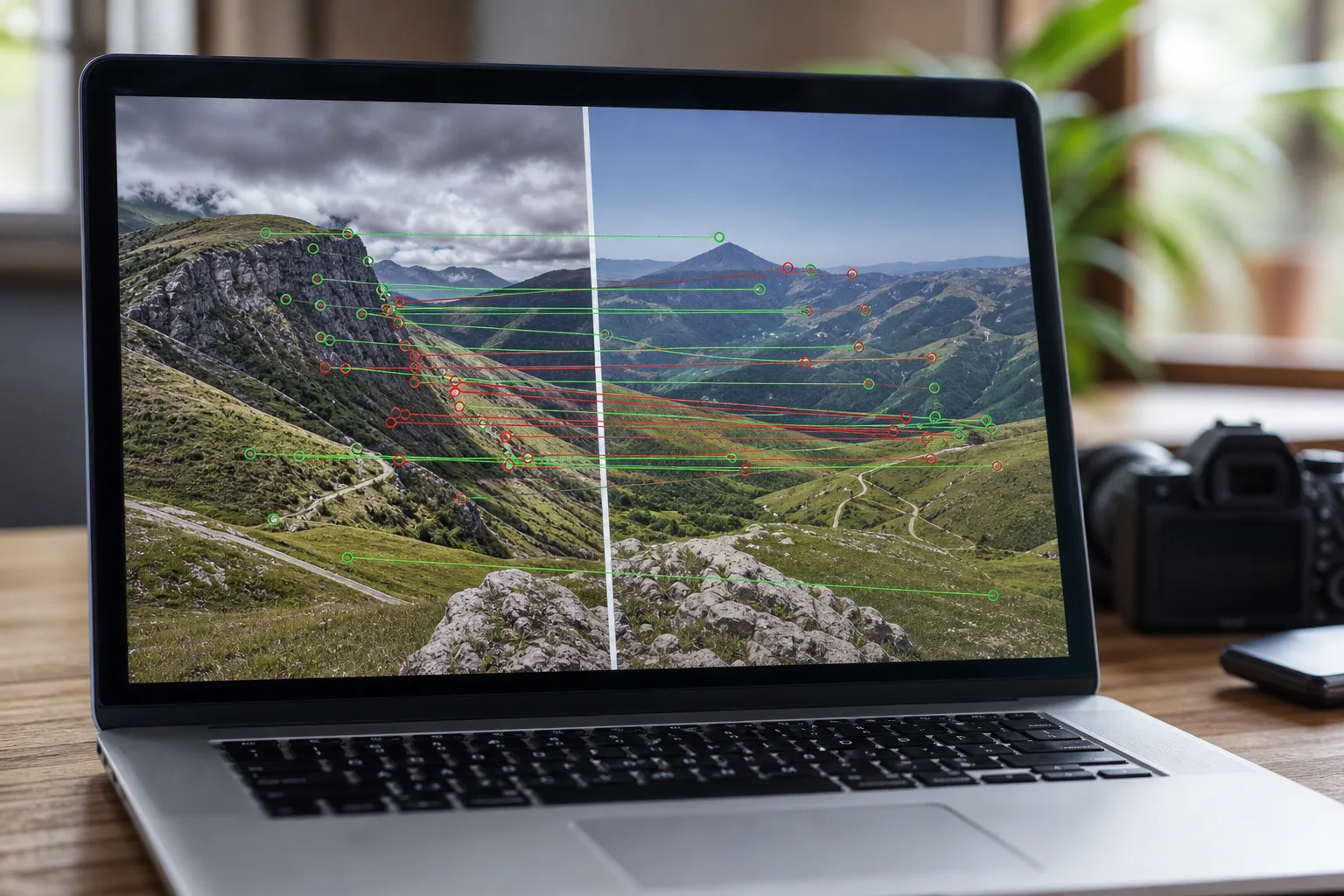
- Image alignment is the hardest technical challenge in building a multi-year time-lapse from hundreds of handheld photos.
- Classical image alignment with OpenCV’s ORB algorithm breaks down in low-texture winter scenes, requiring a neural network fallback.
- Switching from ORB to SuperPoint and LightGlue boosted frame acceptance from just 19.7% to 53.2%.
- Forcing RANSAC rotation to zero and scoring matches by LightGlue confidence were the critical fixes that made the pipeline stable.
Table of Contents
When a Personal Project Gets Seriously Hard
Image alignment doesn’t sound glamorous. But spend five minutes watching a time-lapse where the horizon bounces around like a boat in a storm, and you’ll understand immediately why it’s the make-or-break problem in this kind of project. Nicolas Fränkel, a developer who’s been documenting his environment through hundreds of photos taken from roughly the same spot over multiple years, ran headlong into exactly this wall — and the engineering rabbit hole he describes is a genuinely fascinating case study in applied computer vision.
The premise is deceptively simple: photograph the same scene across seasons and stitch the images into a time-lapse. What complicates everything is the word roughly. Fränkel isn’t a tripod. His phone changed from a Samsung S10 to an S21, and then to an iPhone 14 Pro. Each device carries a different camera with a different focal length — 4.30mm for the S10, 6.86mm for the iPhone 14 Pro. That’s a scale difference of roughly 1.6x between devices. Without correction, the landscape in the final video shifts, tilts, and warps in ways that immediately break the illusion of a continuous, stable shot. Accurate image alignment across different hardware is what holds the entire illusion together.
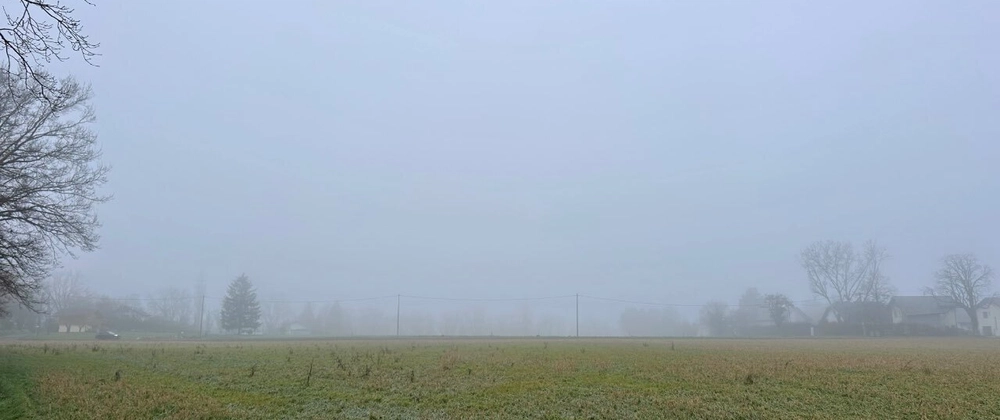
Image Alignment with OpenCV: The Classical Approach
The standard starting point for image alignment in computer vision is OpenCV, the open-source library maintained by the non-profit Open Source Vision Foundation. With over 2,500 algorithms and decades of community contributions, it’s the default toolkit for this kind of work. Fränkel started there, using an algorithm called ORB — short for Oriented FAST and Rotated BRIEF — which combines a fast keypoint detector with a compact binary descriptor.
The idea behind feature-based image alignment is straightforward in principle. Find distinctive points in both images, match them across frames, then compute a geometric transform that maps one image onto the coordinate space of the other. ORB handles the first two steps efficiently and runs well without a GPU. For the transform itself, the algorithm of choice is RANSAC — Random Sample Consensus — which estimates a best-fit geometric model while being resilient to mismatched keypoints that would otherwise corrupt the result.
Fränkel’s first attempt used a full 3×3 homography matrix, which models perspective distortion. It was a disaster. Every small error in keypoint matching got amplified into visible warping. He scaled back to a 2×3 affine transform, which handles translation and scale but not perspective — a much more stable choice when the camera hasn’t moved dramatically between shots.
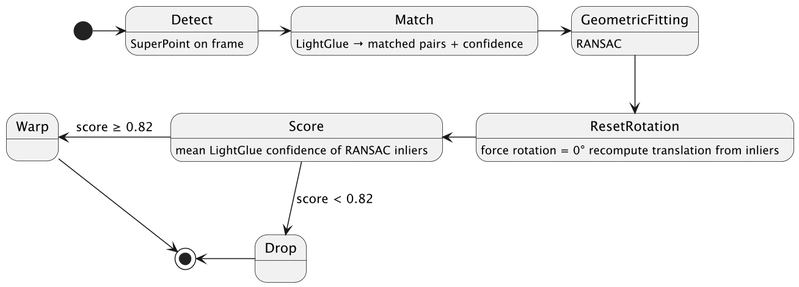
But even that wasn’t enough. RANSAC is non-deterministic by design. Run it twice on identical data and you can get slightly different rotation estimates. In a time-lapse, that means the horizon can drift subtly from frame to frame — not enough to be obviously wrong in a single frame, but deeply distracting when you’re watching dozens of frames in sequence. Fränkel’s fix was pragmatic: force rotation to zero after RANSAC runs, then recompute the translation analytically from the inlier matches. It’s a constraint that sacrifices some theoretical flexibility for real-world visual stability.
He also had to tune the scale tolerance carefully. Given that 1.6x scale difference between the Samsung and iPhone cameras, any scale gate tighter than that ratio would wrongly reject valid frames taken on different devices. This is the kind of problem that’s invisible until you think carefully about the hardware involved — a reminder that image alignment isn’t just a software problem.
Spatial Distribution and the Crop Problem
One subtler issue was where ORB keypoints actually appear in the frame. Like most classical feature detectors, ORB clusters on high-texture regions — in Fränkel’s outdoor photos, that means trees and rooftops, which tend to occupy specific corners of the image. A geometric transform fitted from keypoints all concentrated in one region of the frame will be stable there and unreliable everywhere else. Good image alignment depends on keypoints that are spread across the whole scene, not bunched into one corner.
The fix was to divide each image into a 4×4 grid and cap the number of keypoints per cell. This forces the detector to spread its attention across the whole image rather than obsessing over a single leafy tree. It’s a well-known trick in photogrammetry and visual odometry, and it made a measurable difference here.
Then there’s the output crop. When you warp an image to align it with a reference frame, the valid region — the area that actually overlaps the reference — shrinks whenever the camera was positioned far from its usual spot. If you take the intersection of all valid regions across every frame, one badly-positioned photo can shrink the output resolution for the entire project. Fränkel’s solution was to use percentiles: ignore the worst 15% of frames on each edge, compute crop boundaries from the remaining 85%, and simply drop any frame that falls outside those boundaries. It’s a sensible engineering trade-off — lose a few frames, keep a stable output size.
Where Classical Image Alignment Breaks Down
ORB works well when there’s clear texture in the scene. In winter, it doesn’t. Snow-covered fields, foggy mornings, and flat overcast skies strip away the visual features that classical descriptors depend on. There simply aren’t enough distinctive points for ORB to anchor on, and the resulting image alignment is unreliable at best and completely wrong at worst.
This is a known limitation of classical computer vision. The entire feature-matching paradigm assumes the scene has texture. When it doesn’t, you need something smarter — something that has learned what matters in an image rather than just measuring pixel gradients.
Neural Models: SuperPoint and LightGlue Take Over
Fränkel’s fallback for low-texture frames is a two-model neural pipeline. The first is SuperPoint, a self-supervised keypoint detector trained to find stable, repeatable points across widely varying lighting conditions and viewpoints. The second is LightGlue, a transformer-based matcher that takes SuperPoint’s keypoints from two images and produces matched pairs along with a confidence score for each match.
Both models run locally on Apple Silicon via MPS — Metal Performance Shaders — which means no cloud API calls, no latency waiting on a remote server, and no per-query cost. For a project processing hundreds of frames, that matters. SuperPoint’s feature extraction from the reference image is also cached at startup, so it doesn’t recompute the same embeddings hundreds of times.
The neural approach to image alignment introduced its own problem, though — a subtle one. Fränkel’s first attempt at scoring alignment quality measured the fraction of LightGlue matches that survived RANSAC filtering. Logically, that sounds right: if most matches survive, the geometry must be consistent. But almost every frame scored poorly, and he couldn’t figure out why.
The culprit was parallax. The scene has depth. When the camera shifts even slightly between two shots, objects at different distances don’t move the same way in the image plane — a bush in the foreground shifts more than a hill in the background. LightGlue was correctly matching the same real-world points across frames. But RANSAC, which assumes all matched points lie on a flat plane, was rejecting many of those geometrically correct matches as outliers because they violated the flat-world assumption. The matches weren’t wrong. The scoring metric was.
The fix was to score image alignment using the mean LightGlue confidence of only the RANSAC inliers — the matches that did fit the planar model. After some empirical tuning, Fränkel found that a score between 0.82 and 0.96 reliably indicated a well-aligned frame. The result was striking: frame acceptance jumped from 19.7% to 53.2%.
What This Pipeline Tells Us About Real-World Computer Vision
There’s a broader lesson buried in this project. Computer vision research tends to be evaluated on clean benchmark datasets — well-lit scenes, controlled conditions, consistent hardware. Real-world image alignment problems look nothing like that. They involve hardware changes mid-project, seasonal lighting extremes, depth-induced parallax, and the simple human inability to stand in exactly the same spot twice.
The hybrid approach Fränkel landed on — classical ORB for textured frames, SuperPoint and LightGlue as a neural fallback for the hard cases — is increasingly how production computer vision systems are architected. You don’t replace classical methods with neural ones wholesale; you deploy them in combination, using the faster and more interpretable classical approach where it’s adequate, and reaching for learned models when the problem gets genuinely hard.
The gap between 19.7% and 53.2% frame acceptance represents months of outdoor photography that would otherwise have been thrown away. That’s the real payoff — not an elegant algorithm, but a pipeline that’s honest about where its components fail and builds in the right fallbacks. As neural models like LightGlue get faster and lighter, that hybrid threshold will keep shifting. The question for anyone building similar systems today is how much of the classical stack is still earning its keep — and when it’s finally time to let it go.