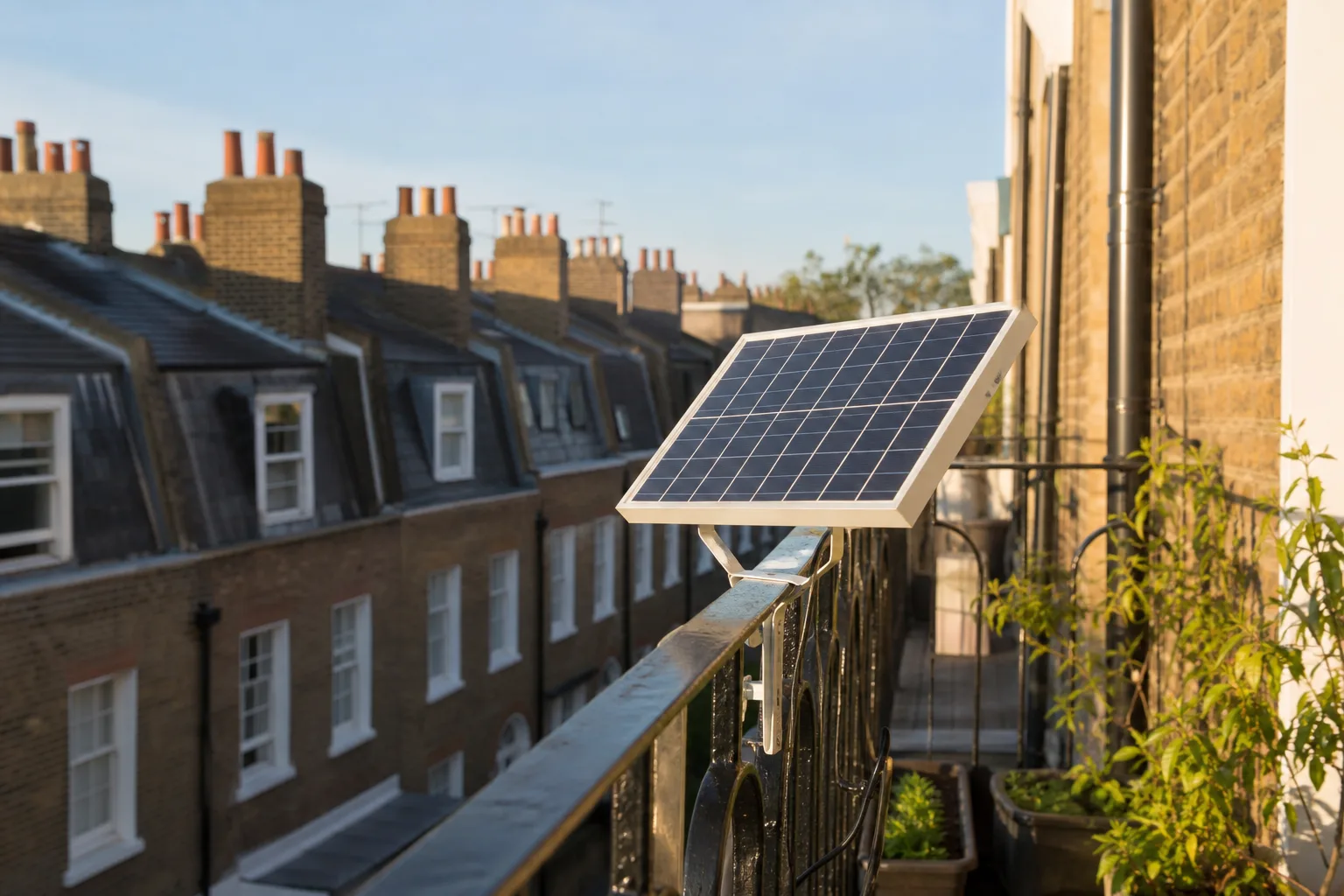
- Helios lets you calculate plug-in solar UK potential for your home using just a postcode and house number.
- The plug-in solar UK market is still in regulatory limbo — these panels are legal across Europe but not yet in Britain.
- Helios uses Environment Agency LIDAR data and ray-tracing to model shading from surrounding buildings with impressive accuracy.
- The tool estimates 20-year lifetime savings after hardware costs, defaulting to 60% self-consumption based on industry spec §3.7.
Table of Contents
The Plug-In Solar UK Problem Nobody Talks About
Plug-in solar UK interest is surging — and yet, if you tried to buy a balcony solar kit in Britain today, you’d hit a wall. These compact, no-permission-needed solar panels have been quietly transforming energy bills across Germany, the Netherlands, and France for the past few years. In Germany alone, over 400,000 so-called Balkonkraftwerke (balcony power stations) were registered in 2023. But in Britain, the regulatory framework hasn’t caught up. The kits technically aren’t approved for sale here yet, leaving renters, flat-dwellers, and anyone without a south-facing roof stuck watching the rest of Europe get cheaper electricity bills.
Into that gap steps Helios, a clever little tool built by South London Scientific that answers the obvious question: if plug-in solar UK panels were available for your home, how much would they actually generate? The answer, it turns out, depends heavily on where you live, which direction your balcony faces, and what’s sitting between you and the sun.
How Helios Models Plug-In Solar UK Yield
The technical approach here is genuinely impressive for what amounts to a side project. You enter your postcode and house or flat number. Helios then cross-references that address against Ordnance Survey data to pin down your exact location. From there, it pulls in aerial LIDAR (Light Detection and Ranging) data from the Environment Agency — the same kind of high-resolution 3D terrain mapping used in flood modelling and urban planning — and ray-traces the surrounding buildings to calculate shading throughout the day and year.
That shading calculation is then fed into PVGIS, the EU’s Photovoltaic Geographical Information System, which returns an estimated annual energy yield based on real historical solar irradiance data for that location. The result is a month-by-month generation estimate that accounts for your specific urban environment, not just a generic regional average.
What Helios doesn’t do is store any of your data. There’s no database, no account creation, no tracking. Your address is used to run the plug-in solar UK calculation and then discarded. In an era when every app wants to harvest your location history, that’s a refreshingly minimal approach.
What the Numbers Actually Mean for Your Bills
Helios goes beyond raw generation figures and tries to translate kilowatt-hours into money. That’s where the assumptions get interesting — and where users need to pay close attention to the small print.
The tool defaults to a 60% self-consumption rate, drawn from industry specification §3.7. In practice, self-consumption — the proportion of solar energy you use yourself rather than export back to the grid — varies significantly depending on whether you’re home during the day, whether you run appliances like dishwashers and washing machines during daylight hours, and what your overall consumption profile looks like. A remote worker with a home office will self-consume far more than someone out of the house nine to five.
On the export side, Helios makes a pragmatic but slightly gloomy assumption: exported energy earns nothing. That’s because most plug-in solar UK kits can’t qualify for the UK’s Smart Export Guarantee, which requires a Microgeneration Certification Scheme (MCS) installation. Standard plug-in kits — the whole point of which is that they don’t need professional installation — fall outside that framework. So any surplus power you push back to the grid is essentially gifted to your energy supplier.
The savings calculation does handle time-of-use tariffs like Octopus Energy’s Agile tariff using a typical-day model, which is thoughtful given how much those tariffs have grown in popularity. Outputs include annual savings and a 20-year lifetime savings figure net of capital expenditure — a genuinely useful number for working out whether the upfront cost of the kit makes sense.
A Note on Accuracy
Helios is transparent about the limitations of its estimates. Real-world yield depends on weather variability, how carefully you install the panel, the specific kit you buy, and how your electricity use shifts over time. The tool recommends refreshing the estimate quarterly, which is a reasonable acknowledgement that energy prices — and your consumption habits — aren’t static.
Why the Regulatory Situation Is Holding Britain Back
The elephant in the room is that none of this matters until Britain actually allows these products to be sold. Plug-in solar UK panels are already legal and widely available in Germany, Austria, France, the Netherlands, and several other European countries, often with minimal or no planning permission required. Germany’s regulations allow systems up to 800W to be plugged directly into a standard household socket after simple registration. The UK has no equivalent framework.
The issue is partly about grid safety standards and partly about the speed of regulatory reform. UK Power Networks and other distribution network operators have raised concerns about the impact of large numbers of unregistered micro-generators on local grid stability — concerns that are legitimate but arguably manageable with the right standards in place. BEAMA, the UK’s trade association for manufacturers of electrical infrastructure, has been engaged in discussions about creating a pathway for these products, but progress has been slow.
Helios is directly tracking the plug-in solar UK regulatory situation and inviting users to leave their email address to be notified when kits become available in the UK. It’s a smart waitlist strategy that also signals genuine demand to anyone in the policy or product supply chain paying attention.
Who Should Actually Use This Tool
Helios is most useful for three groups of people. First, renters and flat owners who’ve assumed solar is not for them — this tool might reveal that a south-facing balcony could generate more than expected, making the case for waiting out the plug-in solar UK regulatory timeline. Second, homeowners who are weighing plug-in solar against a full rooftop MCS installation — the numbers here can help frame the trade-off between low upfront cost and higher long-term returns. Third, policy watchers and energy nerds who want a concrete, data-driven illustration of why Britain’s regulatory lag on this technology has real costs for real households.
The tool won’t tell you what kit to buy or guarantee your savings. But it does something arguably more valuable right now: it makes the abstract concrete. Instead of wondering vaguely whether balcony solar might be worth it, you get a specific number for your specific address, calculated from actual 3D building geometry and real irradiance data.
The Bigger Picture for UK Household Energy
Britain has set ambitious targets for decarbonising home energy, and the government’s Warm Homes Plan puts significant emphasis on expanding low-carbon technology adoption. Yet the country continues to lag behind European neighbours on accessible, low-barrier solar options. Full rooftop installations remain expensive — typically £5,000 to £10,000 — and are simply not viable for the millions of people who rent or live in flats.
Plug-in solar UK adoption could represent a meaningful chunk of distributed generation if the regulatory barriers come down. Germany’s experience suggests demand is not the problem — when the products are legal, accessible, and affordable, people buy them. Tools like Helios help build that demand by making the potential plug-in solar UK savings tangible before the products even hit shelves. That’s a smart play, and if the UK government is paying attention to the waitlist numbers, it might even nudge the regulatory timeline along.