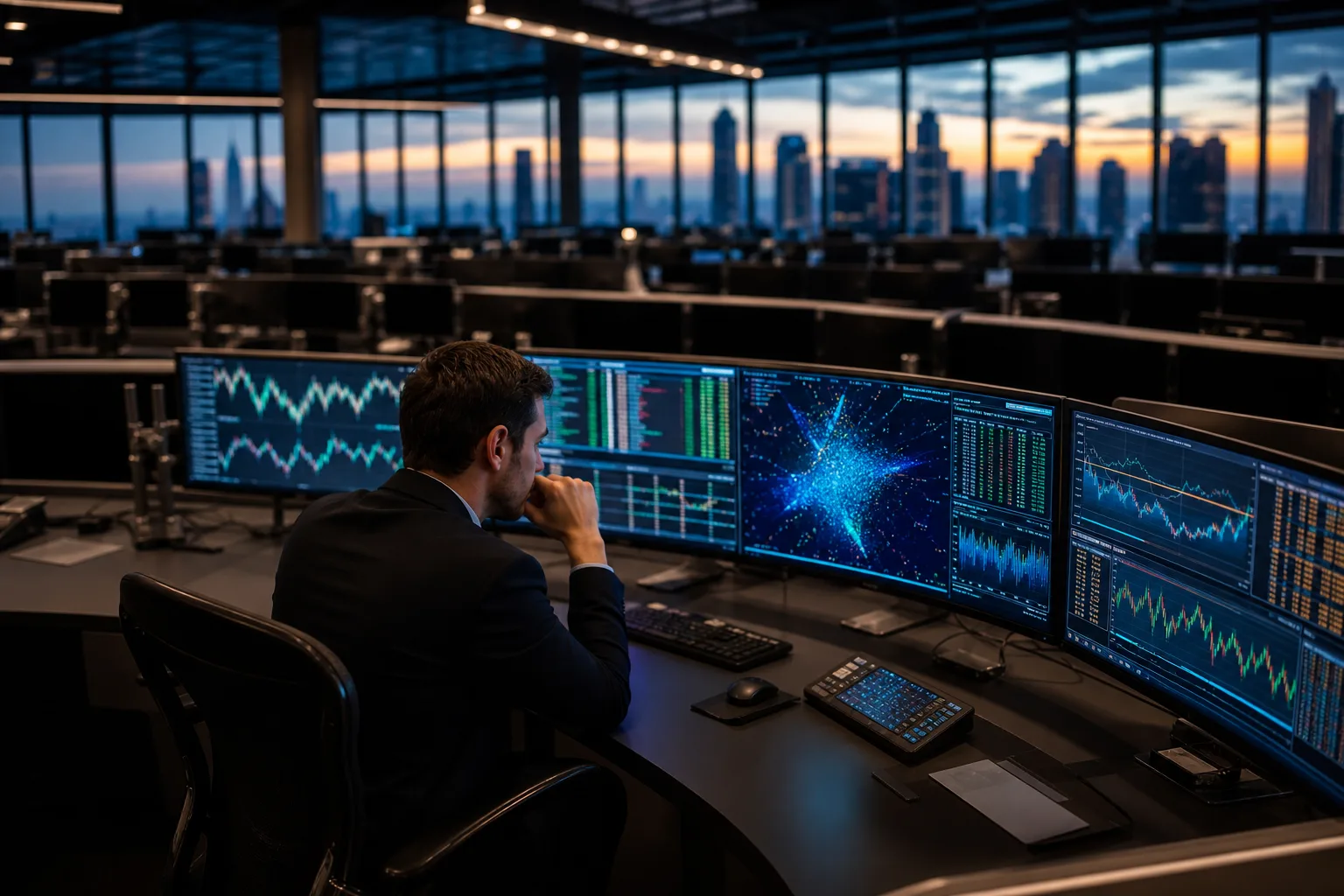
- Wall Street HALO is emerging as a structured approach for investors seeking protection from AI-driven portfolio losses.
- Wall Street HALO targets the growing risk that algorithmic and AI trading systems introduce into traditional market positions.
- Institutional interest in AI hedging strategies has accelerated sharply as machine-learning models gain more market influence.
- The strategy reflects a broader reckoning on Wall Street with how deeply AI has reshaped trading dynamics and risk exposure.
Table of Contents
Wall Street HALO and the New Shape of Market Risk
Wall Street HALO is drawing serious attention from investors who are increasingly worried about a risk category that barely registered five years ago — losses triggered not by bad earnings or geopolitical shocks, but by the AI systems that now do much of the trading. It’s a niche concern that has rapidly become a mainstream one, and the fact that a structured product is being built around it says a lot about how much the market landscape has shifted.
For most of financial history, the biggest threats to a portfolio were fairly legible: recessions, rate hikes, currency swings, a badly timed earnings miss. Human traders made bad calls, but those calls were at least decipherable in retrospect. What’s different about AI-driven volatility is its speed, its opacity, and its tendency toward feedback loops. When multiple machine-learning systems are trained on similar data and react to the same market signals at the same millisecond, the resulting moves can be both extreme and almost impossible to attribute after the fact.
That’s the problem Wall Street HALO is designed to address.
Why Algorithmic Trading Has Changed the Risk Equation
The numbers are hard to ignore. Algorithmic and high-frequency trading now accounts for a substantial and dominant share of all equity volume in the United States. That’s not a fringe phenomenon — it’s the dominant mode of market participation. And as large language models and more sophisticated machine-learning architectures get embedded into portfolio management and execution systems, the character of that algorithmic activity is changing.
Earlier generations of algo trading were largely rules-based. A system would execute a trade when price crossed a certain threshold, or when a spread between two correlated assets widened beyond a defined limit. Predictable, almost mechanical. The newer AI-driven systems are different. They’re adaptive, they learn from their own outputs, and they operate on pattern recognition across datasets that no human analyst could process in real time.
The upside is obvious: faster execution, fewer emotional errors, better processing of complex signals. The downside is that these systems can also amplify instability in ways that are genuinely hard to anticipate. The SEC has been monitoring high-frequency and algorithmic trading risks for years, but the integration of true AI — systems that adapt and evolve — introduces variables that even experienced regulators are still working to understand.
For institutional investors with large, diversified portfolios, the worry isn’t just that AI trading causes flash crashes. It’s subtler than that. It’s the slow bleed of positions being systematically undercut by systems that can identify and act on pricing inefficiencies faster than any human-managed fund can respond. It’s correlation risk — the danger that during stress events, AI systems across different firms all make the same exit trade at the same time, collapsing the liquidity that a portfolio manager was counting on.
What Wall Street HALO Actually Offers
Wall Street HALO positions itself as a targeted hedge against this specific category of risk. Where traditional hedging tools — put options, volatility instruments like VIX-linked products, inverse ETFs — protect against broad market downturns, a product like HALO is calibrated to the behavioural fingerprint of AI trading systems. That’s a meaningfully different design goal.
The logic is that if you can model how AI systems are likely to behave under various market conditions, you can construct positions that profit — or at least hold their value — when those systems create dislocations. It’s essentially building a hedge against the hedgers, or more precisely, against the machines that have largely replaced human hedgers at the execution layer.
Whether that modelling is reliable enough in practice to justify the strategy is the critical question. AI trading systems aren’t static. They update, retrain, and adapt. A hedge that’s calibrated to the behavioural patterns of today’s models may find itself misaligned with how those models operate six months from now. That’s a genuine structural challenge, and any investor considering a product like HALO should be asking hard questions about how the underlying model is maintained and updated over time.
The Broader Trend: Wall Street Is Finally Pricing in AI Risk
What’s most significant about Wall Street HALO isn’t the specific mechanics of the product — it’s what its existence tells us about where institutional thinking has arrived. Until recently, the conversation around AI and financial markets was almost entirely focused on the upside: better predictions, faster execution, superior risk-adjusted returns. The idea that AI trading systems themselves represented a systemic risk was treated as an academic concern, not a portfolio management one.
That’s changing. Money managers who lived through past flash crash events — when algorithmic trading contributed to sudden and severe market dislocations before partially recovering — have long had a healthy respect for what automated systems can do when things go wrong. But today’s AI systems are considerably more capable, more interconnected, and more deeply embedded in market infrastructure than anything that existed in earlier years.
The emergence of dedicated hedging products like Wall Street HALO reflects a maturation in how the industry thinks about AI-related risk. It’s moving from theoretical to actuarial — from “this could be a problem” to “here’s how we price and manage it.” That’s a significant shift, and it mirrors what happened with cybersecurity risk over the past decade, as something once dismissed as an IT problem became a board-level financial exposure that now has its own insurance market.
What Investors Should Be Asking
For anyone taking a serious look at Wall Street HALO or similar products, a few questions cut to the heart of whether the proposition holds up. First, how transparent is the underlying model? If the strategy is genuinely calibrated to AI trading behaviour, the methodology should be explainable, even if the full proprietary detail isn’t disclosed. Opacity in a product designed to manage opacity is a red flag.
Second, what’s the cost of carry? Hedging always has a price, and a strategy targeting a fairly specific risk category may be expensive relative to the protection it provides in benign market conditions. The calculus only works if the protection kicks in when it’s genuinely needed and the premium paid in quieter periods is justifiable.
Third — and this is the one most investors will be tempted to skip — how does the product perform in the exact scenario it’s designed for? Back-testing against historical AI-driven volatility events is useful but imperfect, because the AI systems of two years ago aren’t the ones operating in markets today. Stress-testing methodology matters enormously here.
The broader point is that AI-driven market risk is real, it’s growing, and the financial industry is only beginning to build the tools to manage it systematically. Wall Street HALO may or may not be the best answer — but the fact that credible institutional products are being developed to address this risk class is itself a signal worth paying attention to. The question now isn’t whether AI changes the investment risk landscape. That debate is settled. The question is how fast the hedging infrastructure can evolve to keep pace with the systems it’s trying to account for.
Frequently Asked Questions
What is Wall Street HALO and how does it protect investors?
Wall Street HALO is an investment strategy designed to shield portfolios from losses driven by AI-powered trading systems. As algorithmic models increasingly dominate market activity, HALO offers a structured hedge that aims to offset the volatility and unpredictability those systems can introduce into traditional positions.
Why are AI-driven losses becoming a bigger concern for investors?
AI and algorithmic trading now account for a significant share of daily market volume. When these systems react simultaneously to the same signals, they can trigger sharp, rapid moves that catch traditional investors off guard. That systemic risk is pushing more money managers to look for dedicated hedging tools.
Is Wall Street HALO suitable for retail investors or just institutions?
Based on its structure and the complexity involved, Wall Street HALO appears aimed primarily at institutional investors and sophisticated money managers. Retail investors may find the strategy difficult to access directly, though its underlying principles could filter into ETFs or managed products over time.
How does Wall Street HALO differ from traditional hedging strategies?
Traditional hedges like put options or volatility products protect against broad market downturns. Wall Street HALO is specifically calibrated to the behavioural patterns of AI trading systems, making it a more targeted tool for a risk category that didn’t meaningfully exist a decade ago.