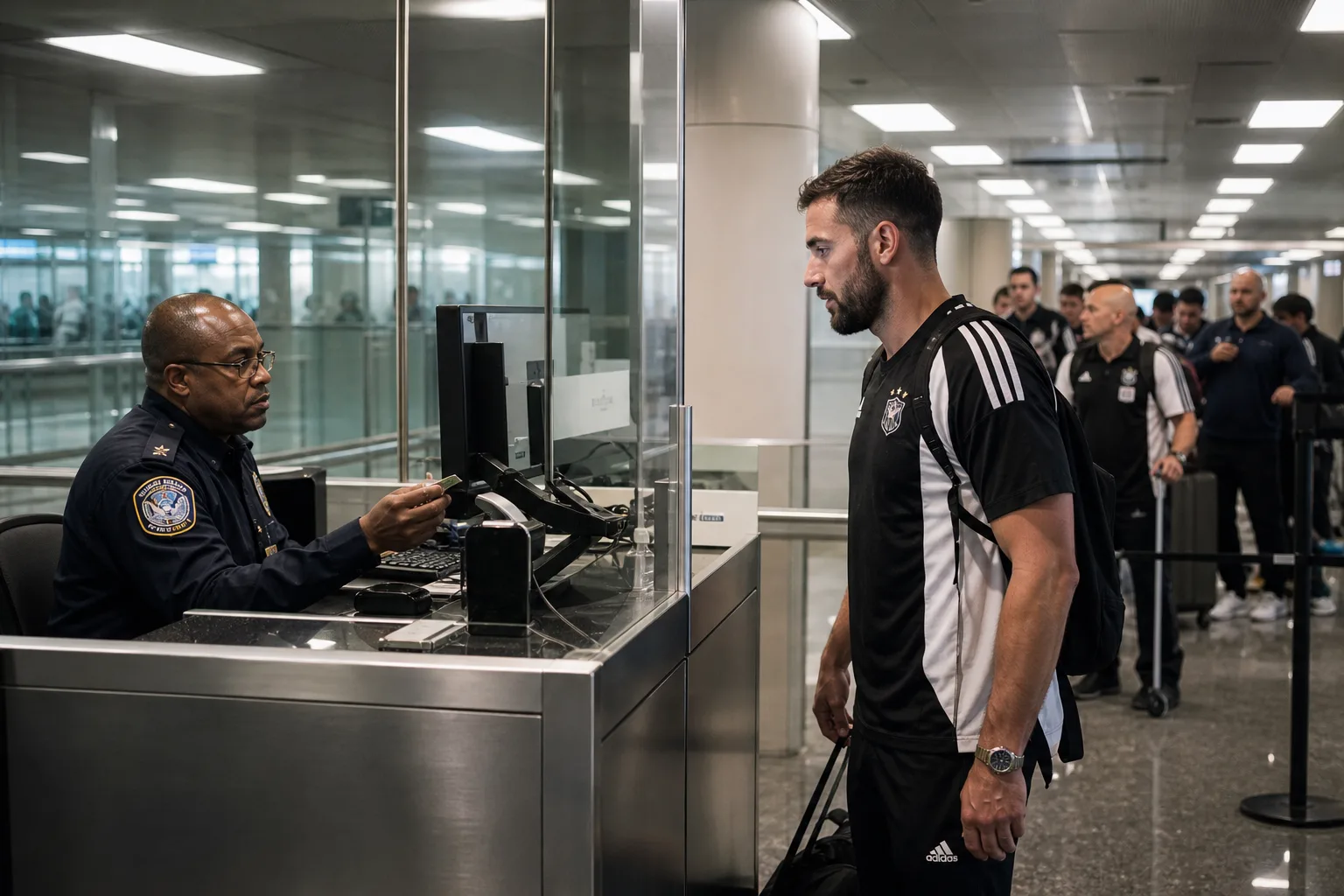
The World Cup 2026 visa crisis was always coming. The moment FIFA awarded a joint hosting bid to the United States, Canada, and Mexico — a historic three-nation arrangement meant to symbolise continental unity — the collision between international football and US immigration policy was practically inevitable. Now, weeks before the opening whistle on June 11, that collision is happening in real time, at border crossings, in airport interrogation rooms, and in the offices of consular officials who hold enormous power over who gets to participate in the world’s most-watched sporting event.
- The World Cup 2026 visa crisis is affecting players, coaches, and officials from at least four competing nations before the tournament even begins.
- Iran’s national team faces the tightest World Cup 2026 visa conditions, forced to train in Tijuana and enter the US only on match days.
- Somali referee Omar Artan was denied entry at Miami despite holding a valid visa and FIFA credentials, raising serious equal-access questions.
- FIFA has deflected responsibility, saying immigration decisions are the host nations’ domain — a stance critics find deeply uncomfortable.
Table of Contents
The World Cup 2026 Visa Problem Nobody Wanted to Talk About
Thirty-nine countries currently face full or partial US travel bans under the Trump administration’s immigration framework. Four of those countries — Haiti, Iran, Senegal, and Côte d’Ivoire — have qualified for the 2026 World Cup. That’s not a footnote. That’s a structural problem baked into the tournament before a single training session takes place on American soil. Every affected delegation has had to navigate the World Cup 2026 visa process under conditions no other competing nation faces.
Human rights organisations have already flagged the situation. The concern isn’t hypothetical: it’s that a tournament explicitly designed to be the most inclusive in World Cup history — the first ever played across three countries — risks becoming a showcase of selective access, where a player’s ability to compete depends not on their skill or their federation’s preparations, but on their nationality and how it intersects with Washington’s current geopolitical mood.
FIFA sold the 2026 bid partly on the premise of scale and openness. More venues, more matches, more fans from more places. What it didn’t — or couldn’t — fully account for was that one of its three host nations would, by tournament time, be running the most aggressive border enforcement posture in decades. The result is a World Cup 2026 visa environment that has caught multiple delegations off guard.
Iran: Training in Tijuana, Playing Under a Clock
The most dramatic illustration of the World Cup 2026 visa situation involves Iran. The geopolitical tension between Washington and Tehran is hardly new, but its impact on a football squad is jarring. Iran’s players did eventually receive US visas — but the conditions attached to those visas are unlike anything applied to any other competing nation.
According to Iran’s ambassador to Mexico, Abolfazl Pasandideh, the team is permitted to enter the United States only on the specific day of each match. No acclimatisation time. No early arrival. And once the final whistle blows, they must leave immediately. Not the next morning. Not after a recovery day. Immediately.
The practical consequence of this? Iran’s training camp is now based in Tijuana, Mexico. The federation had originally planned to prepare in Tucson, Arizona — a sensible choice given the climate and facilities. That plan is gone. Instead, the squad will cross the border to play, then return to Mexican territory each time. It’s a logistical arrangement that has no precedent in modern World Cup history, and it stands as the starkest example yet of how a World Cup 2026 visa restriction can translate directly into competitive disadvantage.
And that’s just the players. At least 15 federal officials and support staff from the Iranian delegation are still waiting on World Cup 2026 visa decisions. Others have reportedly been denied outright. Running a competitive national team program with incomplete staffing and no ability to settle into a host country environment isn’t a minor inconvenience — it’s a genuine sporting disadvantage imposed entirely by administrative policy.
Iraq’s Striker Detained, Photographer Turned Away
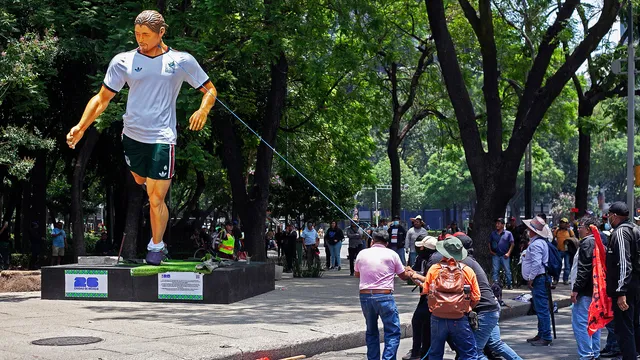
If Iran’s case represents a World Cup 2026 visa issue at the systemic level, Iraq’s experience shows what it looks like at the human level. Aymen Hussein, the striker whose goals were central to Iraq qualifying for their first World Cup in decades, landed at Chicago’s O’Hare International Airport and was held for approximately seven hours. Questioned, screened, scrutinised. Eventually cleared — but not before an ordeal that left a visible mark.
Hussein didn’t stay quiet about it. He publicly questioned why the United States would choose to host a World Cup while treating so many foreign visitors with suspicion. It’s a fair question, and one that American sports diplomacy has no clean answer to right now.
Worse is the case of Talal Salah, the Iraqi national team’s official photographer. After around ten hours at Chicago airport checkpoints, US Customs and Border Protection denied him entry. CBP confirmed the denial following ‘additional screening’ — that phrase doing a lot of work to describe a decision that effectively removed a credentialled media professional from a World Cup delegation. Salah’s exclusion isn’t just a personal injustice; it’s a logistical blow to a national team that deserves the same documentation and media support as every other squad at the tournament. His situation also highlights how the World Cup 2026 visa challenge extends beyond players to every member of a competing nation’s official party.
A FIFA Referee Denied Entry With a Diplomatic Passport
Perhaps the single most striking case in the World Cup 2026 visa saga is that of Omar Abdulkadir Artan. The Confederation of African Football named him the best African referee of 2025. He was selected by FIFA — specifically by Pierluigi Collina, the president of FIFA’s referees’ committee — to officiate at the 2026 World Cup. He would have been the first Somali national ever to referee a World Cup match.
Artan flew from Istanbul to Miami with a diplomatic passport and a properly issued US visa. CBP stopped him on arrival, subjected him to additional checks, and then denied him entry, citing ‘vetting concerns.’ Artan told The New York Times that he ‘had the right papers’ and showed officials his FIFA documentation. None of it mattered.
This case is in a different category to the others. Artan wasn’t a fan, wasn’t an athlete from a politically complicated country, and wasn’t part of a national delegation subject to bilateral tensions. He was a tournament official, appointed by the governing body of world football, carrying diplomatic credentials. His World Cup 2026 visa had been properly issued — and still wasn’t enough. If that combination isn’t sufficient to clear US border control, it’s worth asking what standard any international visitor is actually being held to — and whether that standard is being applied consistently.
FIFA’s response? A statement acknowledging CBP’s decision and noting that ‘immigration procedures are the responsibility of the host nations.’ That’s technically accurate. It’s also a remarkably passive stance from an organisation that has, historically, shown considerably more muscle when commercial interests are threatened than when the human rights of its own officials are at stake.
Uzbekistan, Senegal, and a Pattern Emerging
The scrutiny isn’t limited to nations explicitly under travel bans. Uzbekistan — making its historic first World Cup appearance under Italian coaching legend Fabio Cannavaro — was subjected to an extensive security sweep before a June 8 friendly against the Netherlands at New York’s Icahn Stadium. Players and staff were removed from their bus and lined up individually for metal detector checks, personal searches, and luggage inspections. Bags were laid out on the ground, item by item. Cannavaro himself was among the first processed.
Senegal, whose squad falls under a partial US travel restriction, faced similar treatment on arrival — individual searches and baggage checks at the airport, before the team had even left the terminal. Every member of the delegation encountered the World Cup 2026 visa and entry process as an obstacle rather than a formality. Amnesty International has already raised concerns about how the tournament environment interacts with fundamental freedoms, warning that the 2026 World Cup risks becoming a test case for whether major international sporting events can actually be held in countries with highly restrictive immigration regimes.
That’s the broader question this tournament is now forcing into the open. The incidents affecting Arab and Muslim delegations in particular — Iraq, Iran, Somalia, now Senegal — have a pattern that’s hard to dismiss as coincidence. It reflects an enforcement culture, not just individual decisions.
What This Means for Sport, Diplomacy, and Future Tournaments
The 2026 World Cup was supposed to be a soft-power moment for North America — a demonstration that the continent could host football at its most global, most spectacular scale. The United States, in particular, has been building toward this tournament for years, with Major League Soccer’s growth, upgraded stadiums, and a genuine surge in domestic football culture providing the backdrop.
Instead, the pre-tournament story is about who can’t get in. Or who got in only after hours of interrogation. Or who got sent home despite carrying FIFA credentials and a diplomatic passport. The World Cup 2026 visa issue has become the defining narrative of the build-up in a way that no host nation or governing body would have chosen.
There are real questions here for FIFA about future hosting decisions. The organisation’s current framework essentially outsources immigration compliance to host nations, then steps back when those nations make decisions that directly harm the tournament’s participants. That model may have been workable when hosting was concentrated in Europe, where Schengen Area freedom of movement largely removed the problem. It’s clearly not workable when the host is running an aggressive border enforcement agenda.
The IOC faced versions of this question for Beijing 2022 and is facing it again for Los Angeles 2028. FIFA will face it at every future tournament in countries with restrictive regimes — whether those restrictions are politically motivated, security-driven, or both. The World Cup 2026 visa crisis isn’t just a pre-tournament headache. It’s a preview of the governance challenge that international sport hasn’t figured out how to solve.
Frequently Asked Questions
Which countries are most affected by the World Cup 2026 visa crisis?
Iran, Iraq, and Somalia are the most prominently affected so far. Iran’s squad can only enter the US on match days. Iraq’s star striker was detained for several hours at O’Hare, and Somalia’s top referee was denied entry entirely at Miami despite holding valid credentials.
How many countries face US travel bans heading into the 2026 World Cup?
As of the tournament’s lead-up, 39 countries face full or partial US travel bans. Of those, four — Haiti, Iran, Senegal, and Côte d’Ivoire — have qualified for the 2026 World Cup, creating direct conflicts between tournament participation and US immigration policy.
What is FIFA’s position on the World Cup 2026 visa and immigration issues?
FIFA has acknowledged the individual cases but distanced itself from the decisions, stating that immigration procedures fall under the responsibility of host nations. Critics argue that FIFA’s stance contradicts the tournament’s stated commitment to inclusivity.
Why is Iran’s team training in Tijuana instead of the US?
Because US authorities granted Iran’s players only day-of-match entry clearances, prohibiting them from remaining in the country between games. The Iranian federation relocated its training base to Tijuana, Mexico, abandoning its initially planned venue in the US, so players can cross the border solely to play, then return immediately.