


The SpaceX crypto IPO was supposed to be a milestone moment — proof that blockchain-based platforms could bring ordinary retail investors into the hottest public offerings on the planet. Instead, it became an embarrassing reminder of just how fragile the infrastructure behind tokenized real-world assets still is. On Friday, as SpaceX made its landmark debut on the Nasdaq, four major crypto exchanges — Bybit, Binance, Bitget Wallet, and MEXC — quietly canceled their tokenized IPO campaigns and began issuing refunds.
- The SpaceX crypto IPO fell apart for users on Bybit, Binance, Bitget Wallet, and MEXC when xStocks couldn’t deliver underlying assets.
- Binance alone had collected over $557 million in USDC deposits for its SpaceX crypto IPO campaign before canceling.
- SpaceX shares surged from a $135 IPO price to close at $161.11, valuing the company above $2 trillion on its first day.
- The failed rollout is a significant trust setback for crypto platforms trying to offer retail access to high-demand public listings.
Table of Contents
What the SpaceX Crypto IPO Was Supposed to Be
The premise was genuinely compelling. SpaceX’s IPO was one of the most anticipated listings in years — a company that had transformed the rocket industry, won billions in NASA contracts, and built a satellite internet business in Starlink that’s now operationally profitable. Getting retail exposure to that kind of listing is nearly impossible through traditional brokerage channels, where institutional allocations dominate and the average investor is lucky to buy shares at the open market price, often well above the IPO price itself.
Crypto platforms spotted the gap. If they could tokenize SpaceX shares via a compliant intermediary, they could offer their millions of users fractional, accessible exposure to the IPO before shares hit the open market. It was an elegant pitch, and the demand backed it up. Binance’s campaign alone pulled in over $557 million in USDC deposits from users eager to participate. Bybit launched a dedicated product it branded ‘Bybit IPO Express.’ Bitget Wallet and MEXC ran their own parallel campaigns. The SpaceX crypto IPO, at least on paper, looked like it had serious momentum.
Why It All Fell Apart — xStocks at the Center
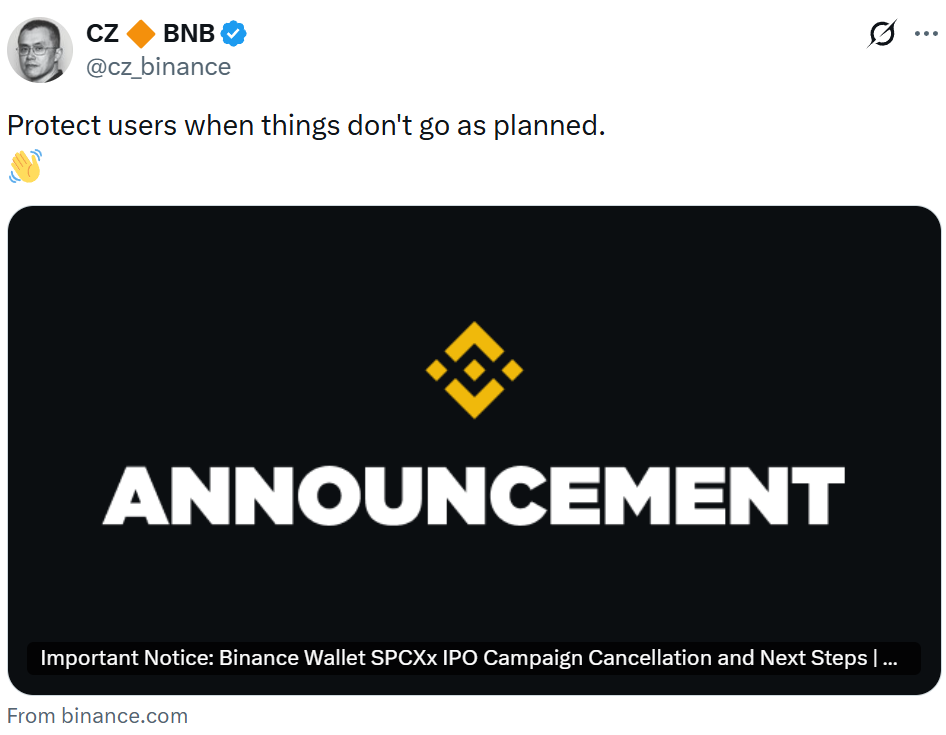
The infrastructure holding all of this together was xStocks, a tokenized equities platform owned by Kraken. Every one of the four exchanges that canceled their SpaceX crypto IPO campaigns was relying on xStocks to source and deliver the underlying assets — the real shares that give tokenized versions their value. When xStocks failed to deliver those assets, the entire chain collapsed simultaneously.
Bybit was among the first to go public with the bad news. The exchange announced directly: ‘Due to xStocks’ inability to deliver the underlying assets, no SpaceX allocations were received. As a result, subscribed users will not receive SpaceX allocations.’ Binance followed, attributing the failure to ‘circumstances outside of our control’ — a phrase that carries its own kind of frustration when half a billion dollars of user deposits are on the line.
Bitget Wallet COO Alvin Kan took a more candid tone on X, writing: ‘It’s disappointing that this didn’t work out in the end. We are in the process of sending out the refunds. Yes, we have hit a setback, and trust in the industry has taken a blow, but we’ll come out of this stronger.’ It’s the kind of statement that’s hard to argue with in the moment, but it also can’t paper over the fact that users who were hoping to capture SpaceX’s first-day gains were left with nothing but their original USDC back in their wallets.
How Much Those Missed Gains Actually Cost
The timing could hardly have been worse. SpaceX’s Nasdaq IPO was reportedly more than four times oversubscribed, raising $75 billion and debuting at $150 per share against an IPO price of $135. By the time Friday’s session closed, the stock was sitting at $161.11 — a gain of roughly 19% from the IPO price on a single day. The company’s valuation crossed $2 trillion, putting it in rarefied company alongside Apple, Microsoft, and Nvidia.
For any user who had deposited funds into one of these SpaceX crypto IPO campaigns, that first-day performance represents a genuine opportunity cost. The refunds are real — there’s no indication anyone is being held out of pocket — but the chance to participate in one of the most successful opening days in recent IPO history is gone. And since these platforms couldn’t fill the orders at the IPO price, users who still want SpaceX crypto IPO exposure will be buying in the open market, almost certainly at a premium.
The Bigger Problem: Tokenized Real-World Assets Still Aren’t Ready
The SpaceX crypto IPO fiasco points to a structural problem that the industry hasn’t fully solved yet. Tokenizing real-world assets — equities, bonds, real estate, commodities — is one of the most discussed opportunities in the entire crypto space. The theory is sound: wrap a traditional financial asset in a token, make it programmable, divisible, and accessible 24/7 on a blockchain. The execution is where things keep getting complicated.
The challenge isn’t just technical. It’s regulatory, custodial, and operational. To tokenize a share of SpaceX stock meaningfully, some entity has to hold the actual underlying shares in a regulated, auditable structure. That entity — in this case xStocks — has to coordinate with brokers, custodians, clearing houses, and the issuing company’s transfer agents. During a hot IPO with massive allocation demand and compressed timelines, that coordination has to work perfectly. On Friday, it didn’t.
What’s notable is that this wasn’t a small or obscure platform failing quietly. Binance is the largest crypto exchange in the world by trading volume. Bybit consistently ranks among the top three. The combined user base of the four affected platforms runs into the hundreds of millions. If the SpaceX crypto IPO model can’t hold up under that kind of pressure from those kinds of operators, the questions it raises about the underlying infrastructure are serious ones.
What Happens Next for Crypto Platforms and Tokenized IPOs
The damage here isn’t financial — refunds appear to be going through, and users aren’t permanently out of pocket. The damage is reputational, and it’s twofold. First, it reflects on the exchanges themselves, who took deposits and made promises they ultimately couldn’t keep. Second, and perhaps more significantly, it reflects on xStocks and the broader tokenized equities ecosystem that was supposed to be the bridge between crypto and traditional finance.
Kraken has been building xStocks as a core part of its expanded product vision, and this is a painful early stumble. The company will need to explain clearly what went wrong in the SpaceX crypto IPO delivery chain — whether it was an allocation issue with the IPO process itself, a licensing or regulatory constraint, a custodial failure, or something else entirely — if it wants exchanges to trust it with the next high-profile listing.

For the crypto exchanges involved, the path forward probably involves more redundant sourcing, clearer contractual guarantees from infrastructure partners, and more conservative public commitments before an underlying allocation is actually confirmed. Running a $557 million deposit campaign on the assumption that a third-party provider will deliver is the kind of operational risk that, in hindsight, needed a much harder backstop.
The ambition behind the SpaceX crypto IPO wasn’t wrong. Giving retail crypto users real, meaningful access to top-tier public offerings is a genuinely useful thing to build. But ambition without reliable execution just creates the kind of story that regulators bookmark and competitors exploit. The next tokenized IPO campaign from any of these platforms will launch into a market of users who remember this SpaceX crypto IPO failure — and they’ll be watching much more carefully.
Frequently Asked Questions
Why did the SpaceX crypto IPO allocations fail on Binance and Bybit?
Multiple crypto exchanges relied on Kraken-owned xStocks to supply the underlying tokenized SpaceX shares. When xStocks was unable to deliver those assets on IPO day, every platform depending on it — including Binance, Bybit, Bitget Wallet, and MEXC — was forced to cancel and refund users.
How much money did Binance collect for its SpaceX tokenized IPO campaign?
Binance’s tokenized SpaceX IPO campaign attracted more than $557 million in USDC deposits before the exchange announced it could not proceed due to ‘circumstances outside of our control.’ All deposited funds are being returned to affected users.
What is xStocks and who owns it?
xStocks is a tokenized equities platform owned by Kraken. It was the intended infrastructure layer for several crypto exchanges’ SpaceX IPO campaigns, responsible for sourcing and delivering the underlying assets that back the tokenized versions offered to crypto users.
Did SpaceX’s actual IPO succeed despite the crypto chaos?
Yes. SpaceX’s Nasdaq IPO was reportedly more than four times oversubscribed, raising $75 billion. Shares opened at $150 against a $135 IPO price and closed the first day at $161.11, giving the company a market valuation above $2 trillion.

