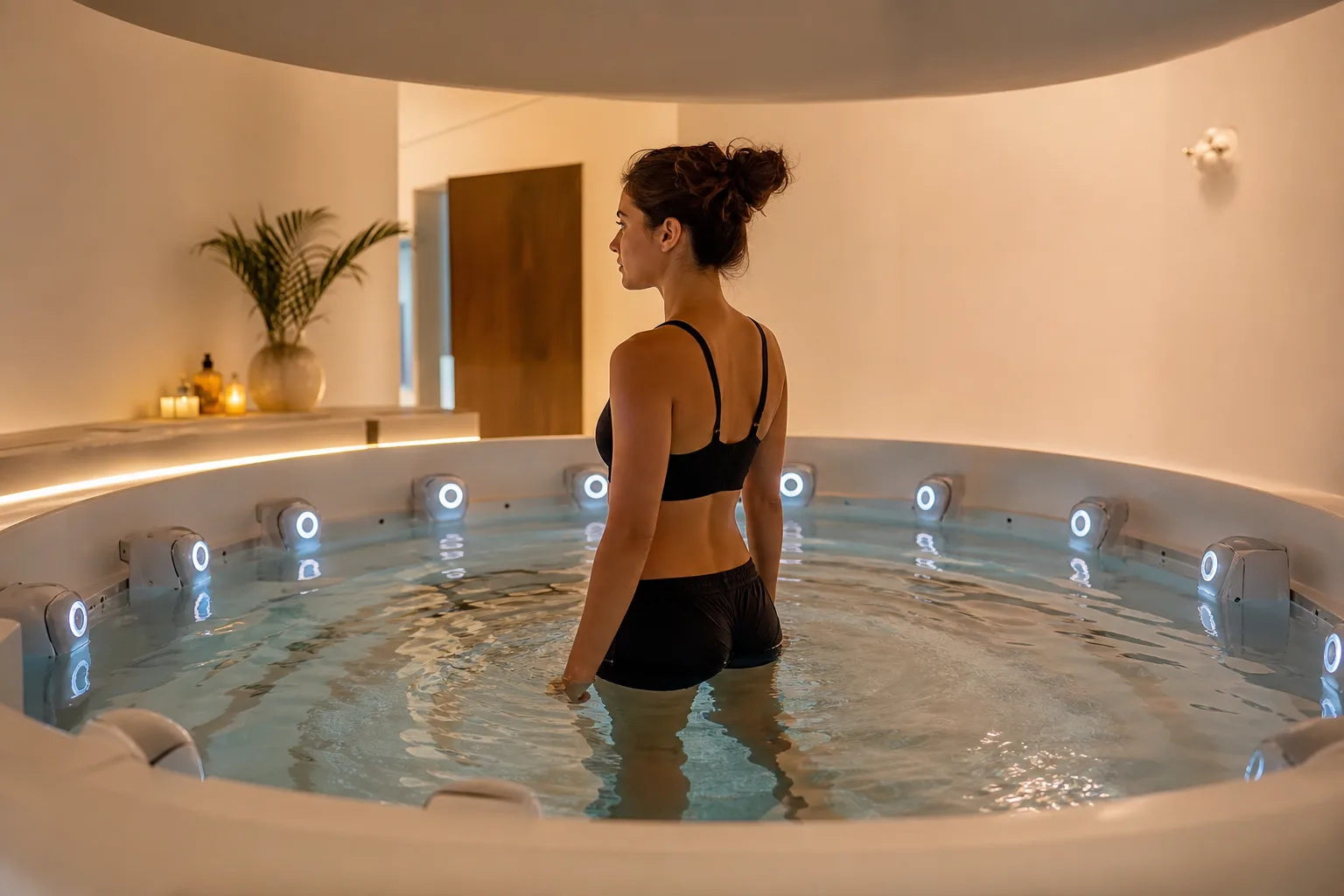
Nobody had ‘AI image startup opens a health spa’ on their 2025 bingo card. But here we are: Midjourney — the San Francisco company best known for generating painterly AI imagery from text prompts — has unveiled a Midjourney ultrasound scanner, a full-body imaging device it’s building in partnership with medical hardware firm Butterfly Network, and it plans to debut the technology inside its own spa by the end of 2027.
- The Midjourney ultrasound scanner uses half a million sand-grain-sized sensors to generate a 3D body image in 60 seconds.
- Midjourney is partnering with Butterfly Network to build the Midjourney ultrasound scanner, with a San Francisco spa opening by late 2027.
- CEO David Holz claims the technology could eventually prevent 30% of all deaths and cut healthcare costs by 50%.
- By 2031, Midjourney wants more than 50,000 scanners deployed globally, capable of one billion scans per month.
Table of Contents
What the Midjourney Ultrasound Scanner Actually Does
The hardware concept is genuinely interesting, even if some of the surrounding claims stretch credulity. You step into a shallow pool — Midjourney describes it as a ‘pool of golden light,’ which tells you a lot about the brand positioning they’re going for — and a ring of underwater sensors does the work. Those sensors are made up of roughly half a million tiny transducer elements, each about the size of a grain of fine sand, that simultaneously act as both speaker and microphone.
They fire ultrasound waves through the body — through skin, fat, muscle, and bone — and measure precisely how those waves are altered in transit. A compute cluster then assembles that data into a full 3D image. The whole process takes around 60 seconds. No radiation, no magnets, no contrast dye. The company compares the echolocation mechanic to how dolphins navigate underwater, which is a nice way of explaining phased-array ultrasound to a general audience without losing them.

The partnership with Butterfly Network is a smart one. Butterfly has spent years miniaturising ultrasound hardware onto a single semiconductor chip — it’s essentially the company that proved you could put serious ultrasound capability into a handheld device. The Midjourney ultrasound scanner is scaling that logic in the opposite direction: instead of shrinking the transducer array, they’re wrapping you in one.
A Timeline That Gets More Ambitious the Further Out You Look
CEO David Holz has never been shy about big visions, and the roadmap here is no exception. The first-generation Midjourney ultrasound scanner is already past the prototype stage — Holz says around a dozen people have been scanned so far, which is a very small number but does confirm this exists in physical form. The San Francisco spa, which will house the scanner for public use, is slated to open before the end of 2027.
The more consequential milestone, at least technically, is 2028. That’s when Midjourney says a third-generation Midjourney ultrasound scanner arrives, featuring ‘completely custom’ silicon that will make current image quality look like night and day by comparison. Scan times will also improve significantly. It’s the kind of claim every hardware startup makes about its future products, but given Butterfly Network’s track record in silicon-based ultrasound, it’s not pure fantasy either.
Then there’s the 2031 target: more than 50,000 scanners deployed globally, running at a combined capacity of one billion scans per month. That’s an extraordinary number. For context, the entire US performs roughly 30 million MRI scans per year. Midjourney is talking about doing that volume every few days, worldwide, by the end of the decade. Whether the economics work at that scale — and whether healthcare systems, regulators, and consumers are ready — is a separate question entirely.
The FDA Question Nobody Can Ignore
Here’s where things get strategically careful. The Midjourney ultrasound scanner will launch doing something that doesn’t require FDA approval: body composition mapping. Think muscle-to-fat ratios, bone density estimates, that sort of thing. It’s the kind of data that fitness trackers and DEXA scanners already provide, and it sits in a regulatory grey zone that doesn’t require the same clearance pathway as diagnostic medical imaging.
It’s a classic move for a health tech startup — enter through the wellness door, build the user base and the data pipeline, and then gradually work toward clinical validation. Midjourney says it plans to submit test results to the FDA on a rolling basis with the goal of eventually securing clearance for full diagnostic imaging. That process could take years, and there’s no guarantee it succeeds.
This matters because Holz’s headline claims — that early scanning could prevent ‘30% of all deaths’ and cut ‘50% of all healthcare costs’ — are explicitly diagnostic in nature. Early detection of cancer, cardiovascular disease, organ abnormalities. That’s not wellness territory, that’s medicine, and you can’t operate there without regulatory sign-off. The company knows this. The question is whether the path from body composition maps to meaningful clinical clearance is realistic within their timeline.
Midjourney’s Pivot — Or Is It an Expansion?
It’s tempting to read this as a strange detour from Midjourney’s core business, but that framing probably isn’t quite right. The company’s image generation platform remains one of the most-used in the world, and Holz has long spoken about Midjourney as something broader than a software product — more of an exploration into how AI can change the way humans understand and interact with reality. Imaging, whether that’s visual art or the interior of your own body, fits neatly into that framing if you squint at it the right way.
There’s also a financial logic. Midjourney is profitable, self-funded, and not beholden to a VC portfolio demanding a narrow lane. Holz can afford to take bets that a Series B startup couldn’t. A high-end spa in San Francisco charging premium prices for a 60-second whole-body scan using the Midjourney ultrasound scanner is actually a plausible business model in a city where people already pay hundreds of dollars for IV vitamin drips and cryotherapy sessions. The market for premium preventive health services is real and growing fast.
What’s harder to model is the jump from one spa to 50,000 global locations in six years. That’s a manufacturing, distribution, regulatory, and operational challenge of an entirely different magnitude — one that even well-capitalised medical device companies struggle with. Midjourney will need more than a clever ultrasound array and good branding to get there.
Why This Matters Beyond the Hype
Scepticism is warranted — Holz’s 30%-of-all-deaths claim is the kind of number that demands peer-reviewed evidence, not a product announcement. And the spa framing, with its ‘golden light’ and dolphin metaphors, does the hardware no favours with the medical community. Packaging the Midjourney ultrasound scanner as a luxury wellness experience is a choice that will raise eyebrows in clinical circles.
But the underlying technology isn’t vaporware. Phased-array ultrasound at this scale is a real engineering challenge that real engineers are working on with a credible partner. If Butterfly Network’s chip architecture can be extended into a full-body immersive format — and if the image resolution genuinely approaches MRI quality by 2028 — that would be a significant development in accessible medical imaging. MRI machines cost between $1 million and $3 million, require specialised facilities, and have global shortages in lower-income countries. A cheaper, radiation-free Midjourney ultrasound scanner that scales to 50,000 units would matter enormously, regardless of who built it or how they branded it.
The San Francisco spa opening in late 2027 will be the first real test. If the Midjourney ultrasound scanner delivers on even a fraction of what Holz is promising, the conversation shifts from curiosity to competition — and every major medical imaging company will need to pay attention.
Frequently Asked Questions
What is the Midjourney ultrasound scanner and how does it work?
The Midjourney ultrasound scanner uses around half a million tiny transducer elements submerged in a water tank to emit and receive ultrasound waves. A compute cluster processes the data into a 3D body image in roughly 60 seconds, with no radiation or magnets involved.
Does the Midjourney scanner need FDA approval?
Not initially. The first use case — body composition mapping — sits outside FDA jurisdiction. Midjourney says it plans to submit test results on a rolling basis to eventually gain clearance for full diagnostic imaging.
When will Midjourney’s spa open and where?
Midjourney plans to open its first spa location in San Francisco by the end of 2027. That’s where the ultrasound scanner will be housed for its public debut, making it both a health facility and a product showroom.
How is this different from an MRI scan?
Unlike MRI, the Midjourney scanner uses no magnetic fields or radiation. Midjourney says the technology should eventually surpass MRI, and describes the third-generation scanner slated for 2028 as when things get serious, with image quality representing a night-and-day difference — though those claims remain unverified at this stage.