Three cryptocurrency wallets at the centre of a crypto World Cup betting controversy have collectively pocketed $24.25 million from Polymarket prediction contracts — and then done something that caught the attention of blockchain analysts: they quietly withdrew their funds and stopped trading entirely. What makes it stranger is that all three accounts routed their profits through a single Binance deposit address, a detail that has lit up the on-chain analytics community and raised questions that neither Polymarket nor Binance has yet answered publicly.
- Three crypto World Cup betting wallets collectively earned $24.25M on Polymarket before abruptly going silent.
- All three crypto World Cup betting accounts funnelled profits through a single shared Binance deposit address.
- Blockchain analytics firm Lookonchain flagged the pattern, though no evidence of insider access has been established.
- More than $5 billion has been traded on World Cup prediction markets across Polymarket and Kalshi this tournament.
Table of Contents
The Three Wallets and What the On-Chain Data Shows
On June 21, blockchain analytics platform Lookonchain published its findings, naming the three wallets as mintblade, GRIMDRIP, and EndlessFate. Their combined record across 16 settled crypto World Cup betting positions was 13 wins — a hit rate that, by itself, isn’t necessarily suspicious in a tournament where upsets happen. But the profits those wins generated are striking.
Mintblade was the biggest earner, generating $9.24 million from five winning positions with zero recorded losses. GRIMDRIP pulled in $7.6 million from just two winning trades. EndlessFate made $7.41 million by correctly calling six of nine outcomes. Add it up and you get $24.25 million distributed across three accounts that, on the surface, look independent of each other.
They don’t look so independent when you follow the money. Every withdrawal from all three wallets went to the same Binance deposit address: 0xB08B…317D. This is the detail Lookonchain says may link the accounts to a single operator. Cryptocurrency exchanges typically assign unique deposit addresses to each customer — it’s how they reconcile incoming funds to individual accounts. Two wallets sharing one address is noteworthy. Three sharing the same address, each with a remarkable winning record, is the kind of pattern analysts flag.
To be clear about what this does and doesn’t prove: the shared address tells you something about who controls the destination of the funds. It tells you nothing about how the bets were chosen. It doesn’t establish identity. It doesn’t show insider access. What it does suggest is that someone — one person or one organisation — was running a coordinated crypto World Cup betting operation across at least three separate Polymarket accounts, then consolidating the returns.
Why the ‘Stop and Withdraw’ Pattern Matters
If the win rate alone were the suspicious element, you’d expect the wallets to keep going. Hot streaks are appealing, and anyone who genuinely believed they had an edge in crypto World Cup betting would have every incentive to press it. Instead, all three accounts stopped placing bets immediately after cashing out and pulled their remaining funds from the platform. That’s the behaviour of someone who achieved a specific goal and exited — not someone riding a lucky run.
On-chain analyst Specter noted that other wallets had shown similar patterns since the World Cup began — placing bets, winning, withdrawing, going dark — though no public evidence was provided to link those accounts to the three Lookonchain identified. Still, the observation suggests this may not be isolated activity within crypto World Cup betting markets.
It’s worth stepping back to understand what the alternative explanations look like. Prediction markets allow users to build large positions when liquidity is available, and anyone willing to take the unpopular side of a heavily favoured outcome can earn an outsized payout if an upset or draw occurs. The Spain–Cape Verde match is a good example of this dynamic. A Polymarket account called fishalive reportedly made around $9 million after placing roughly $4.2 million against Spain — including about $427,000 wagered at an implied probability of just 9% that Spain wouldn’t win. Spain’s scoreless draw turned that into a $4.7 million payout. Was that insider knowledge, or was it a contrarian bet that landed? There’s no public evidence either way.
The same ambiguity applies to crypto World Cup betting more broadly. A sophisticated analyst studying team form, travel schedules, player fitness reports, and historical draw rates in early group-stage matches could plausibly construct positions that outperform the market. High-risk contrarian bets pay well when they hit. None of that requires a leak. But the three wallets’ pattern — the shared withdrawal route, the clean exit, the silence — means the questions aren’t going away.
Crypto World Cup Betting Has Become a Multi-Billion Dollar Arena
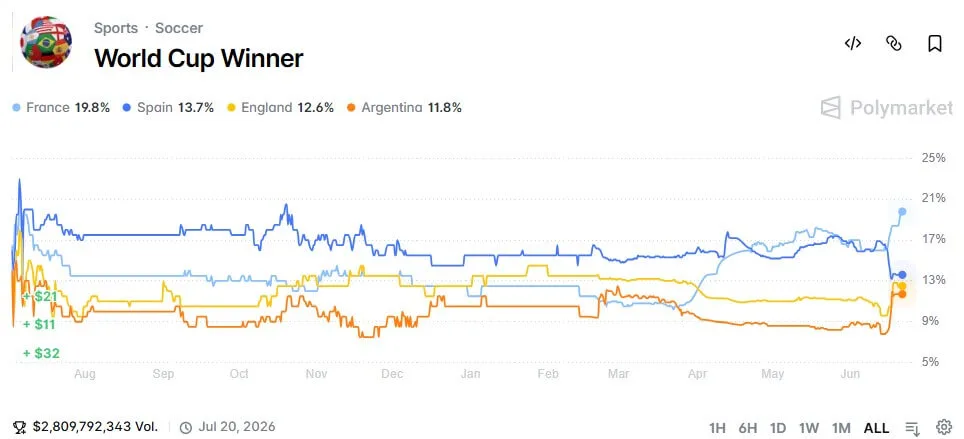
Part of what makes this story significant is the scale of the market these wallets were operating in. The 2025 World Cup, expanded to 48 teams for the first time, has turned crypto World Cup betting and sports prediction markets into a genuinely major financial venue. More than $5 billion had been traded on World Cup contracts across Polymarket’s international exchange and Kalshi during the tournament’s opening stages alone.
Polymarket’s contract on the overall tournament winner reached approximately $3 billion in cumulative volume — making it the platform’s largest sports market. The company listed hundreds of additional contracts covering individual matches, group winners, goal totals, player performances, and tournament awards. The breadth of that market means there were a lot of targets for anyone with an informational edge in crypto World Cup betting.

Dara Campbell, a senior executive at Hashgraph Ventures, didn’t mince words about the trajectory: ‘Everyone knew this World Cup would catapult prediction markets to another level. But the numbers are smashing expectations.’ That’s the commercial reality here. Platforms like Polymarket and Kalshi are benefiting enormously from the surge in interest — which also means they have reputational skin in the game when questions like these arise.
The Insider Trading Question Is Bigger Than These Three Wallets
Prediction markets occupy an intellectually interesting position. Their supporters argue — with genuine theoretical backing — that financial incentives aggregate dispersed information better than polls or expert opinion. Prices become forecasts. The market ‘knows’ things that no individual knows. It’s a compelling model, and one that crypto World Cup betting has stress-tested at unprecedented scale.
The problem is that the same mechanism that rewards good analysis also rewards insider access. If you know the result before the market does, prediction markets are essentially a machine for converting private information into money. And unlike stock markets, where securities laws in most jurisdictions explicitly prohibit trading on material non-public information, the regulatory framework around crypto World Cup betting and prediction markets more broadly is still being assembled.
Both Polymarket and Kalshi moved to tighten their rules earlier this year after a series of politically sensitive trades drew scrutiny — trades on government decisions and policy outcomes where a small number of people had relevant advance knowledge. Polymarket’s terms now explicitly prohibit users from trading when they possess confidential information or can influence a result. Kalshi has placed restrictions on athletes, political candidates, and others directly connected to listed events. These are meaningful steps, but they’re enforced by contractual terms and platform-level monitoring, not securities regulators with subpoena power.
US lawmakers have been circling the space for a while. More than a dozen proposals have been floated addressing prediction markets — covering everything from sports contracts to political trading to markets tied to conflict and death. None has made serious legislative progress. That regulatory gap is part of why the current situation feels uncomfortable: there are credible grounds for suspicion, no obvious enforcement mechanism, and two major platforms that haven’t publicly acknowledged what their own users can read on a blockchain explorer.
The irony of blockchain-based crypto World Cup betting markets is that they’re simultaneously more transparent and harder to police than traditional betting. The transaction data is public and immutable — Lookonchain found these wallets precisely because everything is on-chain. But pseudonymity means you can’t easily connect 0xB08B…317D to a name, a jurisdiction, or a legal obligation. That tension — radical transparency in the data, opacity in the identity layer — is going to keep producing stories like this one for as long as these markets exist at scale. The question is whether the platforms, or eventually the regulators, decide to do anything about it.
Frequently Asked Questions
Is crypto World Cup betting on platforms like Polymarket legal?
Polymarket operates as an international exchange. Kalshi is one of the largest prediction market platforms in the US. Both platforms prohibit users from trading on markets where they hold confidential information or can influence the result, and legality varies by jurisdiction.
Does a shared Binance deposit address prove the wallets belong to the same person?
It’s strong circumstantial evidence. Exchanges typically assign unique deposit addresses to individual customers, so a shared address suggests a common owner or operator. However, it does not conclusively prove ownership or that bets were placed using non-public information.
How much has been traded on World Cup prediction markets in 2025?
More than $5 billion has been traded on World Cup contracts across Polymarket and Kalshi during the tournament’s opening stages. Polymarket’s single contract on the tournament winner alone reached roughly $3 billion in cumulative volume.
What rules do Polymarket and Kalshi have against insider trading?
Polymarket explicitly prohibits trading when a user possesses confidential information or can influence an outcome. Kalshi has introduced restrictions on athletes, political candidates, and others directly connected to listed events, following scrutiny of politically sensitive trades.