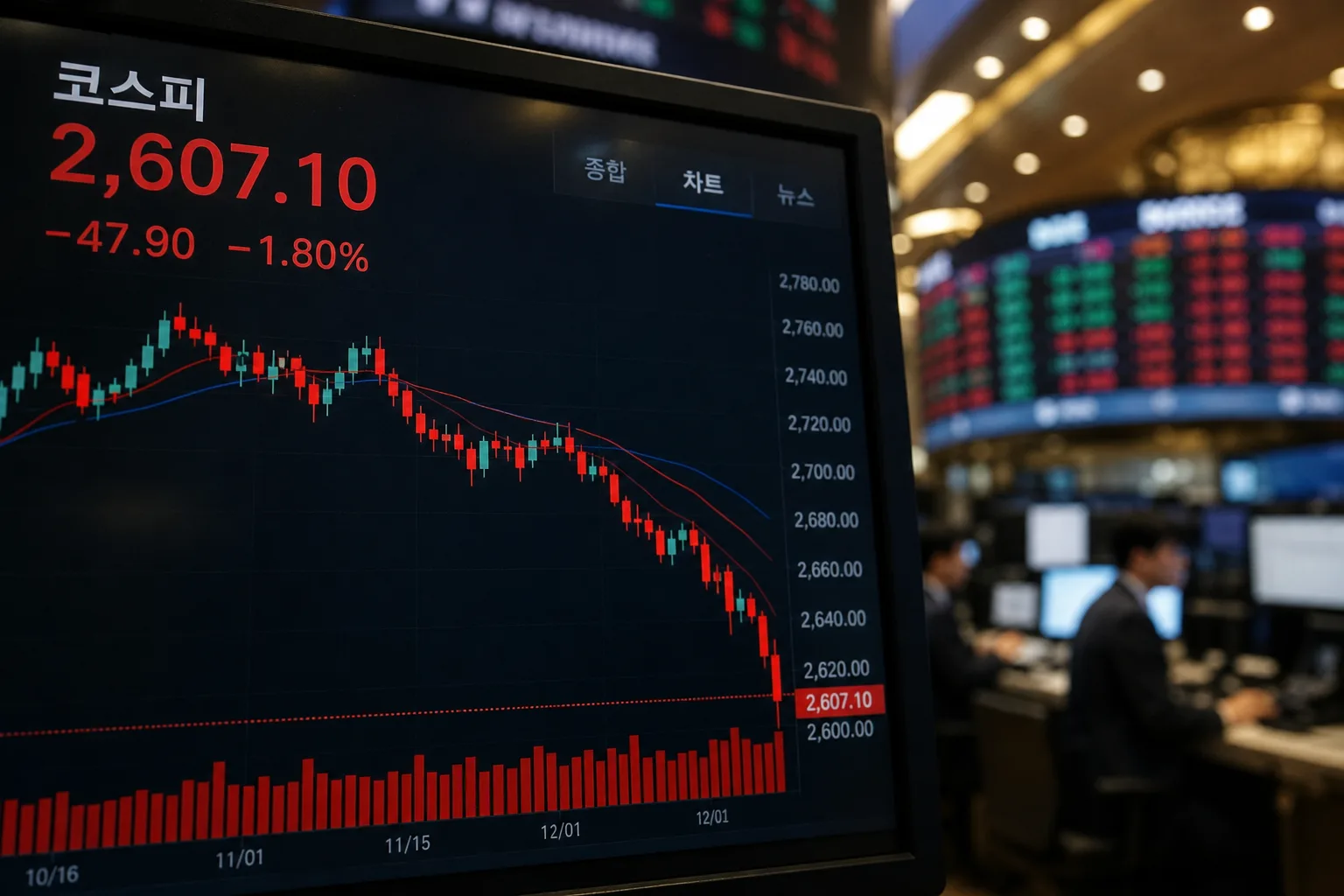
The KOSPI crash that shook global markets on Tuesday wasn’t just a bad day for South Korean stocks — it was a self-inflicted wound. The country’s top financial regulator publicly admitted it had rushed the approval of leveraged exchange-traded funds tied to its two most powerful chipmakers, Samsung Electronics and SK Hynix. What followed was one of the steepest single-day declines in recent memory, a forced trading halt, and a ripple effect that pulled Bitcoin below $63,000.
- The KOSPI crash of nearly 10% was triggered after regulators admitted rushing approval of leveraged Samsung and SK Hynix ETFs.
- The KOSPI crash dragged Bitcoin below $63,000, with over $714 million in crypto positions liquidated within 24 hours.
- South Korean retail investors held roughly $39 billion in borrowed funds, magnifying forced selling as prices collapsed.
- US-listed spot Bitcoin ETFs recorded a rolling 30-day net outflow of $6.35 billion, stripping away key buying support.
Table of Contents
How the KOSPI Crash Unfolded
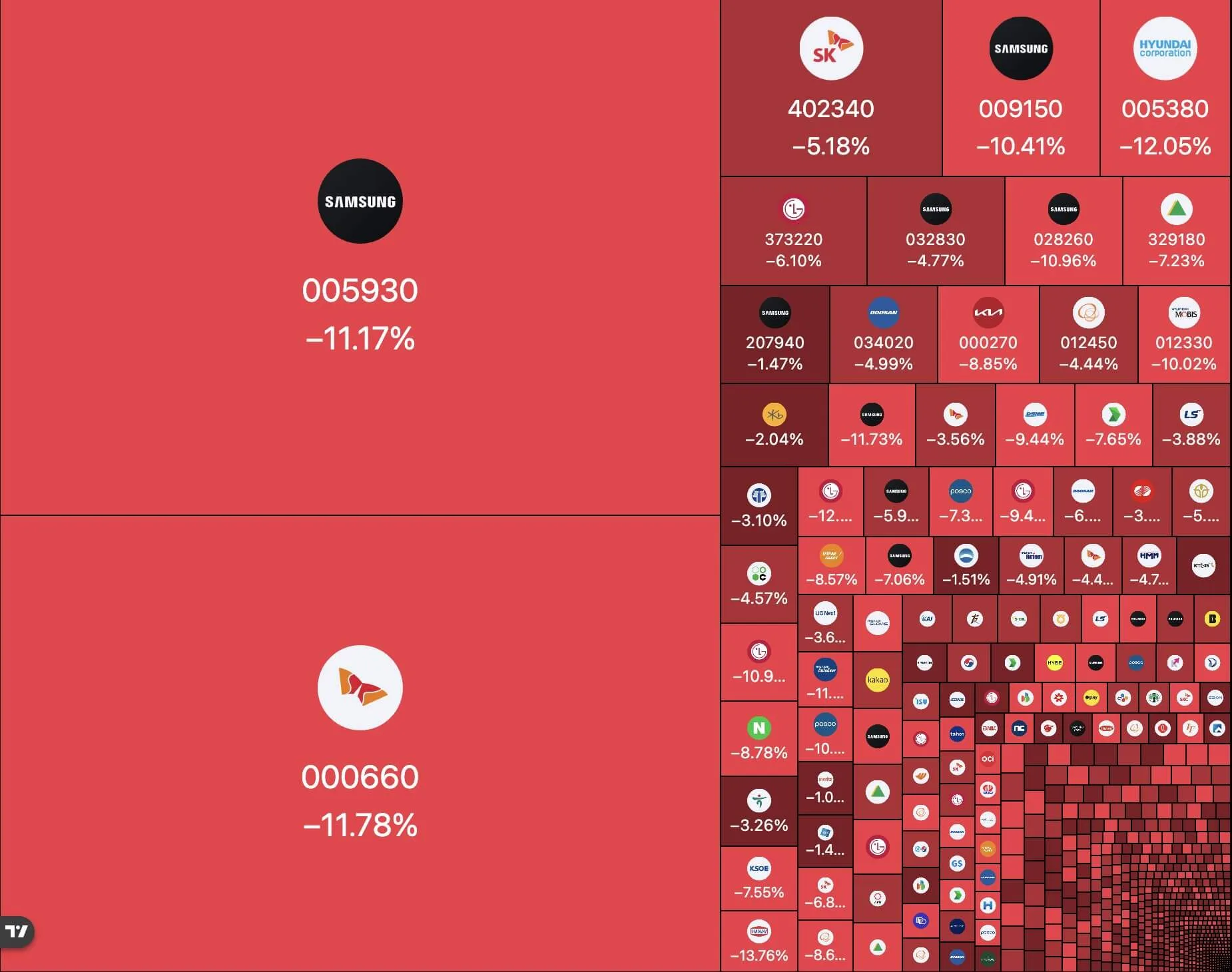
South Korea’s benchmark KOSPI index closed down 9.99% at 8,203.84 — its worst session since March 4. That’s a brutal number by any standard, but it didn’t come out of nowhere. The index had been on a remarkable run, reaching a record above 9,100 points just the day before and sitting up nearly 95% for the year. The fuel behind that rally was concentrated almost entirely in semiconductors. Samsung and SK Hynix together account for more than half of the KOSPI’s total market value, making the index essentially a leveraged bet on AI server demand and high-bandwidth memory chips.
When overseas investors started reducing exposure to technology shares — partly in response to weakness in US tech and persistent expectations of elevated interest rates — the KOSPI crash had nowhere to hide. Samsung and SK Hynix each fell more than 12%, pulling the entire index with them and triggering an automatic 20-minute trading suspension. The selling spread across the region, pushing the MSCI Asia-Pacific index down about 2.9% and Japan’s Nikkei 225 roughly 3% lower. But South Korea took by far the largest hit.
The Leveraged ETF Mistake That Made It Worse
The KOSPI crash didn’t just reflect a bad macro environment — it was made significantly worse by a regulatory miscalculation. Financial Supervisory Service Governor Lee Chan-jin acknowledged on June 22 that the regulator had acted too quickly when it approved leveraged ETFs tracking Samsung and SK Hynix. The products launched in late May and were explicitly designed to deliver multiples of each stock’s daily performance. In a bull market, that amplifies gains. In a selloff, it amplifies losses just as efficiently.
The original rationale was actually reasonable on paper: authorities hoped the funds would pull South Korean retail investors away from US-listed stocks and back into domestic markets, easing pressure on the Korean won in the process. Lee admitted that strategy hadn’t worked, and said he regretted not blocking the products from launching. That’s a remarkable thing for a sitting regulator to say publicly.
The scale of retail participation made the KOSPI crash considerably worse. The sixteen leveraged funds launched with roughly $3 billion in combined assets. By the time the selloff hit, those holdings had ballooned to more than $9 billion, with retail investors accounting for approximately 92% of ownership. That concentration created a serious structural hazard. Leveraged ETFs must continuously rebalance their exposure by buying or selling securities and derivatives as prices move. When the underlying stocks are already dominant in the index, that rebalancing can act like an accelerant on a fire.
Goldman Sachs had actually flagged this risk before the funds launched, estimating that a 5% swing in Korean stocks could generate roughly $4.7 billion in dealer rebalancing flows — equivalent to about one-eighth of the market’s normal daily turnover. That warning aged poorly. Tuesday’s decline didn’t stop at 5%.
Compounding the problem further: South Korean retail investors had accumulated record levels of debt to chase the rally. Borrowed retail investment reached approximately 60 trillion won — about $39 billion — by the end of May. Margin calls and forced liquidations on that scale don’t just hurt individuals. They generate additional sell orders that push prices lower, triggering more margin calls in a feedback loop that’s notoriously hard to stop once it starts. The KOSPI crash demonstrated precisely how quickly that loop can spiral beyond control.
KOSPI Crash Pulls Bitcoin Into the Storm
Bitcoin didn’t have an obvious direct connection to South Korean chip stocks, but markets don’t always need clean narratives when sentiment turns. As the KOSPI crash sent risk assets selling off across Asia and into broader global markets, Bitcoin fell alongside them — dropping as much as $1,500 in a matter of hours and slipping below $63,000 for the first time in recent sessions. It was trading near $62,300 after touching an intraday low of around $62,000.
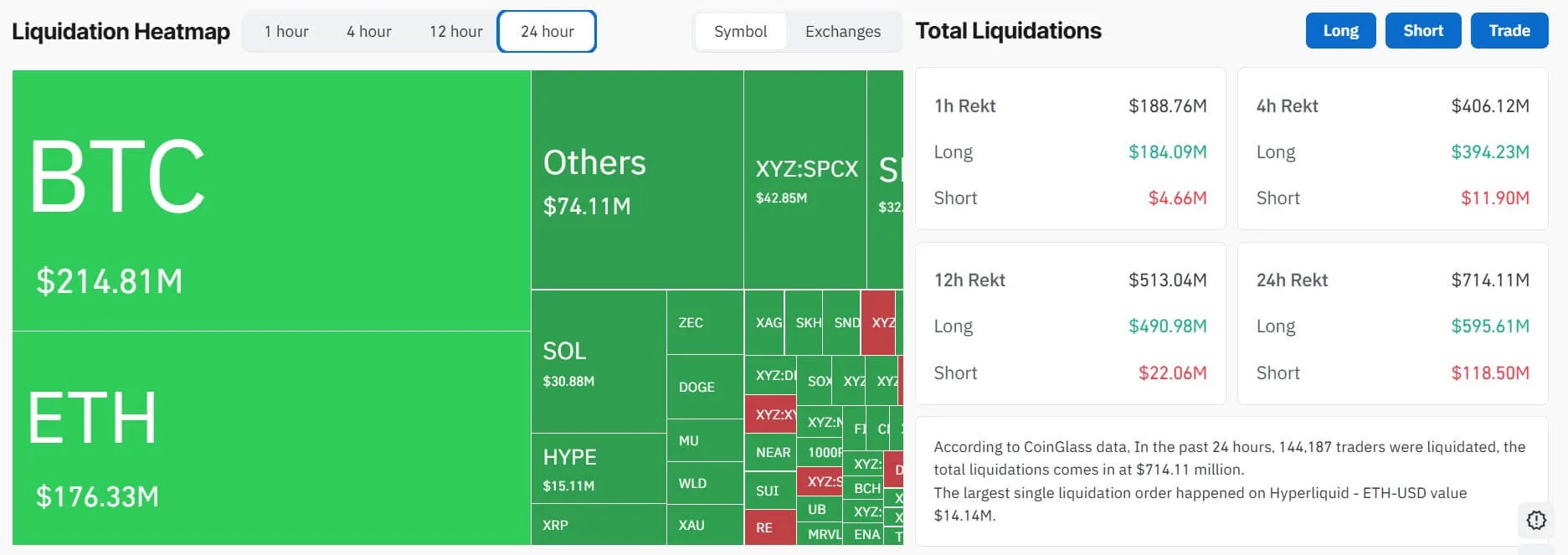
The decline quickly became self-reinforcing. CoinGlass data showed that exchanges liquidated approximately $190 million in crypto positions within a single hour as Bitcoin broke through key price levels where leveraged longs no longer had sufficient collateral. Long traders accounted for about $184 million of that total — a clear sign of how heavily positioned the market had been for continued upside. Over the full 24-hour period, total crypto liquidations climbed to roughly $714 million, with Bitcoin traders absorbing about $215 million in forced closures and Ethereum positions accounting for around $177 million more.
This is the mechanism crypto veterans know well and newer participants keep rediscovering the hard way. When prices fall through critical support levels, exchanges automatically close undercollateralized positions. Those closures generate fresh sell orders. Those sell orders push prices lower. And the cycle continues until the leverage is fully washed out — or a buyer large enough to absorb the flow steps in.
Bitcoin ETF Outflows Removed the Safety Net
What made Bitcoin particularly vulnerable to this kind of pressure wasn’t just the KOSPI crash — it was the state of institutional demand heading into the session. US-listed spot Bitcoin ETFs had recorded a rolling 30-day net outflow of approximately $6.35 billion, the largest comparable outflow since those products began trading. That’s a significant number because institutional ETF flows had been one of the most reliable sources of buying support for Bitcoin since the products launched earlier this year.
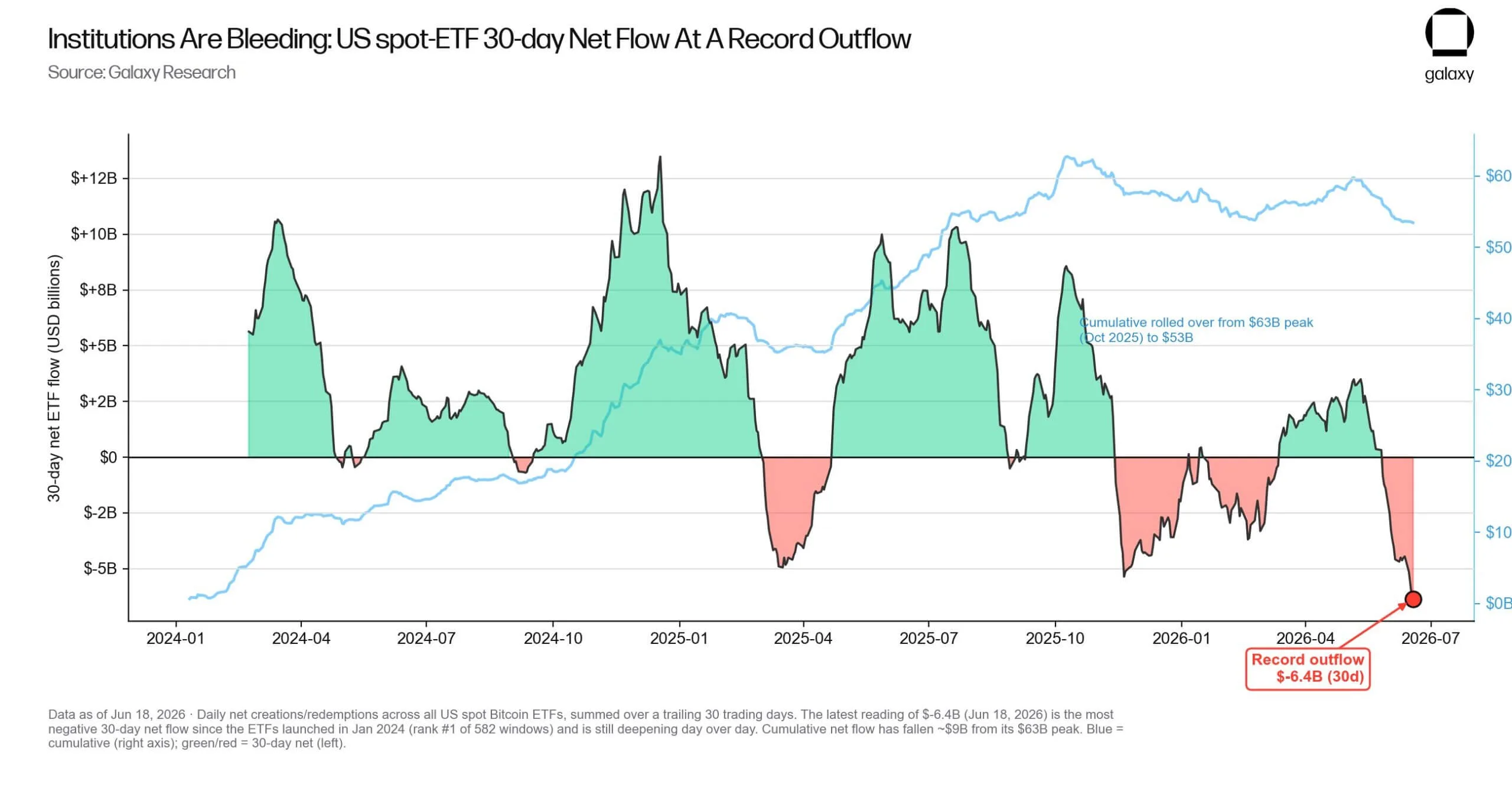
Strip away that support and you get a market that’s more exposed to sudden sentiment shifts. There was no institutional cushion ready to absorb the selling when it came. The combination of retail-driven leverage in crypto and institutional withdrawal from spot ETFs left Bitcoin in a structurally weak position precisely when a macro shock arrived.
What Comes Next — and What This Signals
South Korean authorities are now considering stabilization measures, though Lee Chan-jin declined to specify whether those could include leverage limits, tighter eligibility requirements, or outright restrictions on new leveraged products. The ambiguity itself is a problem — markets hate uncertainty, and the absence of a clear plan will likely keep foreign investors cautious about re-entering Korean equities at scale.
There’s a broader lesson here that applies well beyond South Korea. The KOSPI crash illustrates what happens when index concentration, retail leverage, and poorly timed financial product approvals collide with a macro catalyst. The index’s extreme dependence on two semiconductor companies isn’t a new problem — it’s one analysts have flagged for years — but the introduction of leveraged ETFs amplifying exposure to those same companies was a material escalation of existing risk.
For crypto markets, the story is really about structural fragility. Bitcoin’s drop wasn’t caused by the KOSPI crash — the timing was coincidental, both markets reacting to the same global risk-off mood. But the severity of Bitcoin’s decline, and the speed at which leveraged positions unwound, reflects a market that had built up considerable speculative overhang. With ETF inflows now running negative and institutional buyers on the sidelines, the next major test for Bitcoin will be whether organic demand can absorb volatility without the institutional bid that propped it up through earlier corrections this year.
Frequently Asked Questions
What caused the KOSPI crash on June 22?
The KOSPI crash followed a broader risk-off move in global markets and was amplified by the Financial Supervisory Service admitting it had rushed approval of leveraged ETFs tied to Samsung and SK Hynix. Those funds, holding over $9 billion in assets, intensified selling pressure through forced rebalancing.
Why did Bitcoin fall alongside South Korean stocks?
Bitcoin dropped because both markets were caught in the same broad retreat from risk assets. Leveraged crypto positions began unwinding as prices fell, triggering around $190 million in liquidations within a single hour and adding sell momentum to an already fragile market.
How much did Samsung and SK Hynix lose in the selloff?
Both Samsung Electronics and SK Hynix fell more than 12% each during the session. Because the two companies together account for more than half of the KOSPI’s market value, their losses were the primary engine of the index’s near-10% decline.
What are South Korean authorities doing about the leveraged ETF problem?
Financial Supervisory Service Governor Lee Chan-jin acknowledged the regulator acted too quickly when approving the products. Authorities are now considering stabilization measures, though specifics such as leverage limits or restrictions on new products had not been confirmed at the time of the selloff.