
The crypto stocks slump that’s been building since late 2024 has now hit a level where the numbers are genuinely difficult to ignore. While a broad selloff has knocked tech valuations across the board, crypto-focused equities are absorbing punishment that makes Oracle, Netflix, and Salesforce look almost comfortable by comparison.
- The crypto stocks slump has pushed Coinbase and Circle down 69% and 72% from their all-time highs, far outpacing Big Tech declines.
- Coinbase missed Wall Street expectations badly in Q1 2025, reporting a loss of $1.49 per share against forecasts of a $0.27 profit.
- Bitcoin has fallen more than 54% from its October peak, dropping below $60,000 and dragging sentiment across the entire sector.
- The crypto stocks slump has led 21Shares to lower its 2026 outlook, citing Bitcoin’s persistent four-year cycle as the dominant price driver.
Table of Contents
How Bad Is the Crypto Stocks Slump, Exactly?
Let’s put some concrete numbers on this. Coinbase (COIN) is down 69% from its all-time high. Circle (CRCL), the stablecoin issuer behind USDC that only recently went public, has shed 72% from its peak. Those are brutal drawdowns by any standard — but the context makes them even starker.
According to data compiled by The Kobeissi Letter, major technology companies that have also suffered during this cycle are down between 48% and 57% from their highs. That list includes Oracle (ORCL), Salesforce (CRM), Netflix (NFLX), and Palantir (PLTR) — none of which are having a great year, but all of which are holding up better than the crypto cohort. Meanwhile, the large-cap S&P 500 has only retreated around 3.5% from its recent high. The divergence is hard to explain away. The crypto stocks slump, measured against these benchmarks, stands in a category of its own.
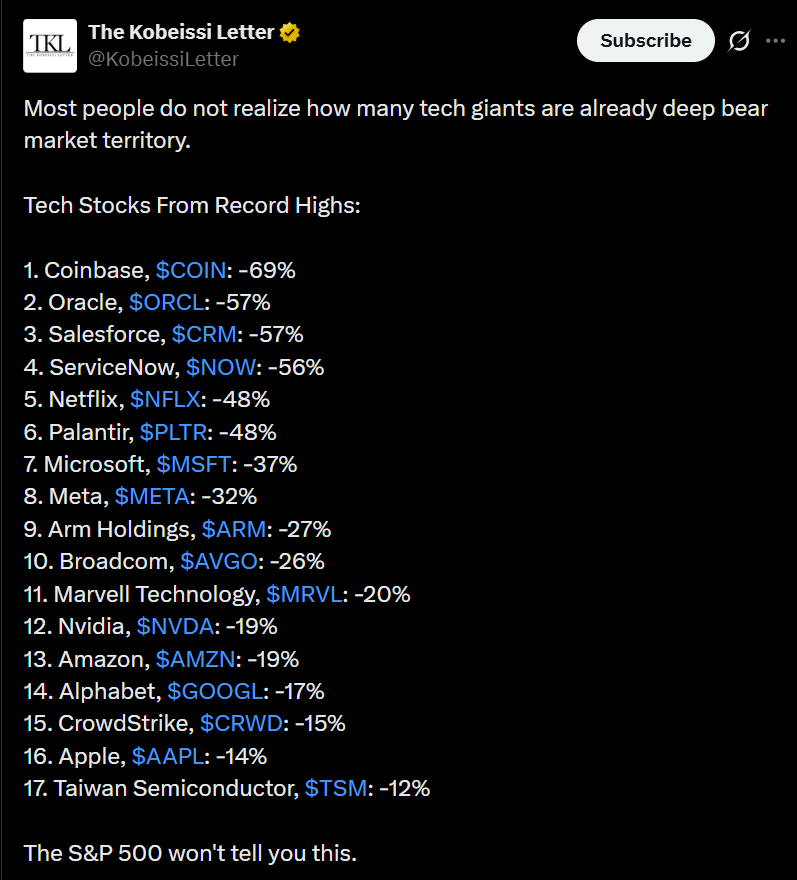
What this tells us is that the crypto stocks slump isn’t simply a byproduct of broader market nervousness. There’s something more specific happening here — a sector-level repricing that reflects genuine concerns about profitability, regulatory uncertainty, and the structural dependence these companies have on token prices they can’t control.
Coinbase’s Q1 Results Made Things Worse
Coinbase’s first-quarter 2025 earnings report didn’t help sentiment. The exchange posted a loss of $1.49 per share — a wide miss against Wall Street’s consensus forecast of a $0.27 profit. Revenue fell 21% compared to the previous quarter. That kind of result, in a sector already fighting negative headlines, tends to have an outsized psychological effect on investors who were looking for any sign that the crypto stocks slump was easing.
The core problem for Coinbase is structural. Its revenue is heavily tied to trading volume, and trading volume is tightly correlated with crypto prices and retail enthusiasm. When Bitcoin is falling and sentiment is sour, fewer people are trading, fewer are onboarding, and the margins on those who are start to compress. Diversification into things like staking, subscriptions, and institutional custody services has helped at the margins, but it hasn’t been enough to decouple the business from the underlying crypto cycle.
Circle’s situation is different — its USDC stablecoin business is theoretically less volatile than an exchange — but its stock price has still been hammered. Investors appear to be applying a blanket discount to anything with ‘crypto’ in its DNA, regardless of the underlying business model. That’s worth watching. If even a company with a dollar-pegged product can’t escape the gravity of the broader crypto stocks slump, it raises real questions about whether any crypto-native equity can sustainably trade on its own fundamentals right now.
Bitcoin and Ether Extend Their Declines
The market backdrop isn’t helping anyone. Bitcoin has fallen more than 54% from its October 2024 peak and recently dropped below $60,000 — a psychologically significant level that tends to trigger stop-losses and accelerate negative sentiment loops. Ether has been hit even harder in percentage terms, sliding to around $1,500, which puts it roughly 69% below its high from last year. These token-level declines are a direct accelerant of the crypto stocks slump, feeding the negative cycle of reduced trading volumes and compressed margins.
These aren’t just bad optics. Falling token prices directly affect the earnings models of companies like Coinbase through reduced transaction volumes. They affect the balance sheets of firms that hold Bitcoin on their treasury. And they shape the narrative around whether crypto is in a sustained maturation phase or just another speculative cycle playing out the same way it always does.

The broader tech selloff adds another layer of complexity. AI-related concerns — specifically fears that rapid advances in artificial intelligence could disrupt existing software and services business models — have unsettled investors across the sector. Semiconductor stocks have generally fared better, perhaps because the AI boom creates hardware demand regardless of which software model wins. But crypto equities sit in an awkward position: too speculative for the ‘AI infrastructure’ narrative, too correlated with risk-off sentiment to hold up when macro conditions tighten. The crypto stocks slump is, in part, a product of that double exposure.
21Shares Walks Back Its Optimistic Call on Bitcoin’s Cycle
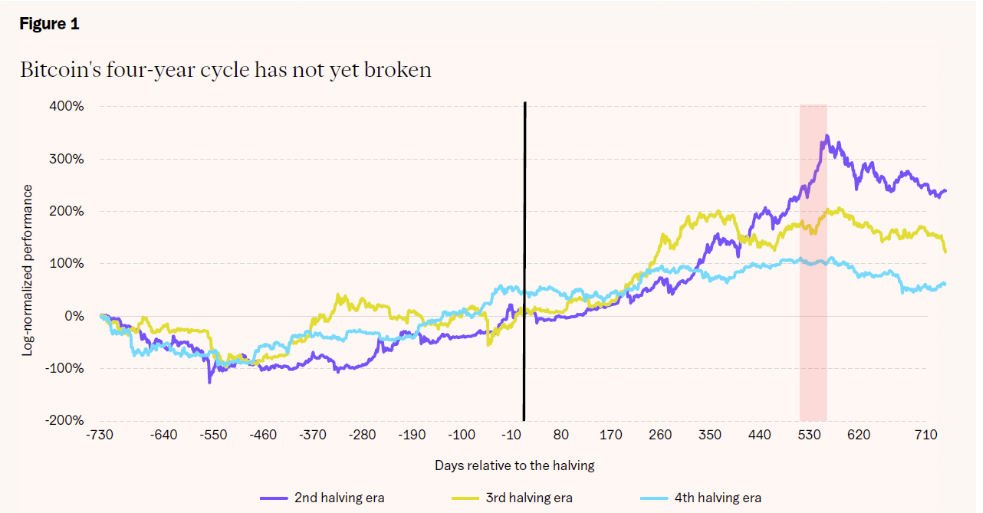
One of the more telling developments in recent weeks came from asset manager 21Shares, which has quietly walked back a fairly bold prediction it made earlier this year. The firm had argued that Bitcoin’s traditional four-year market cycle — the pattern of boom and bust tied loosely to the halving schedule — had effectively become obsolete, diluted by the scale of institutional participation.
In its midyear outlook, 21Shares revised that position significantly. ‘Bitcoin’s cycle is evolving, but it has not broken yet,’ the firm stated, acknowledging that the four-year cycle remains the dominant force shaping price action. It’s a meaningful concession. The theory that institutional adoption would fundamentally change Bitcoin’s volatility profile was compelling, and a lot of 2026 price forecasts were built on it. Those forecasts are now being quietly lowered, and the crypto stocks slump is making that revision process even more uncomfortable for analysts who had called for a swift recovery.
What 21Shares does maintain is that institutional adoption itself continues to strengthen — just in ways that don’t necessarily translate to immediate price support. Stablecoins are seeing growing institutional use. Tokenization of real-world assets is gaining traction. Prediction markets built on blockchain infrastructure are expanding. But the firm’s conclusion is sobering: strong fundamentals and rising adoption have been unable to override the cyclical bear market dynamic currently in control of crypto prices.

There’s something almost paradoxical about that finding. The crypto industry spent years arguing that institutional adoption would be the catalyst that permanently elevated prices and reduced drawdowns. And by most measures, institutional adoption is genuinely happening — Bitcoin ETFs now exist in the US, major banks are experimenting with tokenization, and corporate treasury holdings of Bitcoin are becoming almost routine. Yet here we are, 54% below last year’s peak, with the four-year cycle as dominant as ever and the crypto stocks slump showing no clear signs of reversal.
The Regulatory Wildcard That Won’t Go Away
One factor that doesn’t get enough attention in the current selloff is the slow pace of crypto regulation in the United States. Progress on comprehensive market structure legislation has been uneven at best — and that uncertainty has real consequences for publicly listed crypto companies trying to expand their product offerings and institutional client base.
Coinbase, in particular, has been vocal about needing regulatory clarity to build out services that compete with traditional financial institutions. Without it, the company operates in a grey zone that makes institutional partners nervous and limits what products it can responsibly offer US customers. That regulatory overhang is a structural drag that doesn’t show up neatly in any single quarter’s earnings but persistently suppresses the premium investors are willing to assign to crypto equities.
The crypto stocks slump, in that sense, isn’t entirely a story about token prices. It’s also a story about an industry that is maturing faster at the technology and adoption layer than at the regulatory and public-market credibility layer. Until those two things align more closely, the gap between crypto equity drawdowns and broader tech drawdowns is likely to persist — and investors who are waiting for a catalyst to close that gap may be waiting longer than they’d like.
Frequently Asked Questions
Why is the crypto stocks slump worse than the broader tech selloff?
Crypto equities like Coinbase and Circle carry double exposure — they’re hit by both general tech market weakness and the specific pressures of falling digital asset prices. Bitcoin dropping below $60,000 and Ether sliding to around $1,500 have compounded the damage well beyond what traditional tech stocks are experiencing.
How badly did Coinbase miss earnings expectations in Q1 2025?
Coinbase reported a loss of $1.49 per share in Q1 2025, a stark miss against Wall Street’s consensus forecast of a $0.27 profit. Revenue also fell 21% quarter-over-quarter, reflecting the toll that declining crypto trading volumes and falling asset prices are taking on the exchange’s business model.
What is 21Shares saying about Bitcoin’s four-year cycle in 2025?
21Shares walked back an earlier prediction that Bitcoin’s four-year market cycle had become obsolete. In its midyear outlook, the firm said the cycle remains the dominant force driving crypto prices, though growing institutional ownership has helped moderate the depth of Bitcoin’s drawdowns.
Is institutional adoption of crypto still growing despite the downturn?
According to 21Shares, yes — institutional adoption in areas like stablecoins, tokenization, and prediction markets continues to strengthen. However, the firm argues this hasn’t been enough to override the cyclical bear market dynamics currently suppressing digital asset prices across the board.