

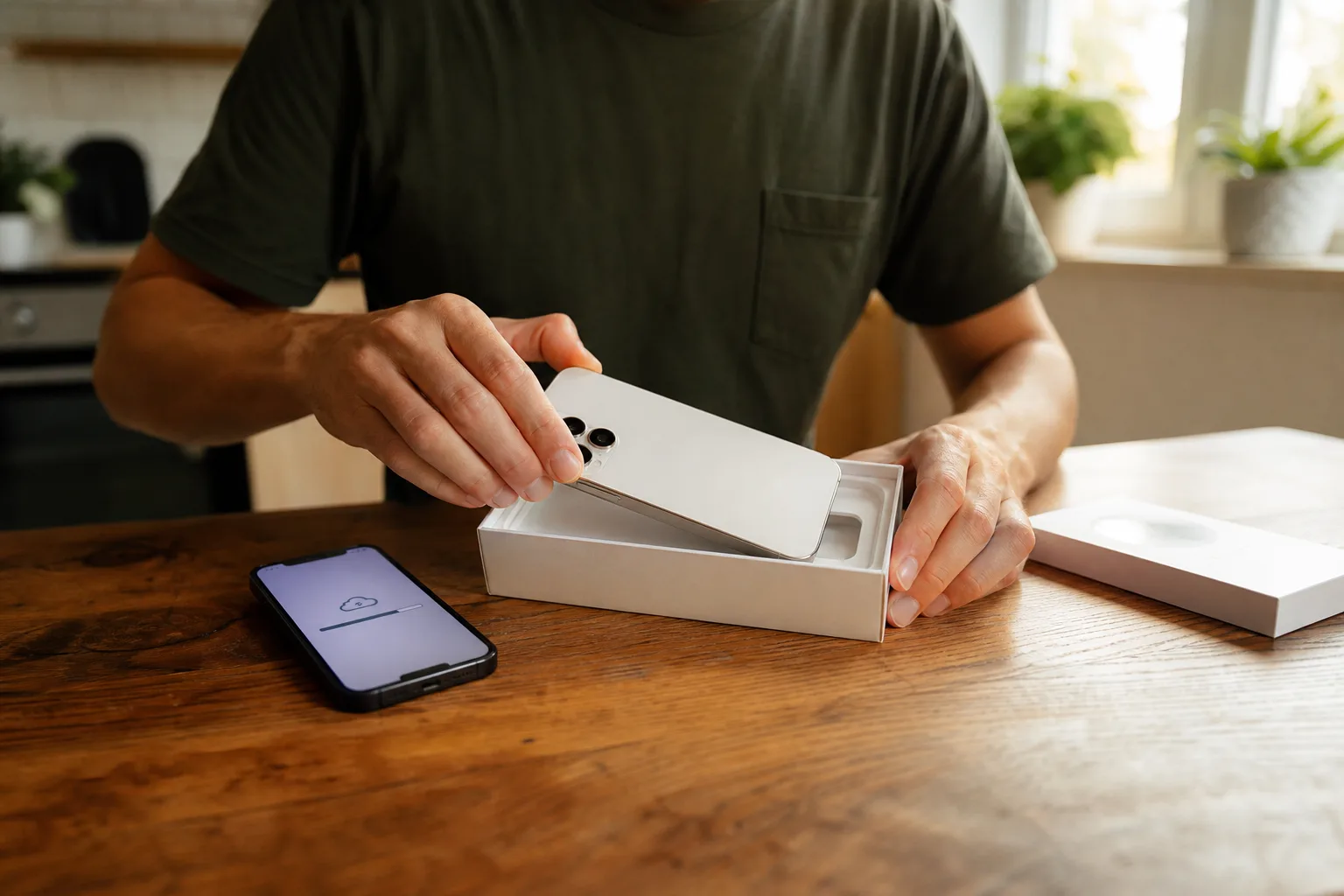
- Apple reportedly considered shipping replacement hardware with a customer’s iCloud backup and personal data already loaded.
- The Apple device setup idea points to an awkward trade-off: the easier the upgrade, the more companies and systems must handle intimate digital information.
- Apple’s reported hesitation fits a wider consumer backlash against surveillance, opaque data collection, and connected devices that feel uncomfortably invasive.
- Hardware leasing could make upgrades routine, but it would also turn device replacement into an ongoing relationship instead of an occasional purchase.
Table of Contents
Apple device setup was reportedly headed toward a stranger future
The usual Apple device setup ritual is already a minor magic trick. You buy an iPhone, iPad, or Mac, sign in with an Apple Account, approve a few prompts, and before long the new machine begins to resemble the old one. Photos return. Messages reappear. Apps download. Your home screen, for better or worse, follows you like a digital shadow.
Bloomberg’s Mark Gurman has reported that Apple once explored taking that idea further as part of a possible hardware subscription or leasing program. The proposed so-called “white-glove” option would reportedly have sent customers a new device preloaded with data from their iCloud backup. Open the box, turn it on, and much of your digital life would already be waiting.
That sounds convenient right up until you picture the delivery truck.
Apple has not announced such a service, and Gurman says the feature is not expected to arrive. Still, the report is revealing. It shows where Apple’s product thinking may be headed as it considers a world in which customers upgrade on a 12-, 24-, or 36-month cycle rather than buying a phone outright every few years. It also exposes the hard limit on frictionless computing: eventually, the friction being removed is the small pause that reminds people their information is being moved somewhere.
The convenience case is easy to understand
Anyone who has helped a parent migrate to a replacement phone knows why Apple would consider this. A standard Apple device setup can be painless when everything goes right, but it can also turn into an evening of forgotten passcodes, two-factor codes sent to the wrong device, banking apps demanding fresh verification, and a progress bar that appears permanently stuck at 73 percent.
Apple already has much of the plumbing. iCloud backups can restore app data, settings, photos, messages, device preferences, and other information after a customer authenticates. Apple’s Quick Start transfer process can move data directly between nearby devices. A more concierge-style Apple device setup would mostly remove the customer from the waiting room.
For a tightly managed fleet of leased devices, the appeal is obvious. Apple could send a fresh phone when a contract period ends, arrange the old unit’s return, and make the replacement feel less like a migration than a routine appliance swap. It is the same appeal behind managed corporate laptops: employees want a working computer, not an IT project.
There is a consumer argument for it, too. A person whose phone is broken, stolen, or lost does not want to spend hours rebuilding their digital routines. They want their transit pass, work apps, photo library, health data, and password manager back as quickly as possible. In that moment, an Apple device setup that is largely complete on arrival would feel like a lifesaver.
But consumers do not experience that convenience as an abstract cloud workflow. They experience it as a box arriving at their front door with an alarming amount of their life already inside.
Why the privacy optics get ugly fast
The reported white-glove concept runs directly into the story Apple has spent years telling about itself. The company positions privacy as a product feature, from on-device processing to its insistence that customers should have meaningful control over personal information. Apple’s privacy policy and product messaging repeatedly emphasize data minimization, encryption, and user choice.
A preloaded Apple device setup complicates that message, even if the technical implementation were carefully designed. Customers would reasonably ask where the restored data lived before shipment, who or what had access to the device while it was staged, whether it could be remotely erased in transit, and what happens if the package is misdelivered. Encryption can answer some of those questions. It cannot erase the instinctive discomfort.
Frankly, the optics may matter as much as the architecture. People tolerate invisible systems until those systems become tangible. Most users understand, vaguely, that their backup is stored in the cloud. A phone arriving with their messages, private images, financial apps, and family photos ready to go makes that invisible arrangement feel suddenly physical. It is less like retrieving files from a secure locker and more like having a stranger pack your apartment into a moving van.
That is especially sensitive because an Apple device setup can touch categories that are far more personal than a desktop folder: Health data, location history, authentication tokens, saved passwords, private conversations, and photos. Apple could design layers of authentication so that none of it is usable until the owner verifies their identity. Yet a product does not live or die solely on whether its engineers can make it safe. It also has to pass the far simpler test of whether ordinary people believe it feels safe.
Privacy backlash has changed the timing
There was a stretch of the late 2010s when big-tech resignation felt almost fashionable. People shrugged at tracking because every service seemed to be tracking them anyway. That mood has hardened into something more skeptical. Public fights over license-plate camera networks, smart-home microphones, location brokers, and facial recognition have made the costs of ambient data collection easier to see.
Apple is hardly outside that conversation. Its privacy branding helps distinguish the company from advertising-driven rivals such as Google and Meta, but it also raises expectations. If Apple introduces smart glasses, as Gurman has separately reported it is exploring, those expectations will get even tougher. Wearable cameras are where convenience and creepiness meet face-to-face.
My read is that Apple understands the political and cultural timing. An Apple device setup service that felt innocuous five years ago could now be read as proof that the company has become too comfortable holding the keys to customers’ lives. The company does not need that fight, particularly when its existing migration tools are already good enough for most buyers.
Subscription hardware changes what ownership means
The more consequential part of this report may be the leasing idea itself. Hardware subscriptions promise predictable monthly costs and painless upgrades, but they also normalize a relationship in which the manufacturer remains present long after the sale. The phone becomes less like a camera you own and more like a car lease: useful, replaceable, and perpetually tied to the provider’s terms.
That model can work. Apple already sells device payment plans, upgrade programs, and subscription bundles; carriers have trained customers to think in monthly handset payments for years. A polished Apple device setup experience would make recurring upgrades easier to sell because switching hardware would stop feeling disruptive.
Still, ownership has a psychological value that spreadsheets miss. When you buy a device outright, you decide when it is obsolete. When you lease it, the upgrade cycle has a quiet way of deciding for you. Add a service that moves your data automatically between each new unit, and Apple device setup could become another nearly invisible part of that cycle.
Almost too frictionless, perhaps. The smartest version of Apple’s future upgrade machine may not be the one that makes customers forget where their data is. It may be the one that gives them enough control—and enough visible reassurance—to remember they are still in charge.

