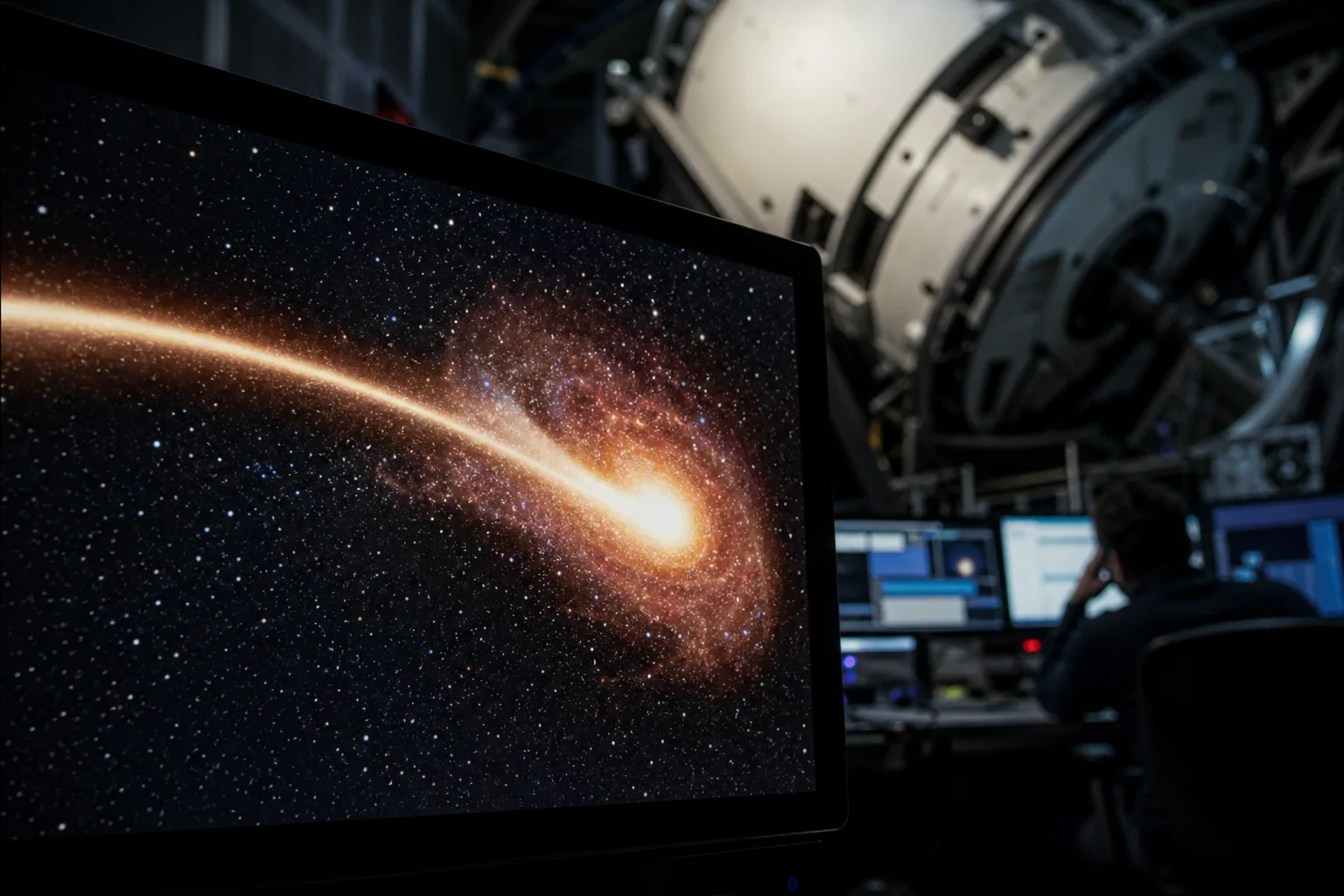
Sometimes the universe hands astronomers a clue they weren’t expecting. A stellar death detected recently turned out to be far more interesting than a routine cosmic event — because the black hole responsible for it had no business being where it was. The culprit was a wandering black hole, a supermassive beast unmoored from any galactic center, caught in the act of tearing a star apart. It’s the kind of discovery that raises more questions than it answers, and that’s exactly what makes it so compelling.
- A wandering black hole not anchored to any visible galaxy’s center was caught tearing apart a nearby star.
- The tidal disruption event, AT2024tvd, gave astronomers a rare direct signal from a wandering black hole in action.
- Findings published in The Astrophysical Journal Letters suggest the black hole was likely stripped from a merged or disrupted galaxy.
- Off-center stellar deaths like AT2024tvd could become a key tool for locating rogue supermassive black holes across the universe.
Table of Contents
A Stellar Death in the Wrong Place
The event in question is catalogued as AT2024tvd, a tidal disruption event — the technical term for what happens when a star wanders too close to a black hole and gets stretched and shredded by the extreme gravitational gradient. These events are violent, luminous, and mercifully brief on cosmic timescales. They’re also one of the few ways we can spot black holes that aren’t actively feeding on surrounding gas.
What made AT2024tvd stand out immediately was its position. Tidal disruption events are expected to originate from the centers of galaxies, because that’s where supermassive black holes live. The signal from AT2024tvd didn’t come from any galactic center. It was off-axis — spatially displaced from where you’d expect it. That single geometric clue set off a chain of investigation that led researchers to a remarkable conclusion: the black hole responsible isn’t anchored to any visible galaxy at all. It’s a wandering black hole, and it’s traveling alone.
What Is a Wandering Black Hole, Exactly?
The short answer is a supermassive black hole that has been displaced from its host galaxy — or whose host galaxy no longer meaningfully exists around it. Supermassive black holes, those with masses ranging from millions to billions of times that of our Sun, are thought to reside at the cores of virtually every large galaxy. The Milky Way has one: Sagittarius A*, famously imaged by the Event Horizon Telescope collaboration in 2022.
But galaxies collide, merge, and disrupt each other constantly on cosmic timescales. When two galaxies merge, their central black holes can interact through a complex gravitational dance. In some scenarios, one black hole gets ejected from the resulting merged system entirely — flung out like a stone from a sling. In others, the host galaxy gets tidally disrupted or simply too diffuse to remain recognizable, leaving its central black hole effectively homeless.
A true wandering black hole is then an object of enormous mass with no bright galactic nucleus around it, no accretion disk to make it shine, and no easy way to detect it directly. It’s dark, massive, and moving. Finding one is extraordinarily difficult — which is precisely why AT2024tvd matters so much.
How a Dying Star Revealed a Hidden Monster
Tidal disruption events are becoming one of astrophysics’ most powerful diagnostic tools, and AT2024tvd is a prime example of why. When a star gets pulled apart, the debris heats up and radiates intensely across multiple wavelengths — X-rays, ultraviolet, optical light. Modern sky surveys like the Zwicky Transient Facility are built to catch exactly these kinds of transient brightening events, flagging them for follow-up observations.
Once AT2024tvd was flagged and its off-center position confirmed, the research team worked to rule out mundane explanations. Could the apparent offset be a measurement artifact? Could a smaller, fainter galaxy be hosting a more ordinary supermassive black hole? After careful analysis, the evidence pointed instead toward a genuinely displaced black hole — a wandering black hole that happened to intersect the path of an unfortunate star.
The findings were detailed in a paper published on June 12 in The Astrophysical Journal Letters, a peer-reviewed journal that focuses on rapid communications of significant astrophysical results. The specificity and confidence of the conclusions reflect how much our detection and analysis capabilities have improved in recent years.
Why Wandering Black Holes Have Been So Hard to Find
The fundamental problem with a wandering black hole is that it doesn’t advertise itself. Active galactic nuclei — the blazing cores of galaxies where a central black hole is actively consuming material — are among the brightest objects in the observable universe. They’re impossible to miss. A dormant supermassive black hole drifting through intergalactic space, on the other hand, emits essentially nothing detectable. It’s like trying to spot a dark boulder on a moonless night.
Theorists have long predicted that wandering black holes should exist, and in meaningful numbers. Galaxy mergers are common across cosmic history, and simulations suggest that not every black hole ends up neatly settled at the center of a post-merger remnant. Some get kicked to the outskirts of galaxies. Some, in extreme cases, may escape galaxies entirely. But predictions and detections are very different things, and confirmed examples have been frustratingly rare.
That’s why AT2024tvd is significant beyond its own individual story. It demonstrates that tidal disruption events — stellar deaths — can serve as beacons for these otherwise invisible objects. If a wandering black hole strays into a region with enough stellar density to eventually catch a victim, that moment of destruction becomes detectable across billions of light-years.
The Broader Picture: Rogue Black Holes and Galaxy Evolution
The implications here connect directly to some of the biggest open questions in modern astrophysics. How common are wandering black holes? How far can they travel from their origin points? Could there be dormant supermassive black holes lurking in the outskirts of our own local galaxy group? These aren’t idle speculations — they bear on our understanding of how galaxies grow, merge, and evolve over billions of years.
The mass of the black hole involved in AT2024tvd hasn’t been widely publicized yet, but the very fact that it’s classified as supermassive puts it in a category that profoundly influences the structures around it. A supermassive black hole doesn’t just sit there passively — it shapes the space, gas, and stellar dynamics in its vicinity, even when it’s not actively feeding.
For the broader field, the key takeaway from AT2024tvd might be methodological rather than just observational. Tidal disruption events are now arriving at a rate of dozens per year thanks to next-generation survey telescopes. If even a small fraction of those turn out to be off-center like AT2024tvd, astronomers suddenly have a statistical sample to work with — enough to start mapping the population of wandering black holes across cosmic history.
The Rubin Observatory’s Legacy Survey of Space and Time, set to come fully online in the mid-2020s, is expected to detect tidal disruption events at an unprecedented rate. It’s entirely possible that AT2024tvd is just the first clearly confirmed case in what will become a recognized class of events — and that the universe has many more hidden monsters waiting to betray their positions the same way, one shredded star at a time.
Frequently Asked Questions
What is a wandering black hole and why is it unusual?
A wandering black hole is a supermassive black hole not located at the center of a visible galaxy. Most supermassive black holes anchor the cores of galaxies, so finding one adrift is genuinely rare and scientifically significant.
What is a tidal disruption event and how does AT2024tvd fit in?
A tidal disruption event occurs when a star passes close enough to a black hole to be ripped apart by gravitational forces, releasing a bright flare of radiation. AT2024tvd is one such event, notable because it happened off-center — pointing to a black hole not sitting at the heart of any galaxy.
How do astronomers detect a wandering black hole if it has no galaxy around it?
Without a host galaxy to betray its position, a wandering black hole is essentially invisible — until it destroys something. Tidal disruption events like AT2024tvd produce intense, detectable bursts of light that act as beacons, letting astronomers pinpoint a black hole’s location even in otherwise empty space.
Where were the AT2024tvd findings published?
The research was published on June 12 in The Astrophysical Journal Letters.