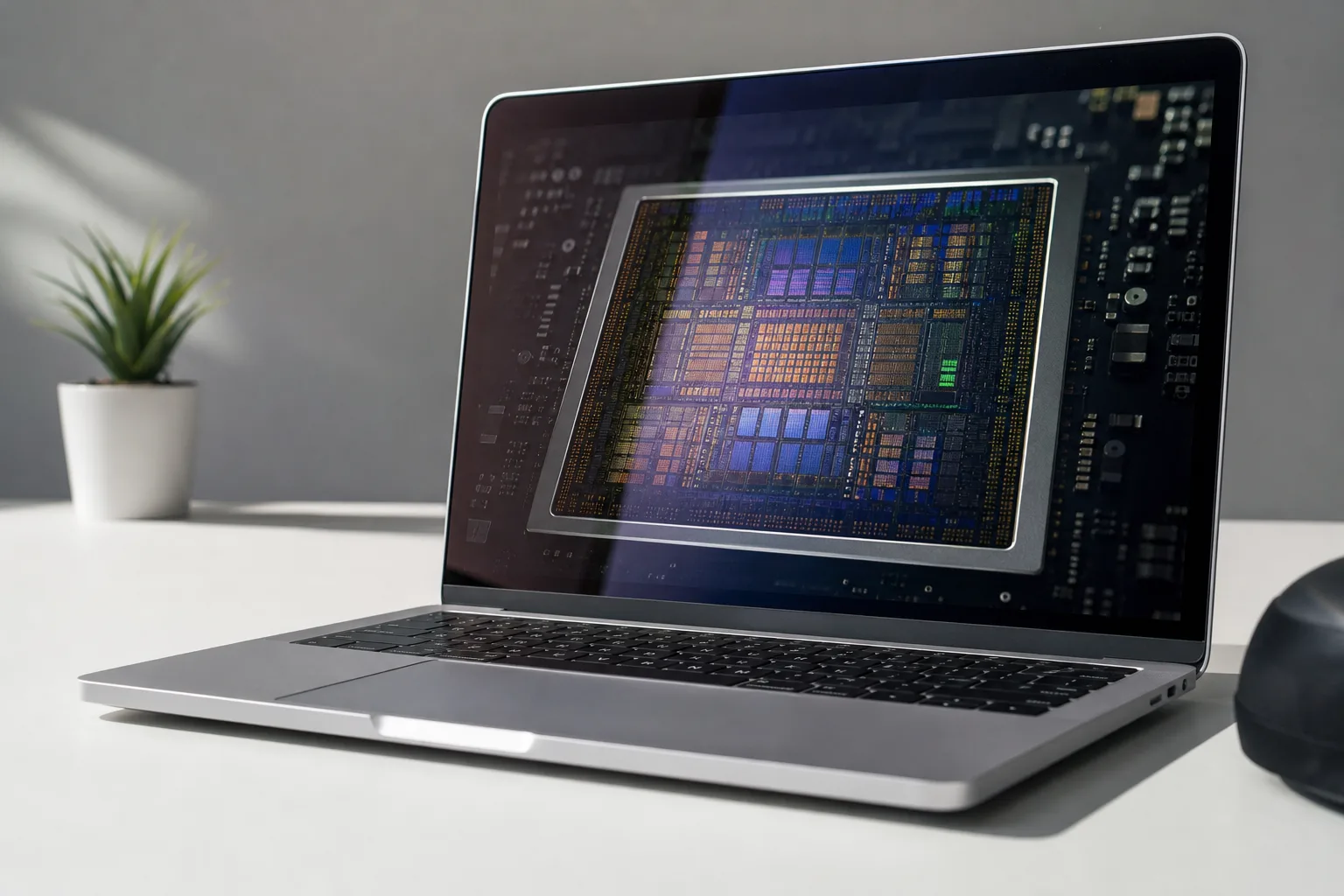
The Apple Silicon roadmap just got a lot more interesting — and a fair bit stranger. A new report is claiming that Apple plans to skip the M6 Pro and M6 Max chips entirely, a decision that has immediate consequences for the company’s most anticipated upcoming Mac: the touchscreen MacBook. At the same time, Apple is quietly lobbying the Trump administration to greenlight imports of Chinese-made RAM, a move that lays bare just how tangled the company’s supply chain has become under the current US trade regime.
- The Apple Silicon roadmap will skip the M6 Pro and M6 Max entirely, according to a credible new report.
- Apple’s upcoming touchscreen MacBook will run M5 Pro and M5 Max chips rather than next-gen Apple Silicon roadmap hardware.
- Apple is separately lobbying the Trump administration to approve imports of Chinese-made RAM amid tariff-driven price pressure.
- Together these moves signal Apple is managing its chip strategy more conservatively amid global supply chain uncertainty.
Table of Contents
Apple Silicon Roadmap Takes a Detour: No M6 Pro or M6 Max
The report, surfaced by 9to5Mac, is blunt: Apple will not ship an M6 Pro or an M6 Max chip. That’s a notable departure from the cadence Apple has established since transitioning from Intel. With the M1 through M5 generations, the company has consistently delivered a base chip followed by Pro, Max, and Ultra variants — each stepping up core counts, memory bandwidth, and GPU performance. Skipping two of those four tiers isn’t a minor footnote. It’s a meaningful deviation in the Apple Silicon roadmap.
What’s driving the decision? Apple hasn’t said, and it’s unlikely to before any official product announcement. But the timing is worth examining. TSMC’s next-generation process nodes are under enormous demand pressure — Nvidia, Qualcomm, AMD, and Apple are all competing for leading-edge fab capacity. It’s plausible that Apple is making a strategic call to concentrate its most advanced wafer allocations on the base M6 and jump straight to a more capable M7 Pro and M7 Max, rather than release mid-cycle silicon that might underwhelm relative to where the competition is heading. Analysts tracking the Apple Silicon roadmap closely will note this is the first time such a skip has been reported across an entire chip tier.
There’s also a product portfolio logic here. The M6 Pro and M6 Max historically power the MacBook Pro 14-inch and 16-inch, and the Mac Studio. If those machines stick with M5 Pro and M5 Max for a longer cycle, it wouldn’t be unprecedented — Apple kept the Mac Pro on Intel longer than anyone expected, and the company has shown it’s willing to let certain product lines sit a generation behind when the business case supports it.
The Touchscreen MacBook Gets M5 Pro and M5 Max, Not M6
The most direct casualty of this Apple Silicon roadmap shift is the touchscreen MacBook — arguably the most talked-about unannounced Mac in years. The device, which would represent the first Apple laptop with a touch-enabled display since the company abandoned the Touch Bar, had been widely assumed to debut with next-generation silicon. It won’t, if this report is accurate. Instead, it’s set to launch with M5 Pro and M5 Max chips.
That’s not necessarily a bad outcome for buyers. The M5 Pro and M5 Max are genuinely fast chips — capable of handling professional video editing, 3D rendering, and machine learning workloads that would have required a workstation just a few years ago. The touchscreen MacBook’s appeal was never purely about raw compute anyway. It’s about the form factor shift: a Mac that can accept stylus or finger input while still running macOS properly, without the compromises of iPad’s iPadOS. The chip powering it matters less than whether Apple can actually pull off the software experience.
Still, launching a new product category on last-generation silicon carries a real risk. Apple positions the Mac as premium hardware, and ‘it’s new but not the newest chip’ is a headline the company would probably prefer to avoid. There’ll be buyers who wait for a second-generation touchscreen MacBook with whatever M6 or M7 silicon Apple has ready by then. How the Apple Silicon roadmap evolves from that point will determine whether the skipped variants are remembered as a stumble or a calculated reset.
Apple vs. Tariffs: Asking Trump to Approve Chinese RAM
Separate from the chip architecture story, but deeply connected to it financially, is Apple’s push to get Chinese-manufactured RAM approved by the Trump administration. According to the report, Apple has formally asked for the exemption following price increases caused by existing tariffs on Chinese goods.
This is a window into the pressure Apple is navigating. The company has spent years diversifying its supply chain toward India and Vietnam, but memory — DRAM in particular — remains heavily concentrated in a handful of Asian manufacturers, and China sits inside that supply web. When tariffs hit, the cost gets passed somewhere. Apple is clearly trying to ensure it doesn’t get passed to the consumer in a way that hurts sales volume.
The tariff exemption request also signals something broader: Apple’s relationship with the US executive branch is now a meaningful business variable. The company that once prided itself on supply chain predictability is now navigating geopolitical uncertainty as a core operational challenge. Tim Cook has historically cultivated relationships with political leadership — he attended Trump’s inauguration dinner and has been visible at White House meetings — and those relationships are being put to work in concrete ways. The memory cost pressure is one more external force reshaping the Apple Silicon roadmap and the products built around it.
Whether the exemption gets approved is an open question. The Trump administration has shown willingness to grant carve-outs for major US companies on specific components, but it’s done so inconsistently and often with conditions. For Apple, the stakes are high enough that it’s asking anyway.
What This All Adds Up To
Taken together, these three stories paint a picture of an Apple that’s managing its hardware strategy more carefully — and more reactively — than the polished product keynotes suggest. The Apple Silicon roadmap is being reshaped not just by technical decisions but by supply chain economics, trade policy, and product portfolio timing.
Skipping M6 Pro and M6 Max isn’t a crisis. Apple’s silicon is still comfortably ahead of the Windows PC competition on performance-per-watt, and the M5 generation will satisfy most professional users for another cycle. But the decision does compress the product differentiation story that Apple relies on to justify its premium pricing — and it hands the touchscreen MacBook a slightly awkward debut narrative.
The RAM tariff issue is a reminder that no matter how much Apple invests in its own chip design, it can’t vertically integrate everything. Memory is a dependency it can’t engineer away, and trade policy can move faster than supply chain restructuring.
Investors and Mac enthusiasts alike should watch for what Apple announces at WWDC and beyond. If the Apple Silicon roadmap is genuinely skipping two major chip variants, the company will need to make that story land convincingly — or face an unusual round of questions about where its hardware is actually headed.