
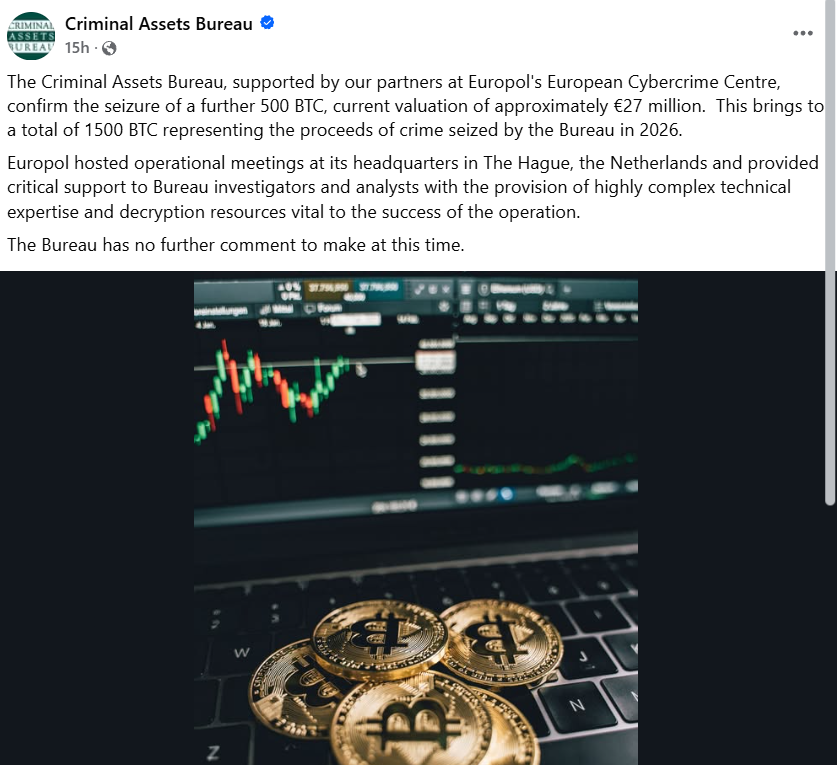
Ireland’s Criminal Assets Bureau has quietly become one of Europe’s most active enforcers of crypto-asset recovery, and 2026 is shaping up to be its biggest year on record. The latest Irish Bitcoin seizure — another 500 BTC, valued at roughly €27 million (about $30.9 million) — pushes the bureau’s year-to-date total to 1,500 BTC, or approximately $92.4 million. That’s a remarkable haul. But the far more intriguing story is the $277 million in Bitcoin that’s still sitting out there, tied to a convicted drug dealer, a missing piece of paper, and a fishing rod.
- The Irish Bitcoin seizure total for 2026 has reached 1,500 BTC, worth approximately $92.4 million, following three separate 500 BTC recoveries.
- Ireland’s Criminal Assets Bureau conducted the latest Irish Bitcoin seizure in collaboration with Europol’s European Cybercrime Centre.
- Wallets linked to convicted drug dealer Clifton Collins still hold an estimated 4,500 BTC — roughly $277 million — untouched by authorities.
- Collins allegedly bought 6,000 Bitcoin in 2011–2012 with drug proceeds and stored wallet keys on a single sheet of paper, which was reportedly lost.
Table of Contents
Three Seizures, One Very Busy Bureau
The Criminal Assets Bureau — known in Ireland simply as CAB — confirmed Thursday’s 500 BTC recovery via a social media post, noting that Europol’s European Cybercrime Centre had provided ‘operational coordination, technical expertise and decryption support’ during the investigation. That last detail matters. Decryption support typically implies the wallet in question wasn’t simply handed over — authorities had to work to get inside it. CAB offered no further comment and declined to identify the wallet owner or elaborate on the broader investigation.
This is the third Irish Bitcoin seizure of exactly 500 BTC in 2026. Whether that’s coincidence or a coordinated strategy to methodically work through a known cluster of wallets is something CAB isn’t saying. But the pattern is hard to ignore, and the on-chain data tells its own story. Each Irish Bitcoin seizure in this sequence has followed a remarkably consistent structure, which analysts say points to a deliberate, wallet-by-wallet enforcement strategy rather than opportunistic recoveries.
The Clifton Collins Connection — and 4,500 BTC Still Unaccounted For
The backdrop here is one of crypto’s stranger true-crime episodes. Clifton Collins, an Irish drug dealer arrested in 2017 after police found cannabis in his car, allegedly used proceeds from his operation to purchase around 6,000 Bitcoin between late 2011 and early 2012 — back when BTC was worth pocket change. He spread the holdings across 12 wallets. His security setup? A single sheet of A4 paper bearing the private keys, reportedly tucked inside the aluminium cap of a fishing rod case at his rental property.
Then he got arrested. His landlord — apparently unaware of what was stored there — allegedly cleared out his belongings. Collins has claimed the fishing rod was stolen before the landlord ever entered the property. Either way, the paper was gone, and with it, ostensibly, access to what is now a nine-figure fortune. The Irish Times later reported that the wallet accessed by CAB in March was one of those original 12 Collins wallets, and that authorities had somehow managed to gain entry to at least one of them despite the private key reportedly being lost. Each confirmed Irish Bitcoin seizure from this cluster represents a significant technical and legal achievement given those circumstances.
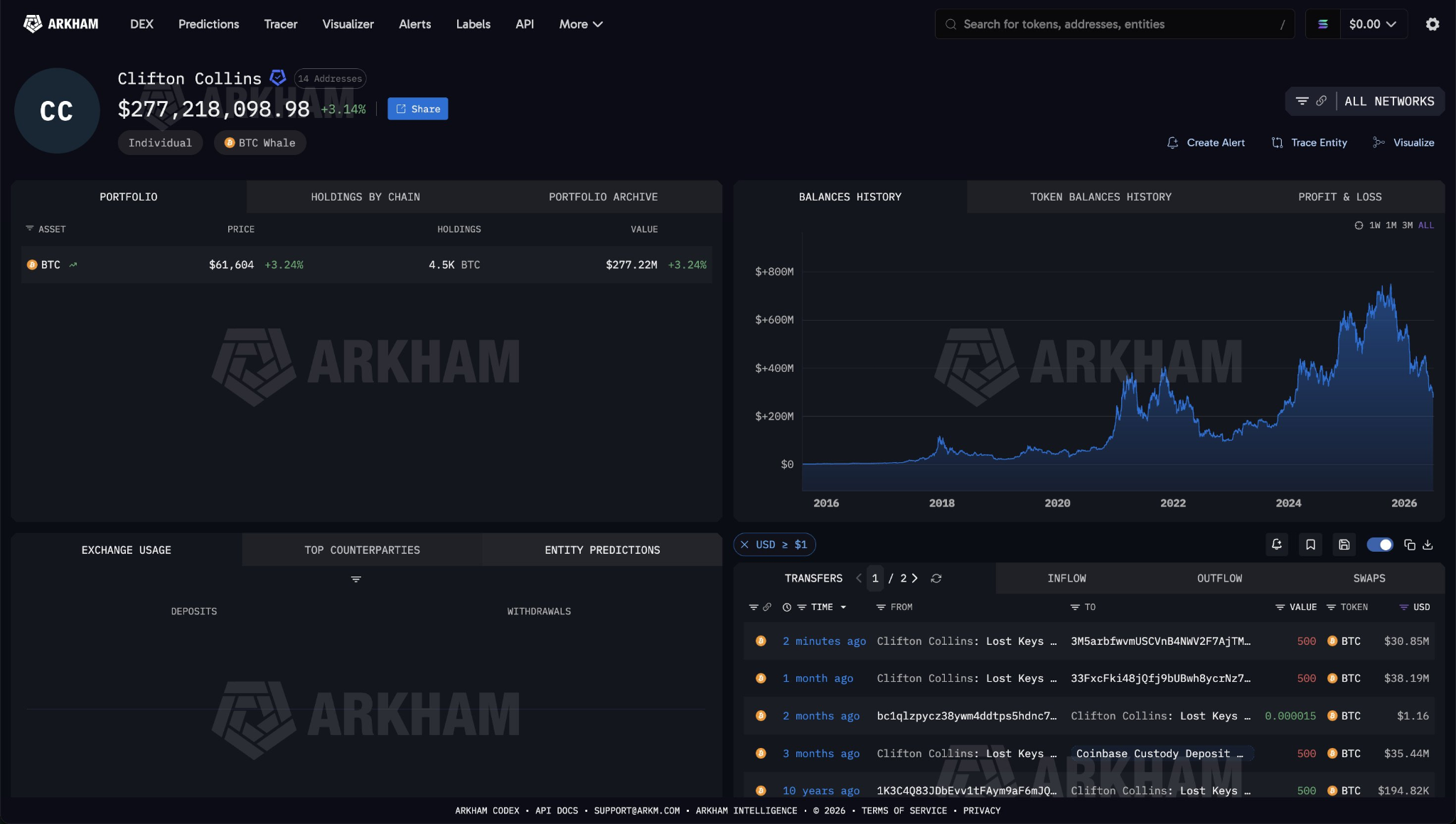
Following Thursday’s seizure, Arkham Intelligence data showed a wallet address associated with Collins moving 500 Bitcoin to an unknown address — the timing is suspicious, to put it mildly. And as of Friday, wallets tied to Collins still hold an estimated 4,500 BTC, worth around $277 million at current prices. The Irish Bitcoin seizure campaign has barely scratched the surface of what’s potentially still recoverable.
How Do You Seize a Wallet Without the Private Key?
This is the question that doesn’t get asked enough in coverage of crypto law enforcement. Traditional asset seizure is relatively straightforward — freeze a bank account, impound a vehicle. But Bitcoin wallets are different. Without the private key, you simply can’t move the funds. So how is CAB doing it?
Europol’s involvement is telling. ‘Decryption support’ in this context most likely refers to one of a few possibilities: authorities may have found a copy of the private keys through physical evidence searches, they may be using sophisticated forensic tools to recover key material from devices, or — less likely but not impossible — there’s cooperation from someone with inside knowledge of the wallet structures. The bureau hasn’t explained its methodology, which is understandable from an operational security standpoint, but it does leave a gap in the public record.
What’s clear is that the Irish Bitcoin seizure operation is not a matter of simply guessing passwords. These are real cryptographic keys being accessed through some combination of legal process, technical forensics, and international cooperation. Europol’s European Cybercrime Centre has been deepening its crypto-tracing capabilities for years, and Ireland appears to be a beneficiary of that infrastructure. Every successful Irish Bitcoin seizure adds to a growing body of case law and operational precedent that other EU member states will likely reference as they build their own enforcement frameworks.
Ireland as a Crypto Enforcement Model
It’s worth putting this in European context. Many EU member states are still building the institutional muscle to deal with crypto-denominated crime at scale. Ireland’s CAB has existed since 1996 — originally created to target organised crime proceeds — and it’s adapted remarkably well to the digital asset era. Its ability to coordinate with Europol on technically complex wallet recoveries puts it ahead of most of its counterparts on the continent.
The EU’s broader push for crypto regulation, including the Markets in Crypto-Assets (MiCA) framework that came into full effect in 2024, has also created a more cooperative regulatory environment that makes cross-border law enforcement easier. Tracing and seizing crypto assets is no longer purely a technical challenge — it’s increasingly a legal and procedural one, and the infrastructure to support it is maturing fast.
For comparison, the US Department of Justice has seized billions in Bitcoin over the past several years — most famously the 94,000 BTC tied to the 2016 Bitfinex hack, recovered in 2022. The UK’s Metropolitan Police has made significant seizures too. Ireland’s numbers are smaller in absolute terms, but relative to the country’s size and the specific nature of this investigation, the 2026 Irish Bitcoin seizure campaign is significant.
The $277 Million Question
The story isn’t over. With 4,500 BTC still in wallets associated with Collins, and Thursday’s on-chain movement suggesting someone is actively managing at least some of those funds, this case has a long way to run. CAB will be watching every transaction. So will the blockchain analytics firms that law enforcement increasingly relies on — companies like Chainalysis, Elliptic, and Arkham, whose tools can trace fund flows across wallets and exchanges in near real-time.
The deeper question is what happens to funds that can’t be legally accessed. If the private keys to some of those remaining 4,500 BTC are genuinely lost, authorities face an impasse. They can prove the funds are criminally derived. They can watch the wallets. But without the keys, or without someone deciding to move the funds to a traceable exchange, the Bitcoin just sits there — frozen by circumstance rather than by law.
And if someone is moving those funds — as Thursday’s on-chain data suggests — it raises an uncomfortable possibility: whoever has access to the Collins wallets may be one step ahead, quietly liquidating before the next Irish Bitcoin seizure warrant arrives. At $277 million and counting, that’s a race worth watching very closely.
Frequently Asked Questions
How much Bitcoin has Ireland’s Criminal Assets Bureau seized in total through the Irish Bitcoin seizure campaign in 2026?
Ireland’s CAB has seized a total of 1,500 BTC in 2026, with a combined value of approximately $92.4 million. The latest 500 BTC recovery was carried out with operational and technical support from Europol’s European Cybercrime Centre.
Who is Clifton Collins and how is he connected to the seized Bitcoin?
Clifton Collins is an Irish convicted drug dealer arrested in 2017. Police allege he used drug proceeds to buy around 6,000 Bitcoin in late 2011 and early 2012, spread across 12 wallets. He stored private keys on a piece of A4 paper, which may have been discarded after his arrest.
How much Bitcoin linked to Clifton Collins remains unrecovered?
According to on-chain data tracked by Arkham, wallets associated with Collins still hold approximately 4,500 BTC — worth around $277 million as of Friday. Authorities have not confirmed whether these wallets are the direct target of ongoing investigations.
What role did Europol play in recovering the latest 500 Bitcoin?
Europol’s European Cybercrime Centre provided operational coordination, technical expertise, and decryption support during the investigation. CAB did not provide further details about the specific tools or methods used to access the wallet.