

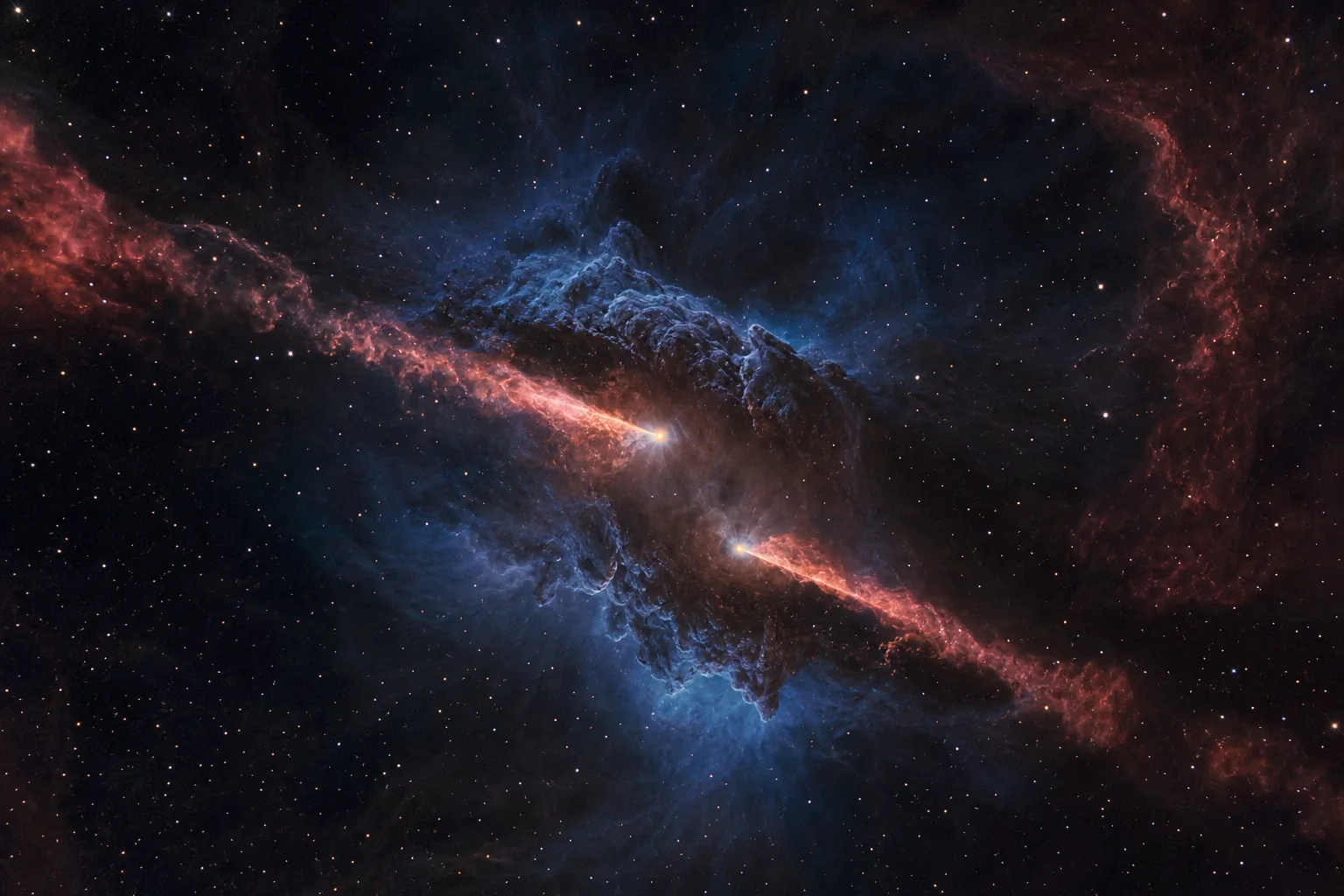
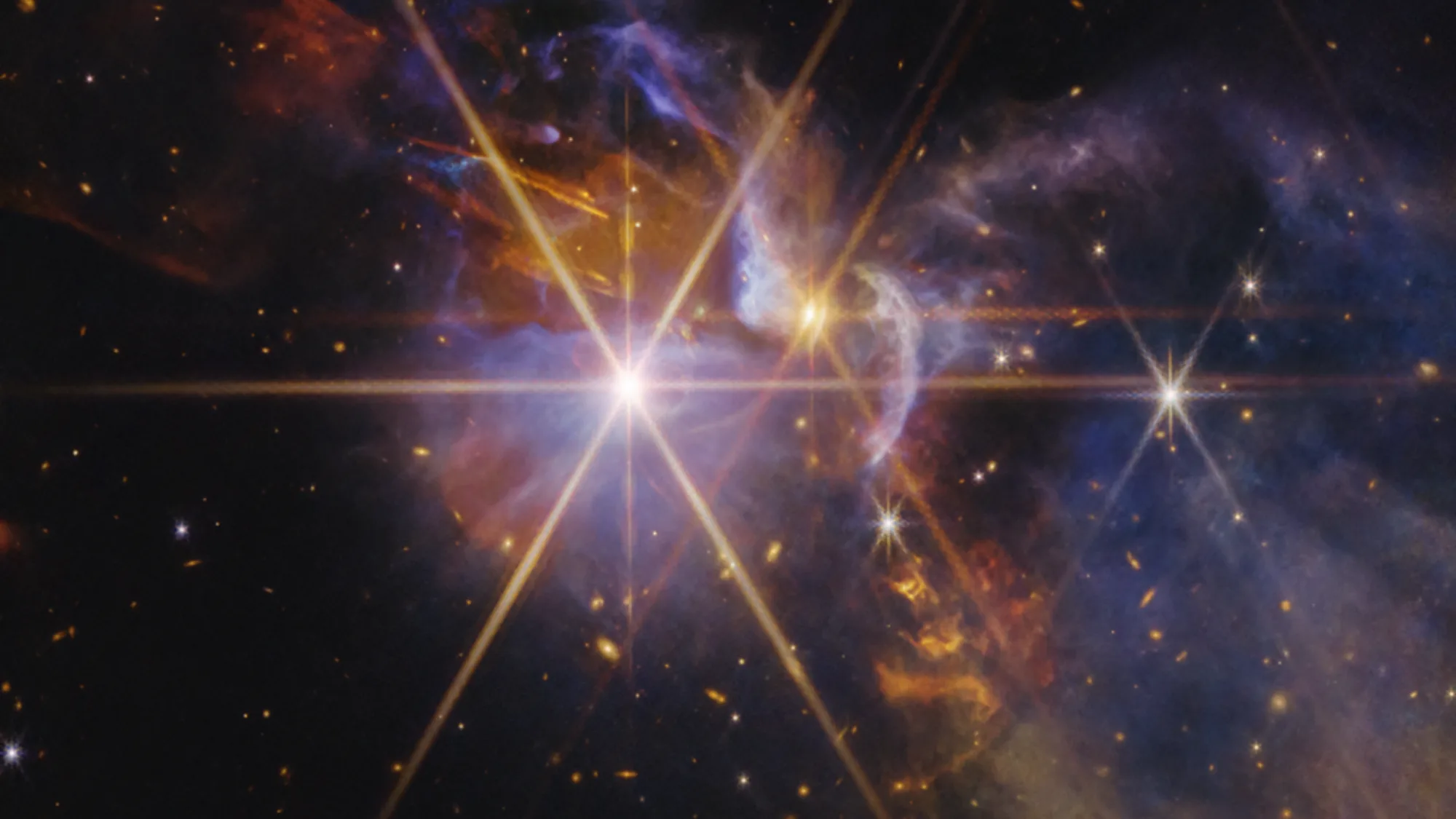
NASA has released a new image from the James Webb Space Telescope showing infant stars in the FS Tau star-forming region firing dramatic jets of gas and dust into surrounding space. The timing was deliberate — the agency released it to celebrate America’s 250th birthday, framing the cosmic outbursts as a celestial parallel to Independence Day fireworks. It’s a neat bit of symbolism, and honestly, the image earns it.
- NASA’s JWST captured infant stars in the FS Tau region, just 450 light-years away, in striking infrared detail.
- The infant stars are firing episodic jets of material, supporting a long-debated theory about how protostars gather mass.
- Blue ridges visible in the image show gas shunted by protostar outflows, creating dense light-reflecting structures.
- NASA released the image to mark the 250th anniversary of the United States, timing the cosmic fireworks deliberately.
Table of Contents
What JWST Found in FS Tau
FS Tau sits roughly 450 light-years from Earth, placing it squarely among the nearest star-forming regions we can study in any real detail. It’s been on astronomers’ radar for years, but earlier instruments could only scratch the surface — literally. Dense clouds of molecular gas and dust that cradle infant stars are essentially opaque to visible light, which made deep observation with something like Hubble frustratingly limited.
JWST changes that equation entirely. Its infrared sensitivity lets it cut through those clouds the way a thermal camera sees through fog. What emerged in the FS Tau image is a portrait of protostars in the act of becoming — blazing outflows, compressed gas ridges, and structural gaps that tell a surprisingly detailed story about how stars are actually born.
The Physics Behind the Fireworks
To understand why the image looks the way it does, it helps to know what infant stars are actually doing at this stage of their lives. A protostar begins as a cold, dense patch inside a molecular cloud — a region where gas and dust have clustered together and begun collapsing under their own gravity. As the clump contracts, it heats up, and surrounding material keeps spiraling inward.
But the infall isn’t clean or passive. As infant stars pull material from their surrounding discs, they also periodically blast some of it back out — launching high-velocity jets along their polar axes. These outflows punch into the surrounding cloud, compressing the gas they hit and carving out distinctive structures. In the JWST image, those structures appear as vivid blue ridges: dense gas regions that have been physically shunted aside and are now reflecting light from the protostars nearby.
What makes the FS Tau image particularly interesting to researchers isn’t just the visual drama — it’s the gaps between those jets. Those pauses in the outflow pattern support the idea that protostars don’t accumulate material in a smooth, continuous stream. Instead, they accrete in bursts, pulling in matter episodically with periods of relative dormancy in between. It’s a model that’s been theoretically supported for a while, but seeing the physical fingerprints of it in this kind of detail is a different matter entirely.
Why Infrared Makes All the Difference
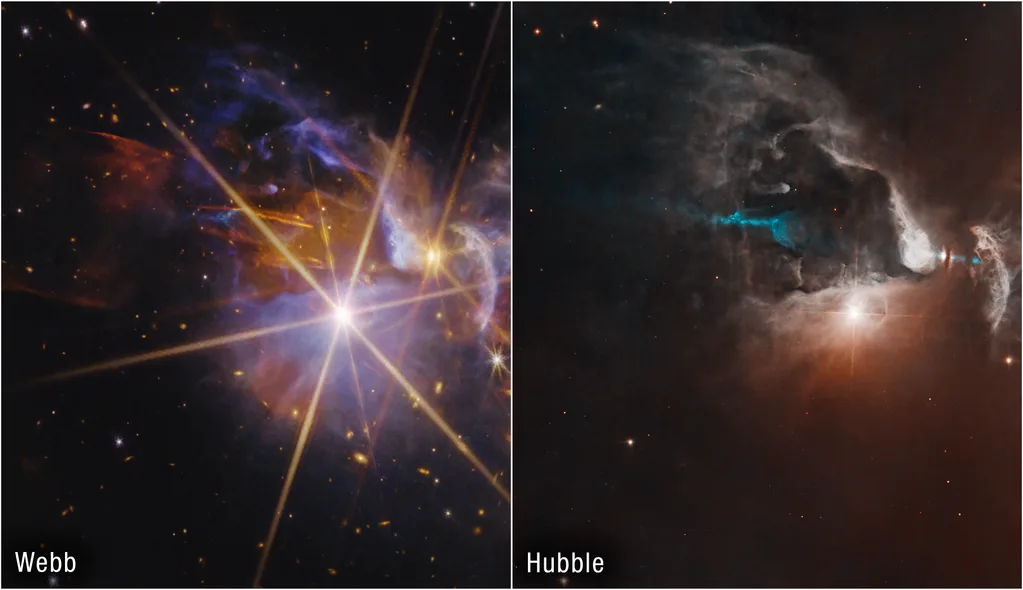
The comparison between what Hubble previously captured in FS Tau and what JWST now shows is stark. Hubble’s visible-light observations revealed the broader environment — wisps of nebulosity, the rough positions of stellar objects — but the thick inner cloud remained a wall. JWST’s near- and mid-infrared instruments pierce that opacity, resolving the infant stars themselves and the fine structure of their outflows with a clarity that simply wasn’t possible before.
This isn’t just about prettier pictures. One of the central goals of studying regions like FS Tau is understanding what astronomers call ‘feedback’ — the way radiation and outflowing material from young, low-mass stars reshape the molecular clouds around them. Does a protostar’s activity accelerate or suppress further star formation nearby? Does it inject enough energy to disperse the cloud entirely, or does it help trigger new collapses in compressed regions? The answers have implications for understanding galaxy evolution at scales far larger than any single star system.
Low-mass stars are a particularly important focus here because they’re the most common type in the universe. Our own Sun is a low-mass star, which means the processes on display in FS Tau are directly relevant to understanding our solar system’s own ancient history. Every jet captured in the JWST image is a possible analog to something that happened in our own stellar neighbourhood some 4.6 billion years ago.
Infant Stars and the Bigger Picture for JWST Science
This release fits into a broader pattern of JWST science that keeps delivering on the telescope’s core promise: seeing through dust to the hidden machinery of the universe. Since its first science images were released, NASA’s James Webb Space Telescope has imaged everything from the atmospheric composition of exoplanets to the earliest galaxies, but its contributions to star formation research have been consistently striking.
FS Tau isn’t an isolated case. JWST has now returned detailed imagery from several star-forming regions, including the Carina Nebula’s ‘Cosmic Cliffs’ and the Orion Nebula’s inner core, building up a comparative picture of how these environments differ and what universal patterns emerge. Each new target adds data points to models that theorists have been refining for decades.
The episodic accretion story visible in FS Tau, for instance, echoes findings from other young stellar regions and gives observational weight to simulations that have long predicted this kind of bursty behaviour. There’s a slow but real convergence happening between theoretical models and direct observation — and JWST is the instrument making that convergence possible on the timescale of a few years rather than a few decades.

What Comes Next
NASA’s choice to frame the FS Tau release around a national holiday is partly PR, but it also reflects how confident the agency is in the image’s visual impact. The blue ridges, the glowing outflows, the structural symmetry of the jets — this is the kind of image that does genuine public communication work, translating abstract astrophysics into something viscerally beautiful.
For the researchers involved, the real work now is in the data underlying that image. Spectroscopic follow-up on the outflow structures can reveal their chemical composition and velocity, helping pin down exactly how much energy infant stars are injecting into their surroundings. Longer observation campaigns will track whether the accretion gaps visible now persist, widen, or close — giving dynamical insight into the timescales of these episodic bursts.
FS Tau isn’t going anywhere, and JWST’s observing schedule still has years of operational life ahead. If this image is the opening frame, the full story of what’s happening inside that molecular cloud is still very much being written.

