
The case for gaming data for AI keeps getting harder to dismiss — and General Intuition just made it a lot louder. The New York-based startup, valued at $2.3 billion, has closed a $320 million funding round with a roster of investors that reads like a who’s who of the AI moment: Jeff Bezos, Coatue Management, Eric Schmidt, and researchers affiliated with both MIT and Google DeepMind. The thesis is deceptively simple but genuinely provocative: if you want to build AI that truly understands the physical world, the internet isn’t enough.
- Gaming data for AI training could close the gap LLMs have in understanding how objects move through space and time.
- General Intuition, valued at $2.3 billion, just closed a $320 million round backed by Bezos, Coatue, and Eric Schmidt.
- The startup spun out of Medal TV, a gaming clip platform, giving it unique access to vast real-world gameplay footage.
- CEO Pim de Witte acknowledges serious ethical questions around whether its models could be used in defense applications.
Table of Contents
The Problem with Training AI on Text
Large language models have had a spectacular few years. ChatGPT, Claude, Gemini — these systems can write, reason, and converse at a level that would have seemed implausible five years ago. But there’s a structural weakness baked into how they’re built. They’re trained almost entirely on text, and text is a poor representation of how the physical world actually works. Words describe movement, but they don’t capture it. A sentence can tell you a ball rolls down a hill, but it can’t teach a model the underlying mechanics — the friction, the trajectory, the way momentum builds and dissipates. This is precisely why researchers have begun looking at gaming data for AI as a richer alternative to text-only corpora.
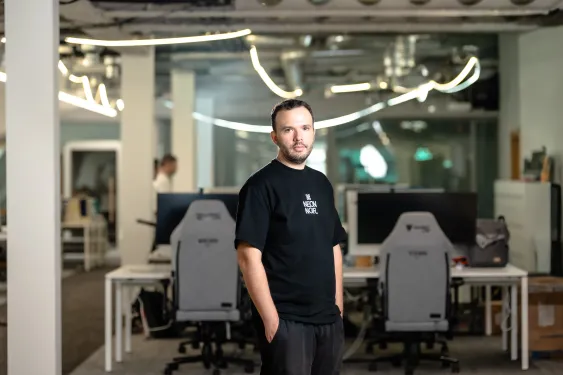
This is the gap that General Intuition CEO Pim de Witte is targeting. In his framing, achieving artificial general intelligence requires AI that can reason about how things move through space and time — not just how words relate to other words. Text-only training, no matter how vast the corpus, hits a ceiling when it comes to physical intuition. That’s why the company is building what are called ‘world models’: AI systems that develop an internal simulation of how environments behave, rather than a statistical map of human language.

Why Gaming Data for AI Makes Structural Sense
So why games? The answer isn’t as niche as it sounds. Gaming data for AI offers something genuinely rare: continuous, high-fidelity recordings of agents — human players — making decisions in dynamic, physics-governed environments, second by second, across millions of hours of footage. Unlike dashcam video or robot sensor logs, gaming footage is already paired with intent. A player aiming, dodging, building, or navigating is expressing a constant stream of cause-and-effect reasoning that’s visible in the data.
Compare that to the kind of data scraped from the open web. Web data is overwhelmingly static, decontextualized, and optimized for human reading rather than machine learning about physics. A Reddit thread describing a car crash tells you almost nothing useful about the dynamics of a car crash. A first-person shooter clip, by contrast, contains spatial geometry, object permanence, reaction timing, and environmental consequence — all in one frame sequence. The case for using gaming data for AI becomes even clearer when you stack those properties side by side against any other freely available video dataset.
This is also why the company’s origin story matters. General Intuition didn’t start from scratch hunting for gaming data for AI training — it spun out of Medal TV, a platform built around gaming highlights and clip sharing. That heritage gave it a pre-existing, enormous library of player-generated footage before it wrote a single line of world-model training code. That kind of proprietary data moat is exactly what serious AI investors have been chasing since the training-data scarcity conversation started heating up in 2023.
The Physical AI Race and Where General Intuition Fits
General Intuition is entering what’s become an increasingly crowded but still wide-open field. Physical AI — the branch of AI research focused on understanding and interacting with the real, three-dimensional world — has attracted serious money and serious talent over the past two years. Tesla’s Optimus robot, Figure AI, and Google DeepMind’s own robotics work are all, in different ways, trying to solve the same core problem: how do you give a machine genuine spatial intelligence? For many researchers, gaming data for AI world-model training represents one of the most scalable answers available today.
Most of these efforts focus on robotics hardware as the delivery mechanism. General Intuition’s angle is different — it’s betting that the world model itself is the breakthrough, and that gaming environments are the most efficient training ground available right now at scale. It’s a software-first approach to a problem the industry often frames as a hardware challenge.
The caliber of the investor group signals that this framing is being taken seriously at the highest levels. Eric Schmidt’s continued involvement in frontier AI bets is well-documented; his presence here alongside MIT and DeepMind researchers suggests this isn’t purely a financial play but something closer to a conviction bet on the underlying science. Coatue, which has backed everything from Snap to Databricks, brings the institutional weight that turns a $2.3 billion valuation into something more than a headline number.
The Defense Question Nobody Wants to Dodge
There’s an uncomfortable thread running through General Intuition’s story that de Witte has been willing to address directly, which is more than can be said for many AI founders right now. World models trained on gaming data for AI development — built to understand how objects move, where agents are likely to go, how cause-and-effect plays out in space — are exactly the kind of technology that defense and intelligence agencies find interesting. Autonomous targeting systems, simulation environments for military planning, drone navigation models: the applications aren’t a stretch of imagination.
De Witte has spoken publicly about where the company’s ethical red lines are, though the specifics of those boundaries remain vague enough to invite scrutiny. This is the same tightrope that virtually every advanced AI company is walking right now — and very few are walking it gracefully. OpenAI reversed its own policy on military applications in early 2024. Palantir, by contrast, has leaned aggressively into defense contracts as a core part of its identity. General Intuition hasn’t declared which direction it’s heading, and at a $2.3 billion valuation with Bezos money on the table, that question is only going to get louder.
What Comes Next for World Models
The $320 million raise positions General Intuition to scale its training infrastructure and, presumably, to start demonstrating that world models built on gaming data for AI research actually generalize beyond game environments — into robotics, autonomous vehicles, or industrial simulation. That’s the leap that separates an interesting research project from a company that justifies its valuation.
The broader bet here is that the AI field is approaching a point where the bottleneck isn’t raw compute or model architecture — it’s the quality and type of data going in. If that’s true, then whoever controls the richest, most physically grounded datasets has a structural advantage that’s genuinely hard to replicate. Gaming data for AI, in that context, isn’t a curiosity. It’s a calculated land-grab on a resource the rest of the industry hasn’t fully recognized yet. Whether General Intuition can turn that advantage into deployable, real-world intelligence is the question that $320 million is now riding on.
Frequently Asked Questions
Why is gaming data for AI considered better than internet data?
Internet data is mostly text, which is great for language tasks but poor at teaching AI how objects behave physically over time. Gaming data captures dynamic environments with spatial and temporal context that text-based data lacks, which may help AI models better understand how things move through space and time.
What is General Intuition and who funds it?
General Intuition is a New York-based AI startup valued at $2.3 billion that trains world models on gaming data. Its investors include Jeff Bezos, Coatue, Eric Schmidt, and researchers from MIT and Google DeepMind. It recently closed a $320 million funding round.
How did General Intuition get its gaming data?
The company spun out of Medal TV, a gaming platform. That origin gave it access to gaming data — a valuable dataset for training AI models that need to understand physical, real-time environments.
What are the ethical concerns around General Intuition’s technology?
The source notes that world models trained on gaming data could potentially be used for defense applications, and CEO Pim de Witte has discussed where the company draws ethical red lines on such use. The specifics of those boundaries are touched on in the company’s public discussions.