


XRP has been through a genuine stress test. The late-June sell-off that pushed the token toward $1.02 wasn’t just a routine pullback — it was a leverage flush, the kind that strips out the crowded, over-extended futures positions that can turn a 5% dip into a 20% wipeout. The good news is that the excess has largely cleared. The harder question, the one the market now has to answer, is whether XRP ETF demand and organic spot buying can actually carry the price from here.
- XRP ETF demand must now drive recovery after late-June’s leverage flush removed excess futures pressure from the market.
- XRP ETF demand stayed positive during June 22–26, pulling in $22.99M while Bitcoin and Ethereum ETFs bled $2.06B.
- XRP open interest sits near $2.35 billion — large enough for leveraged trading to dominate price action again if spot buyers retreat.
- Futures still account for the vast majority of XRP’s daily turnover, making any spot-led rally the exception rather than the rule.
Table of Contents
What the Washout Actually Cleared
To understand where XRP stands now, you have to understand what happened at the end of June. The token fell to around $1.02, long liquidations accelerated, and realized losses hit their weakest reading since 2022. Futures turnover — a proxy for speculative appetite — dropped to roughly $2.84 billion, down from more than $30 billion during the same window a year earlier. That’s a collapse in trading activity that signals genuine capitulation, not just a temporary lull. Analysts tracking XRP ETF demand noted that even during this turbulence, regulated product flows remained a stabilising counterweight to the futures-driven chaos.
Open interest, which tracks the total value of active futures contracts still held by traders, fell to approximately $2.34 billion as the selling intensified. According to CoinGlass’s open-interest explainer, falling OI can reflect forced liquidations, voluntary position exits, or traders simply reducing exposure as volatility spikes. In XRP’s case it was probably all three at once. The net result: fewer traders are now sitting at leverage levels that could be triggered by the next 10% move.
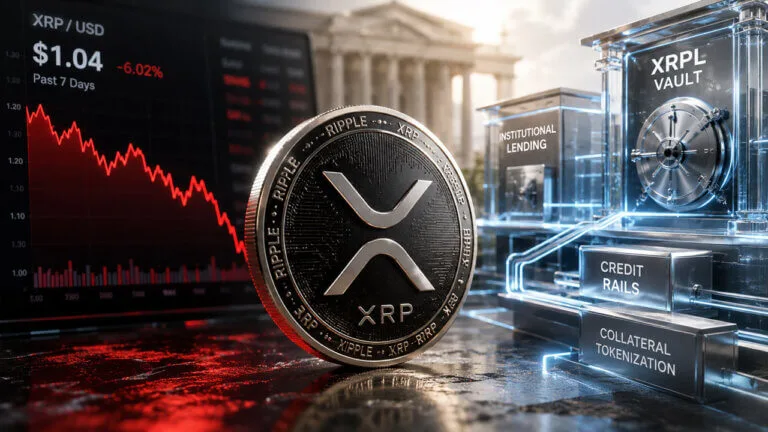
That’s meaningfully better than it was. Liquidation cascades — where one wave of forced selling triggers another — are one of the most destructive features of heavily leveraged crypto markets. XRP saw exactly that dynamic building through June, and the washout removed a good chunk of that risk. The token has since stabilised around $1.08, up about 2.7% over seven days, with a market cap hovering near $67 billion. Not a dramatic recovery, but arguably a healthier one because it’s not being driven by fresh leveraged bets piling back in. Whether XRP ETF demand can fill the void left by retreating speculators is now the market’s central question.
XRP ETF Demand: The Signal That Actually Matters Now
Here’s where things get interesting. Once the forced sellers are gone, a market can either drift sideways or find genuine new buyers. For XRP, the clearest indicator of real, non-leveraged demand right now is its regulated ETF products — and the flow data from late June told a story worth paying attention to. Monitoring XRP ETF demand week by week has become one of the more reliable ways to separate structural buying from speculative noise.
During the week of June 22–26, U.S. spot Bitcoin ETFs shed approximately $1.79 billion in assets. U.S. Ethereum ETFs lost around $273.5 million. XRP spot ETFs, by contrast, pulled in $22.99 million. That’s a notable divergence. Institutions were cutting their broadest crypto exposure — the blue-chip stuff — while selectively adding to XRP products. It doesn’t signal a full rotation, but it does suggest some allocators see value at these levels that they didn’t see in BTC or ETH at current prices.

A separate fund-flow report from CoinShares, dated June 1, pointed in the same direction. Digital asset investment products saw $1.67 billion in outflows that week, with Bitcoin accounting for $1.438 billion and Ethereum losing $257 million. XRP drew $20.3 million in net inflows, making it one of the only altcoins with meaningful positive XRP ETF demand during a period of broad institutional de-risking.
Taken together, these two data points paint a consistent picture: XRP ETF demand has held up during risk-off conditions where larger assets have struggled to retain capital. That’s a genuinely encouraging signal. But — and this is a real caveat — $22 million sitting next to $2 billion in outflows from Bitcoin and Ethereum is still a rounding error in the grand scheme of crypto capital flows. It demonstrates resilience, not dominance.
What Spot ETF Inflows Actually Represent
It matters that these are spot ETFs, not futures-based products. The Franklin XRP ETF S-1 filing makes this explicit: the fund is passive, designed to track the price of XRP before expenses, and it explicitly avoids leverage, derivatives, or similar instruments. Every dollar flowing into a spot XRP ETF represents a real, direct claim on the underlying asset — not a side bet on price direction through the derivatives market. That structural difference means XRP ETF demand is a qualitatively different signal than a spike in open interest. ETF inflows don’t unwind in a liquidation cascade, which is precisely why they matter more at this stage of the cycle.
The Maths Don’t Fully Favour the Bulls Yet
Even with the leverage reduction and the relatively steady ETF flows, XRP’s market structure still has some awkward features. CoinGlass data shows roughly $402 million in 24-hour spot volume against approximately $2.25 billion in futures volume — meaning derivatives account for around 85% of XRP’s visible daily turnover. That ratio hasn’t changed dramatically even after the washout. The derivatives market still sets the price discovery rhythm, and that creates a lingering vulnerability. Growing XRP ETF demand is one of the few credible paths to shifting that balance toward more durable, spot-driven price action.
Open interest has already crept back up to around $2.35 billion. That’s not alarming, but it’s worth watching. If speculative traders rebuild their leveraged longs faster than spot demand grows — whether through ETF creations, direct exchange purchases, or institutional OTC deals — XRP could find itself back in the same crowded trade it just escaped. The leverage-driven volatility amplifier doesn’t need to be as extreme as it was in late June to cause damage.
Bitcoin dominance sitting at 58.2% and Ethereum at 9.9% is also a reminder that XRP is still operating in a market where the two largest assets consume the majority of attention and capital. Any broad crypto rally tends to lift all boats, but the opposite is also true. A fresh BTC sell-off would likely test whether XRP ETF demand can absorb the resulting selling pressure or whether it simply pauses until conditions improve.

Where This Leaves XRP Going Forward
The late-June reset did what resets are supposed to do. It eliminated the most fragile part of XRP’s market structure — the over-leveraged long positions that were one bad news cycle away from triggering a cascade. The token can now recover from a cleaner base, and a modest rally from here won’t automatically detonate a pile of underwater futures contracts.
But stabilisation and a sustained trend are two different things. For XRP to build genuine upward momentum, XRP ETF demand needs to scale up significantly from the $20–23 million weekly run-rate we’ve seen so far. Spot volume needs to grow as a share of overall turnover, not shrink back toward the single-digit percentage it’s been flirting with. And the derivatives market needs to stay balanced rather than swinging back toward heavy long concentration.
The structural story for XRP — regulatory clarity improving, spot ETFs now live in the U.S., institutional access expanding — hasn’t changed. But structural narratives don’t move prices on their own. They create the conditions for demand to show up. Whether that demand actually materialises at scale, particularly through the ETF channel, is now the only question that matters. The leverage flush bought XRP some breathing room. What happens with that breathing room is still an open question.
Frequently Asked Questions
Is XRP ETF demand strong enough to sustain a price recovery?
XRP ETF demand has been directionally positive, with products drawing roughly $22.99 million during a week when Bitcoin and Ethereum ETFs saw over $2 billion in combined outflows. The inflows are encouraging but still too small in absolute terms to anchor a major sustained rally without parallel strength in spot volume.
What happened to XRP’s open interest during the late-June washout?
XRP’s open interest dropped to around $2.34 billion as prices fell toward $1.07 and roughly $9 million in long liquidations were triggered. Futures turnover also collapsed, falling to about $2.84 billion from levels exceeding $30 billion during the same period a year earlier.
How do XRP spot ETFs differ from futures-based crypto products?
Spot XRP ETFs like the Franklin XRP ETF hold actual XRP rather than derivatives contracts. Their S-1 filing states the fund is passive, tracks XRP’s price before expenses, and explicitly avoids leverage, derivatives, or similar instruments — making inflows a signal of genuine spot-equivalent demand.
Why does leverage matter so much to XRP’s price stability?
When futures open interest is high and concentrated on the long side, a sharp price drop can trigger a cascade of forced liquidations that amplifies the move downward. The late-June flush reduced that crowding, but with open interest still at $2.35 billion, the risk of a leverage-driven spiral hasn’t disappeared entirely.

