- Exynos 2700 reportedly outscored Qualcomm’s Snapdragon 8 Elite Gen 6 Pro in Samsung’s internal CPU, gaming, and AI evaluations.
- The Exynos 2700 allegedly used 12.7% less power while delivering a 24% gaming lead in low-power testing conditions.
- Samsung’s figures remain unverified, and retail Galaxy S27 phones will determine whether the claimed gains survive real-world thermal limits.
- If Exynos really pulls off a win, Samsung could regain control over flagship phone costs, supply, and the performance differences between its own devices.
Table of Contents
Exynos 2700 may finally have a case to make
For years, seeing an Exynos badge on a Samsung flagship has prompted a very reasonable question: did buyers in that region get the lesser version? A fresh South Korean report says the Exynos 2700 could flip that familiar script when it arrives in parts of the Galaxy S27 lineup. If Samsung’s internal figures are close to reality, Qualcomm has a proper fight on its hands.
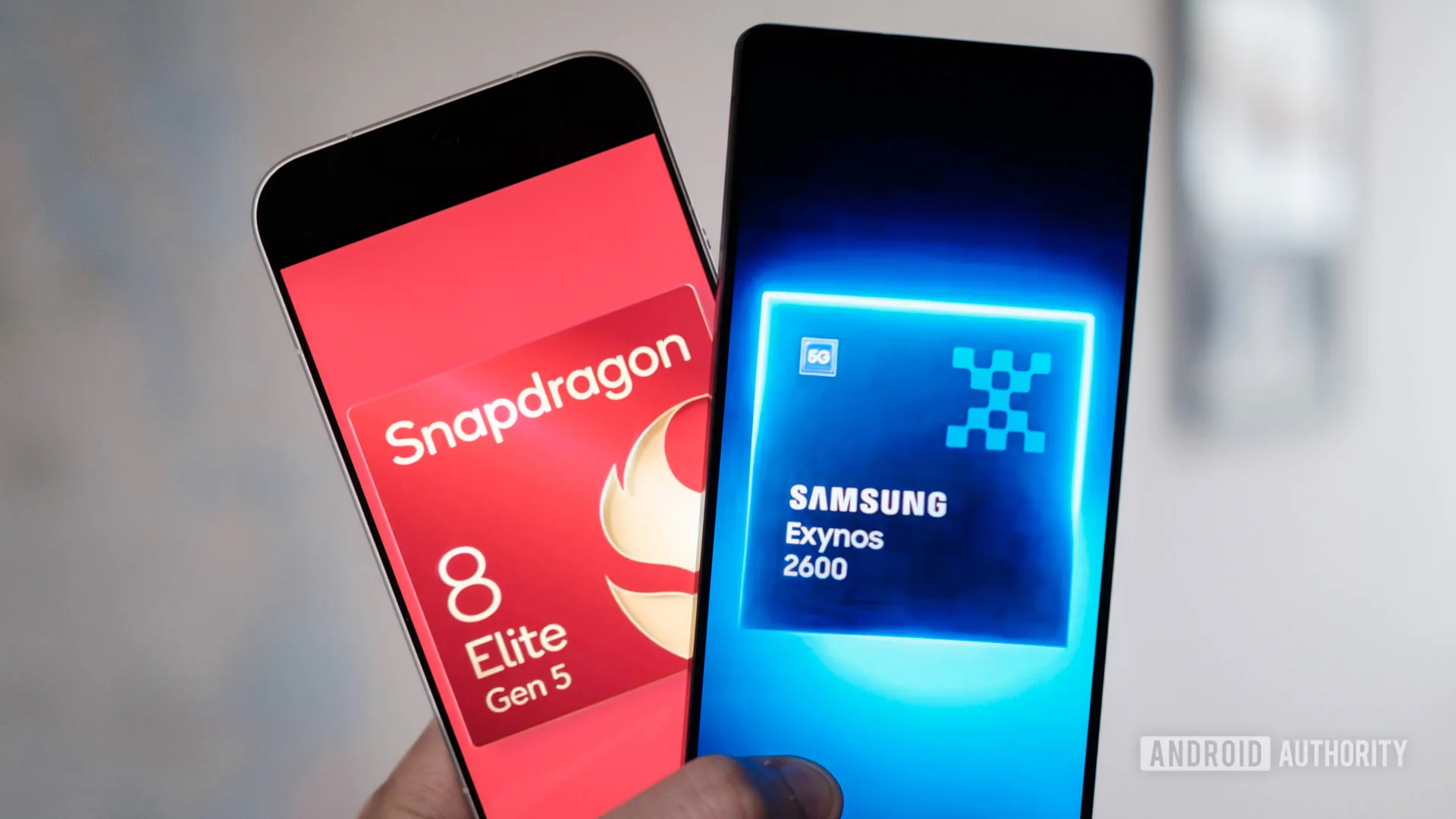
According to reporting from SEDaily, Samsung compared its forthcoming chip with Qualcomm’s Snapdragon 8 Elite Gen 6 and higher-tier Snapdragon 8 Elite Gen 6 Pro. The claimed margins are not trivial. Samsung’s silicon reportedly delivered a 19% lead over the standard Qualcomm part in Geekbench 6.5 multicore testing, and a 9.5% lead over the Pro model.
That is an attention-grabbing claim, but I’d keep the champagne in the fridge. These are said to be Samsung’s own evaluations, not a published test suite from an independent lab using commercial phones. Chip companies test rivals constantly; they also select workloads, power limits, cooling arrangements, and software versions that show their own hardware at its best. That is normal competitive behavior, not necessarily bad faith. It does mean the numbers are evidence, not a verdict.
Why the reported gaming and power figures matter more
The multicore score may grab the headline, but the gaming results are more revealing. The report says the Exynos 2700 was 5% faster in peak gaming performance than Qualcomm’s Pro chip, then stretched that advantage to 24% in a low-power gaming test. It also allegedly consumed 12.7% less power than the Snapdragon 8 Elite Gen 6 Pro.
For anyone who actually uses a phone rather than screenshotting benchmark charts, this is the part to watch. A handset can post a blistering score for 90 seconds and still become a tiny hand-warmer halfway through a match. Sustained performance depends on the whole package: GPU design, memory, screen resolution, modem load, the phone maker’s thermal hardware, ambient temperature, and the often aggressive software rules used to prevent a meltdown.
Low-power performance is especially interesting because it gets at the compromise every flagship phone makes. You want Genshin Impact or Fortnite to stay smooth, but you also want battery life that does not vanish before dinner. A chip that holds comparable frame rates at lower wattage offers phone makers more room to choose: quieter cooling, a thinner chassis, longer play time, or some mix of all three. Samsung has frequently had to defend Exynos devices against complaints about heat and sustained graphics performance. The Exynos 2700 is being positioned as an answer to exactly that history.
Samsung also has a manufacturing problem to solve. Its chip division and foundry business need a flagship win badly. Qualcomm’s premium Snapdragon processors have become the default safe choice for Android makers, while Apple remains the obvious benchmark for tight silicon-and-device integration. A strong Exynos part could help Samsung reduce its dependence on Qualcomm in Galaxy S phones while proving its process technology can support top-tier mobile silicon at volume.
AI claims need a closer look
The report also assigns the Exynos 2700 an 18% advantage in generating AI responses and a 5% edge in recognizing and processing prompts. Those labels are frustratingly broad. On-device AI results can change dramatically based on the model size, quantization method, memory bandwidth, and whether the task runs on an NPU, GPU, or CPU. ‘Generating a response’ sounds clear until you ask: using which model, at what token length, and under what thermal limit?
Samsung has an obvious incentive to push this area. Galaxy AI has become central to the company’s smartphone pitch, from translation and transcription to image editing and writing tools. The company reportedly sees a mix of on-device and cloud processing as part of the future user experience, as described in its Galaxy AI announcement. Better local AI throughput could mean faster features, lower reliance on a data connection, and fewer tasks sent to remote servers. It could also mean very little if the useful features remain gated by software policy or subscriptions. We have all seen impressive hardware features sit idle behind a vague ‘coming soon’ label.
Samsung has made this promise before
Samsung’s Exynos reputation did not become uneven by accident. Across several Galaxy generations, regional comparisons found Snapdragon variants ahead in graphics, battery endurance, or sustained workloads. The Galaxy S22 era was particularly bruising: the company later faced scrutiny over its Game Optimizing Service and the way it managed performance in thousands of apps. Samsung has improved since then, and the company’s recent strategy of mixing Exynos and Snapdragon by market reflects both technical constraints and supply realities. But consumers remember when their expensive phone seems to run hotter than the version sold elsewhere.
That memory is why the Exynos 2700 has a higher burden than a typical annual chip upgrade. It cannot merely win one Geekbench run. It needs to behave well in a Galaxy S27 after 20 minutes of gaming, while shooting 4K video, using 5G, navigating in a hot car, and surviving a full day away from a charger. Frankly, that is a much harder exam than an internal slide deck suggests.
What to wait for before calling a winner
The first independent comparisons should focus on matched Galaxy S27 models where possible, with the same display settings, battery health, software build, and network conditions. Reviewers should test short bursts and long sessions, then examine battery drain, surface temperature, camera processing speed, modem behavior, and performance after repeated runs. A lower score after ten minutes is not automatically failure; what matters is whether the Exynos 2700 reaches a sensible balance instead of collapsing under load.
My read is that Samsung may genuinely be closer than it has been in years. The reported low-power gaming result, if it holds up, is more persuasive than a headline CPU number because efficiency is where great mobile chips separate themselves. But Qualcomm has not released its next flagship hardware for public testing, and Samsung has not placed final retail phones in reviewers’ hands. Until that happens, this is a promising leak with a large asterisk. The Galaxy S27 could turn Samsung’s regional chip split from an apology into an advantage—or remind us why buyers learned to check the processor before ordering.