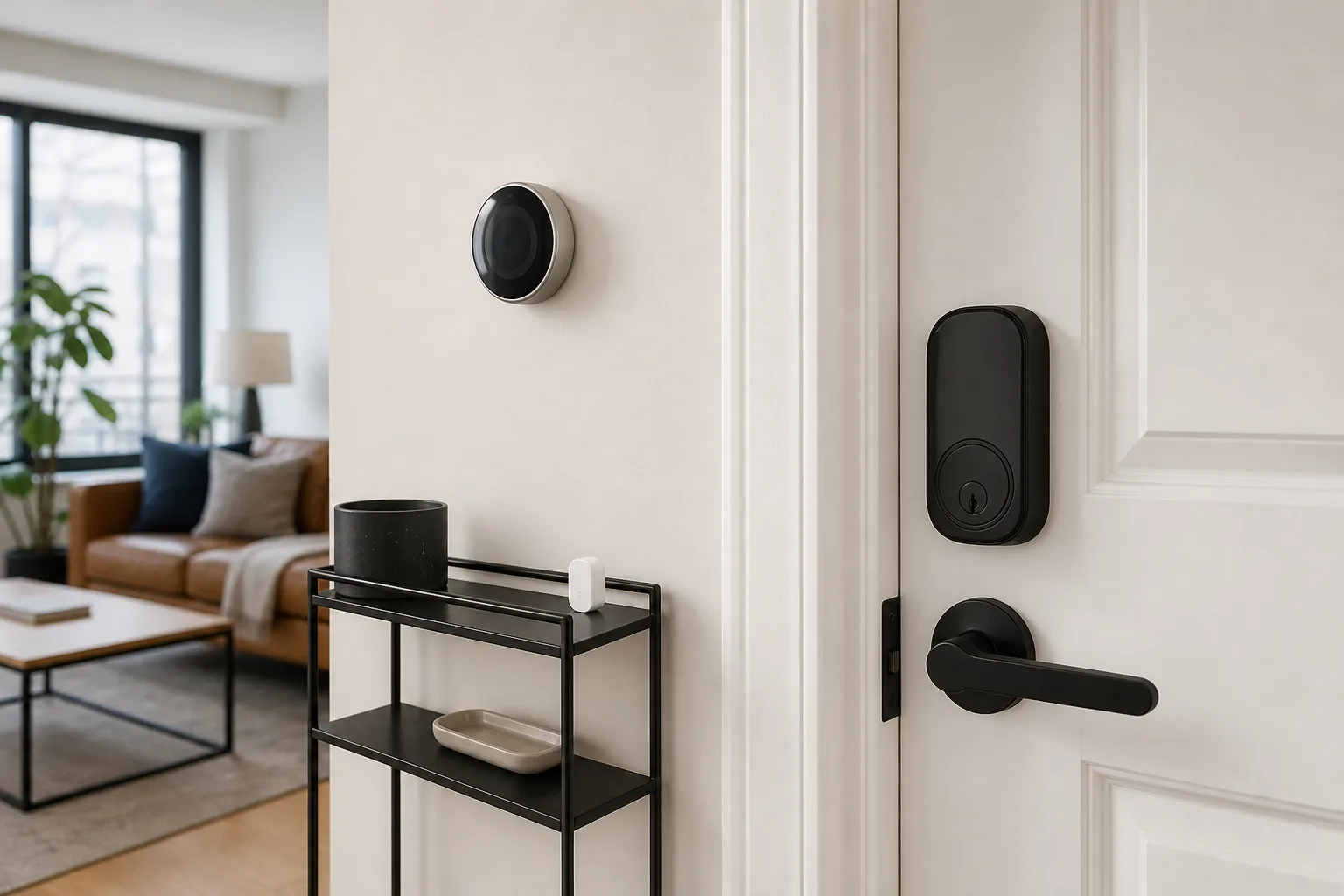
- The Apple LG smart home leak points to a deadbolt lock, thermostat and compact temperature-and-humidity sensor under LG branding.
- Apple LG smart home products could give Apple Home users more hardware choices without forcing Apple to sell every accessory itself.
- The leaked lock reportedly combines a rotating keypad, tap-to-unlock support, emergency power and traditional mechanical backup keys.
- Reports also point to cameras and a video doorbell, though neither Apple nor LG has publicly confirmed the wider lineup.
Table of Contents
Apple LG smart home hardware is starting with the boring stuff
A smart lock, a thermostat and a small environmental sensor may not sound like the stuff of a blockbuster Apple event. But the reported Apple LG smart home lineup could matter precisely because these are the devices people interact with every day, often without thinking about them. A leak attributed to known Apple-device leaker pdfu offers what appears to be an early look at three LG-branded accessories said to have been developed with Apple’s involvement.
The images show a door lock, a circular thermostat and a compact temperature sensor. If they are authentic, this is Apple taking a far more pragmatic route into the home: help build the plumbing, let an established appliance company put its name on the box, and make sure it works properly with Apple Home. Frankly, that is a more believable strategy than waiting for Apple to suddenly become a full-scale thermostat and lock manufacturer.
The reported products are expected to wear LG branding rather than Apple’s. That distinction is important. Apple has spent years making HomeKit and, more recently, Matter support into a selling point, but its own first-party home hardware has remained remarkably thin. The HomePod is useful, and the Apple TV can act as a home hub, but neither solves the very practical question of which lock, sensor or camera a household should buy.
What the Apple LG smart home leak actually shows
The most interesting of the three is the alleged LG Smart Deadbolt Lock. According to the leaked specifications, its keypad rotates to open the lock, a slightly unusual physical interaction in a category full of touchscreens and chunky thumb-turns. The design reportedly includes a swivel pin that can limit the keypad’s rotation on one side, a thoughtful detail for doors near a wall or tight entryway.
Functionally, the lock is said to support automatic unlocking and tap-to-unlock access, along with master codes and integrated emergency power. It reportedly comes with two mechanical keys as well. Good. Mechanical backups are not glamorous, but anyone who has arrived home with a dead phone, drained lock battery and groceries in both hands understands why they matter. Smart-home hardware has a bad habit of making ordinary failures feel absurdly dramatic.
The purported LG Smart Thermostat looks familiar: a circular display that follows the broad visual playbook established by Nest more than a decade ago. The settings reportedly cover humidity, screen brightness and language. There is nothing wrong with familiar here. Thermostats live on walls for years, sometimes decades, and novelty has never been their most valuable feature. Reliability, clear controls and low-friction installation count for much more. Those qualities will matter especially if Apple LG smart home hardware is meant to appeal beyond smart-home hobbyists.
Finally, the small LG Temperature Sensor is said to measure both temperature and humidity. It reportedly has a magnetic rear panel, ships with an adhesive metal plate for non-metal surfaces, and uses a replaceable battery with replacement alerts. That sounds mundane because it is mundane — but it is also the kind of inexpensive sensor that makes automations genuinely useful. A bedroom can cool down when it gets stuffy, or a fan can kick on when a sunroom overheats, without someone opening an app and poking at sliders.
Why Apple needs better partners at home
The Apple LG smart home angle makes strategic sense even though the companies have not publicly confirmed these devices. Apple’s smart-home ambitions have repeatedly run into a familiar obstacle: an ecosystem is only as good as the accessories people can find, afford and trust. For years, HomeKit shoppers faced smaller catalogues and higher prices than buyers willing to use Alexa or Google Home. Matter was supposed to reduce that friction by creating a common connectivity standard, though its rollout has been more gradual than its cheerleaders promised.
Apple explains its approach to home accessories and interoperability through its official Apple Home page, where Matter-compatible products sit alongside HomeKit devices. The company’s pitch is privacy, local control and straightforward setup. Those are sensible strengths. But software promises don’t help much if the lock you want is unavailable, the camera has spotty support, or a basic sensor costs far more than its competitors.
LG brings experience in appliances, displays and connected devices, while Apple brings a huge installed base of iPhone owners and a home platform that remains attractive to privacy-conscious buyers. An Apple LG smart home partnership could therefore plug a gap for both sides. LG gets a cleaner path into Apple households; Apple gets more credible accessories without carrying inventory, warranties and installation headaches for every category.
There is precedent for this arrangement. Apple has long relied on accessory partners, from Belkin to Eve, to flesh out its ecosystem. The difference now is that Apple seems to want a tighter hand in the experience. If these products have genuinely been co-developed, the goal may be less about slapping on compatibility badges and more about removing the annoying edge cases that make home tech feel like a weekend IT job. That would be a meaningful advantage for an Apple LG smart home rollout.
Cameras are where this gets complicated
The lock, thermostat and sensor may only be the first wave. Earlier reporting has suggested the broader Apple LG smart home effort could also include a video doorbell, indoor camera, outdoor camera and floodlight camera. Those categories are bigger bets, and much tougher ones. Ring, Google Nest, Arlo, Eufy and Aqara already occupy crowded shelves, while consumer trust around home cameras is fragile for obvious reasons.
Apple has an opening if it can make privacy a real product advantage rather than a settings-page footnote. HomeKit Secure Video has offered encrypted camera recording through iCloud plans, but the supported camera market has been limited and sometimes confusing. A well-priced Apple LG smart home camera line with genuinely simple Apple Home integration could move the needle. It would need to compete on basics too, though: notification speed, reliable motion detection, usable local storage options and sane subscription terms. Nobody wants another doorbell that sends ten alerts because a tree moved.
My read is that the cameras will determine whether this is a meaningful expansion or merely a tidy accessory refresh. Locks and sensors make an ecosystem more complete. Cameras pull people into an ecosystem and keep them there.
The real test is compatibility, not the renders
Readers should treat the details as reported rather than official. The leaked renders and specifications are plausible, but neither Apple nor LG has publicly laid out a product plan, pricing, release dates or regional availability. It also remains unclear whether every device would support Matter, Thread, Apple Home Key or all of the above. Those technical details can sound tedious; they are actually the difference between a gadget that works for years and one that becomes an expensive paperweight after a platform change.
The Apple LG smart home project will also have to avoid the trap that has caught much of the category: selling individual gadgets instead of a dependable household system. A lock should know when the household has left. A thermostat should respond to room conditions. A sensor should make automations less fiddly, not generate another notification stream. If Apple and LG can make those pieces behave like one product, they may have something. If not, consumers will see three more accessories in an aisle already packed with them.
The leak ultimately comes down to one question: can Apple turn its promise of a private, simple home into hardware people can trust? Partnering with LG could give that promise some physical weight — assuming the eventual products are as dependable as the idea is sensible.