

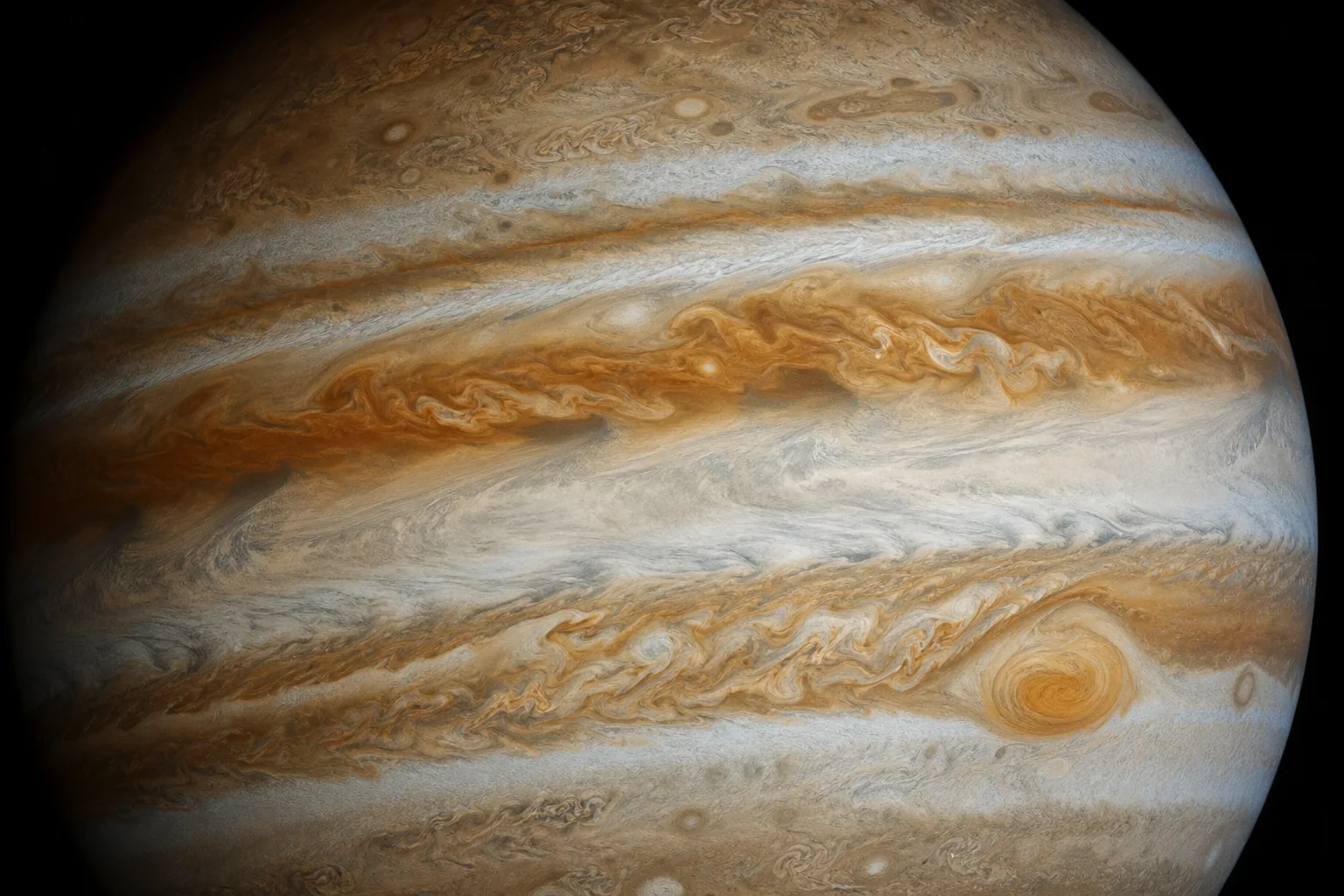
- The Juno Jupiter image highlights a chaotic atmosphere where rapidly moving clouds form bands, vortices, and richly varied colors.
- A Juno Jupiter image is more than planetary wallpaper; scientists use these views to frame questions about Jupiter’s deep weather systems.
- Juno’s long mission changed how researchers study Jupiter by pairing close flyby imagery with measurements of gravity, magnetism, and composition.
- NASA’s public image archives make complex planetary science accessible, though color-enhanced images still require careful interpretation.
Table of Contents
Juno Jupiter image turns a gas giant into a weather map
A Juno Jupiter image can make the Solar System’s largest planet look oddly familiar: creamy cloud decks curl like foam in a fast river, darker belts split and rejoin, and small storms appear caught in a traffic jam with nowhere to go. But the resemblance ends there. Jupiter has no solid surface beneath these clouds, and its weather operates at a scale that makes Earth’s largest hurricanes look almost domestic.
This story was first reported by NASA Science.
The latest Astronomy Picture of the Day selection puts those patterns front and centre. The featured view lingers on Jupiter’s vivid swirls and colors, which explains why it spreads so quickly. Beauty gets people to stop scrolling; the useful part is that the image also offers a reasonably honest glimpse of what planetary scientists are trying to untangle.
Jupiter’s atmosphere is not a quiet blanket of gas. It is a layered, violently active system driven by heat escaping from the planet’s interior, sunlight at the cloud tops, rapid rotation, and jet streams racing around the globe. A photograph freezes that motion for a moment. The science comes from working out what the frozen patterns imply about the machinery still moving beneath them.
Why a Juno Jupiter image matters beyond the color
Juno arrived at Jupiter and was designed around a basic but stubborn question: what is the giant planet actually like under its visible exterior? The spacecraft’s looping polar orbit allowed it to make close passes over regions that earlier missions could not study as thoroughly. Its cameras supplied dramatic views, but Juno’s core contribution was a suite of instruments examining gravity, magnetic fields, microwave radiation, and atmospheric particles.
A Juno Jupiter image is not a laboratory result by itself. The colors in public releases are often processed to bring out faint structures and contrast. That is normal practice in astronomy, not a trick, but readers should treat such images as carefully prepared scientific visualizations rather than a literal postcard snapped through a window.
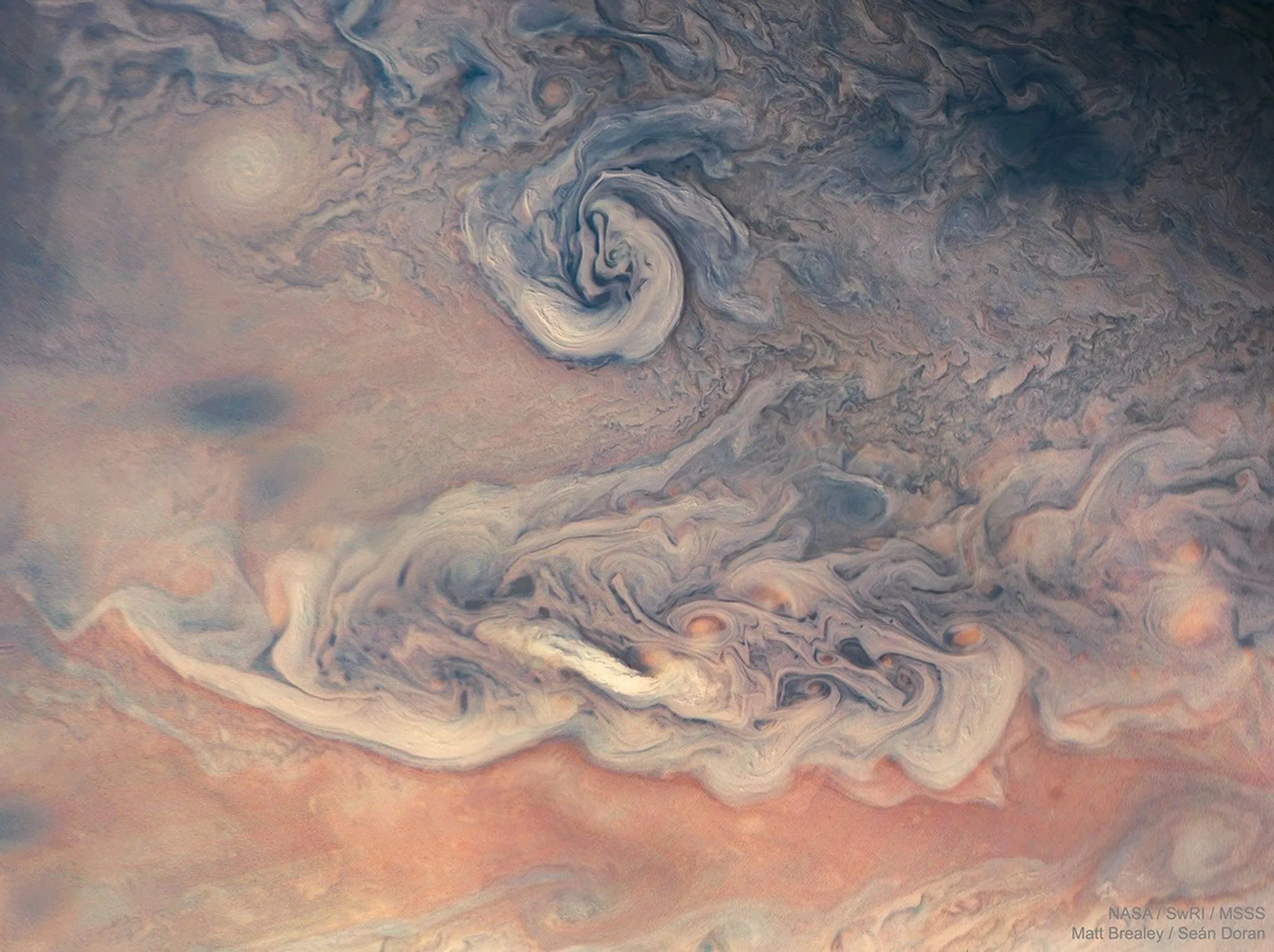
Even so, visible detail is valuable. Bright zones, darker belts, filament-like streaks and compact vortices mark boundaries where gases at different temperatures, altitudes, or chemical compositions meet. Jupiter’s east-west jet streams help maintain its famous striped appearance, while turbulence along those boundaries can spawn the elaborate curls that make a Juno Jupiter image look more like a nineteenth-century oil painting than a raw planetary data set.
Frankly, NASA has done a better job than most institutions at making this kind of science legible to non-specialists. JunoCam was conceived partly as a public-engagement camera, and citizen image processors have played a visible role in shaping some of the mission’s most memorable views. That does not replace peer-reviewed analysis. It does, however, give people a reason to care about the underlying research before a chart of gravitational harmonics enters the conversation.
Jupiter’s weather is not Earth weather with bigger clouds
The easy mistake is to see the swirls and call them storms in the everyday sense. Some are storms, of course, but Jupiter’s atmosphere does not have oceans and continents setting the terms as Earth’s weather does. There is no mountain range interrupting a jet stream, no coastline feeding a tropical cyclone, and no familiar daily surface forecast waiting underneath.
Instead, Jupiter’s rapid rotation organizes atmospheric motion into broad bands. That spin helps shape powerful jets and long-lived vortices, including the Great Red Spot, whose changing size and appearance have been tracked for generations. Researchers are still debating the full story of how deep those weather systems extend and how they exchange energy with layers below.
This is where a Juno Jupiter image earns its keep. A single frame may reveal a small cyclone spinning beside a band of stretched cloud material, or show pale high-altitude clouds pooling around darker, deeper-looking regions. Scientists can compare those forms across time and against data from other instruments. The image supplies context: it tells researchers where an atmospheric feature was and what it looked like when other measurements were taken.
NASA’s Juno mission archive makes the point clearly: the spectacular images are the shop window. The lasting value is the archive, with years of observations that can be revisited as models improve and fresh questions emerge.
The public-image problem, and the public-image opportunity
There is a tension in space imagery that agencies have never completely solved. Make images too raw and they can look flat, dark, or incomprehensible. Process them aggressively and some viewers assume the colors are invented. The sensible middle ground is transparency: explain what was captured, what processing enhanced, and what scientific interpretation remains uncertain.
For the Juno Jupiter image featured by NASA, the essential takeaway is not that Jupiter literally resembles a painted canvas. It is that the visible cloud deck contains structure at every scale, from broad bands spanning thousands of kilometres to compact, twisting features nested inside them. That complexity is the signal, not decoration.
It also offers a useful corrective to the idea that space exploration is only about landing hardware on solid ground. Orbital missions can transform a world we thought we knew. Voyager gave humanity its first close views of Jupiter’s large moons and atmospheric drama; Galileo spent years studying the Jovian system; Juno pushed closer over the poles and deeper into questions about the planet’s interior. Each mission changes the map a little.
A Juno Jupiter image will not settle the mystery of Jupiter’s formation, its diluted core, or the depths of its jet streams. No single photograph could. But it makes the scale of those unanswered questions visible. As planetary missions become more data-rich, connecting a striking image with the harder work behind it may be one of NASA’s most effective tools.
What comes after Juno’s view of the giant planet
Jupiter remains a crowded scientific target. NASA’s Europa Clipper is built to investigate Europa, the icy moon believed to conceal a global ocean beneath its crust, while the European Space Agency’s JUICE mission is aimed at the broader Jovian system and its ocean-bearing moons. Their priorities differ from Juno’s, but both will benefit from the atmospheric and magnetic context Juno helped establish.
The Juno Jupiter image is a reminder that Jupiter is not merely a photogenic backdrop for its moons. It is an active planetary laboratory, one whose atmosphere may hold clues to giant planets around other stars as well. The next question is whether future missions can connect those beautiful cloud-top swirls to a fuller picture of what is happening far below them.
Frequently Asked Questions
What does a Juno Jupiter image show?
A Juno Jupiter image can show the planet’s upper cloud tops in exceptional detail, including swirling storms, folded cloud bands, and color variations. Those visible features trace a turbulent atmosphere, but they do not reveal every layer or process beneath Jupiter’s clouds.
Why are Jupiter’s clouds different colors?
Jupiter’s colors likely reflect differences in cloud chemistry, altitude, particle size, and exposure to sunlight. Scientists are still working through the exact compounds responsible for many hues, which is why visible imagery is most useful when considered alongside Juno’s other measurements.
Did Juno only take pictures of Jupiter?
No. Juno carried instruments designed to study Jupiter’s gravity field, magnetic environment, microwave emissions, atmospheric composition, and polar regions. JunoCam produced public-facing imagery, while the broader mission was built to investigate how the giant planet formed and what lies below its visible cloud deck.