

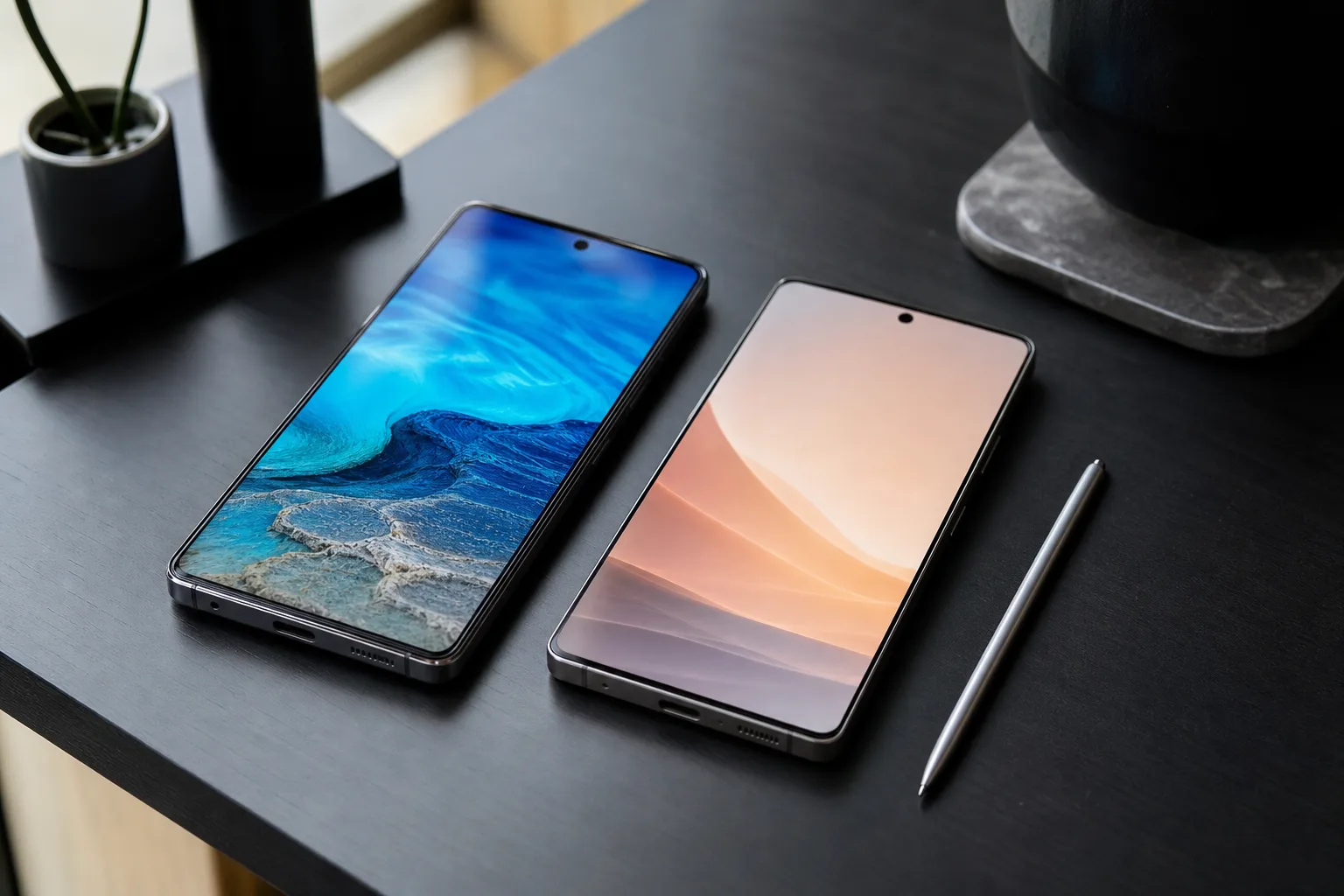
- The Galaxy S26 Ultra case rests on flexibility and useful features, not a simple battle of brand loyalty.
- Choosing a Galaxy S26 Ultra or iPhone 18 Pro will come down largely to software habits, accessories and the way you work.
- Apple and Samsung now sell mature ecosystems, which makes switching between them harder than a comparison of headline specifications suggests.
- Neither company has publicly settled the specifications, pricing or release timing for these future flagship phones.
Table of Contents
The Galaxy S26 Ultra debate is really about switching costs
The Galaxy S26 Ultra is already being framed as the phone that could pull even committed iPhone users back toward Samsung. That’s a familiar story in flagship-phone coverage, but it gets at a real consumer tension: the best phone on paper is often not the one that makes the most sense once your messages, watch, cloud storage, chargers and family group chats are involved.
A recent Android Authority article suggests the iPhone nearly ruined the author’s loyalty. The publication’s premise is less a settled product verdict than a useful prompt. Neither Apple nor Samsung has publicly announced the iPhone 18 Pro or Samsung’s next Ultra handset, so readers should be wary of treating any prospective specifications or feature claims as final.
Frankly, that uncertainty matters. Smartphone reporting has a bad habit of turning supply-chain chatter and familiar upgrade patterns into an imaginary finished product. But the broader contest is already clear enough: Apple wants people to see the iPhone as the calm centre of a tightly managed personal-tech life, while Samsung’s Ultra line has long pitched itself as the maximalist alternative for people who want more control over the device in their pocket.
That conflict won’t be decided by one benchmark chart. It will be decided by whether people value frictionless continuity or optionality when something needs doing right now.
Why the Galaxy S26 Ultra has an opening
Samsung’s Ultra phones have built their identity around abundance. Large displays, extensive camera hardware, a stylus built into the device and a feature set that often reaches beyond Apple’s more conservative version of a flagship: that is the established formula. If the Galaxy S26 Ultra follows that playbook, it will appeal to buyers who look at a phone as a pocket computer rather than an appliance designed to disappear into the background.
The stylus is a good example. Plenty of buyers will never touch it, and that’s fine. But for someone marking up a document, signing a PDF, jotting down measurements or doing a rough sketch, it can solve a small but recurring annoyance without forcing them to hunt for a tablet. Apple’s answer remains a separate iPad and Apple Pencil purchase. That may be better for serious illustration; it is plainly less convenient for a two-minute task.
Samsung also has a history of offering a broader set of camera controls and long-distance shooting options than Apple’s Pro phones. Apple, meanwhile, has often concentrated on dependable point-and-shoot results, video tools and deep integration with its editing and sharing pipeline. There’s no universal winner there. A parent recording a school concert, a traveller trying to capture a distant building detail and a creator who edits video on a Mac may each reach different conclusions.
The Galaxy S26 Ultra could therefore win attention even without an enormous technical surprise. It only needs to preserve the things Samsung users already think Apple refuses to offer: flexibility, visible hardware ambition and fewer rules about how a task should be done.
Apple’s real advantage is not a camera sensor
The iPhone 18 Pro, assuming Apple keeps its usual naming and product rhythm, will arrive with a much more formidable advantage than any individual component: accumulated habit. iMessage remains a social force in the US. Apple Watch owners cannot simply move their watch to Android. AirDrop, iCloud Photos, FaceTime, Apple Pay, shared subscriptions and Mac integration create dozens of tiny reasons not to leave.
None of those services is impossible to replace. That’s the point. Replacing them is possible, but it takes effort, coordination and occasionally a few awkward conversations. Switching platforms is like changing banks, home internet and grocery store at once: each substitution is manageable; the combined paperwork is what stops people moving.
Apple has also been unusually successful at making cross-device features ordinary rather than flashy. A call can move between devices. Photos appear where they are expected. Passwords sync. For readers already embedded in Apple’s world, the iPhone 18 Pro may be the sensible choice even if the Galaxy S26 Ultra eventually offers more visible hardware features.
That does not mean Apple’s approach is automatically superior. It means convenience has a moat. Samsung has its own ecosystem strategy with Galaxy watches, tablets, PCs and SmartThings, and Google’s services work across a far wider range of hardware. Yet Android’s strength is also its messiness: choice can be liberating, but it can put more setup decisions on the owner.
Specs are becoming a weaker reason to upgrade
For years, the flagship-phone market has operated like an arms race conducted at a kitchen-table distance. Every company can promise a brighter screen, a quicker chip or a smarter camera feature. The catch is that current premium phones are already very good. Most people aren’t replacing a two-year-old handset because it cannot open a map or take a decent photo; they replace it because battery health declines, storage fills up, a screen cracks or a particular new feature finally removes an irritation.
That is why the coming Galaxy S26 Ultra versus iPhone 18 Pro argument should be treated as a workflow decision, not a tribal referendum. Ask what happens after the unboxing. Do you need a watch that works with the phone? Do you regularly move files to a Windows PC or a Mac? Are you paying for cloud storage already? Do you want simple automatic photos, or do you want manual controls available when a difficult scene demands them?
There is also the uncomfortable question of price. Top-tier phones increasingly live in laptop territory, and both companies have trained customers to accept long financing plans as normal. That makes the resale value, repairability, software-support policy and durability of a purchase more consequential than a marginal processor gain. A phone costing four figures should last long enough that the next launch cycle feels optional.
Samsung and Apple have both expanded their software-support commitments in recent years, a welcome correction to the old annual-upgrade treadmill. Buyers should still check the exact policy once products are official, rather than relying on assumptions from an earlier model. Buyers can consult Samsung’s Galaxy S24 announcement, but future devices need their own stated terms.
Don’t confuse preference with proof
There is something refreshingly honest about a comparison that admits temptation. Technology purchases are emotional. People enjoy a coherent Apple setup, or they enjoy the sense that an Ultra phone can be bent toward whatever odd job appears during the day. Neither response is irrational.
But prospective buyers should resist declaring the Galaxy S26 Ultra a winner before Samsung reveals it, just as they should avoid assuming the iPhone 18 Pro will be the safe default because Apple made the previous iPhone. Product cycles can produce genuine improvements, but they also produce plenty of familiar updates dressed in new marketing language.
Samsung has the clearer opportunity if it can make its flexibility easier to understand and easier to use. Apple has spent years turning complexity into an invisible service layer. Samsung does not need to copy that strategy, but it does need to show why more options produce better outcomes rather than more menus.
The bigger question is whether either company can make next year’s flagship feel essential to someone holding a perfectly capable recent phone. If they cannot, the contest between the Galaxy S26 Ultra and iPhone 18 Pro may say less about technical progress than about how effectively Apple and Samsung have built habits that are difficult to break.
Frequently Asked Questions
When will the Galaxy S26 Ultra be released?
The source does not provide information about a Galaxy S26 Ultra release.
Is the Galaxy S26 Ultra better than the iPhone 18 Pro?
The source does not compare the Galaxy S26 Ultra with the iPhone 18 Pro.
What should iPhone users consider before switching to Samsung?
The source indicates that the iPhone nearly affected the author’s loyalty, but does not provide switching advice.