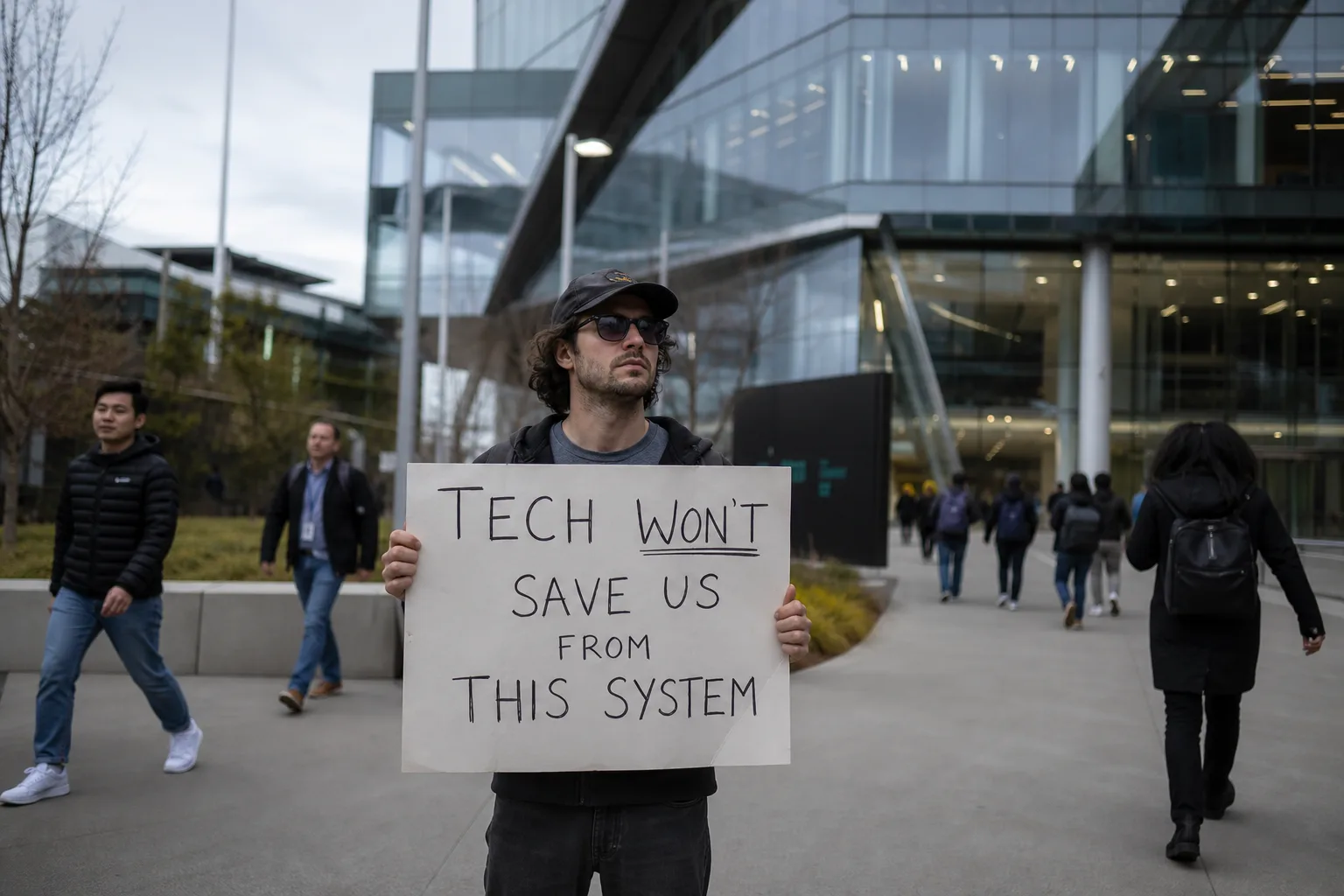
- AI backlash is intensifying across public, political, and academic circles — but investment keeps accelerating regardless.
- Despite growing AI backlash, major tech companies show no signs of pulling back on development or deployment timelines.
- Regulators worldwide are scrambling to catch up, with the EU AI Act representing the most significant legislative response so far.
- History suggests public outrage rarely derails a technology once trillion-dollar incentives are locked in.
Table of Contents
Table of Contents
- AI Backlash Is Getting Louder — So Why Isn’t Anyone Slowing Down?
- What’s Driving the Discontent
- What Would Actually Change the Trajectory?
AI Backlash Is Getting Louder — So Why Isn’t Anyone Slowing Down?
The AI backlash is real, it is loud, and it is coming from every direction at once. Artists are suing. Workers are worried. Academics are alarmed. Politicians are holding hearings. The complaints are not confined to people who distrust new technology on principle; they come from people who see a direct threat to their income, their work, or their ability to tell what is real online.
And yet, if you look at where the money is flowing and where the products are shipping, you would barely notice any of it. Microsoft, Google, Meta, Amazon, and a sprawling ecosystem of startups are pushing artificial intelligence into more corners of daily life with every passing quarter — and showing almost no signs of pumping the brakes.
That apparent contradiction is the central fact of the moment. Public approval is not the only thing that determines whether a technology advances. Corporate strategy, investor expectations, competitive pressure, and the fear of being left behind can matter far more. Once companies come to view a platform shift as strategically essential, slowing down can look riskier than moving ahead through controversy.
AI is particularly difficult to contain because it is not arriving as one product that consumers can simply reject. It is being folded into search, office software, cloud services, customer support, creative tools, coding systems, and internal business processes. A person may object to generative AI and still encounter it through services they use at work or online. That makes resistance more diffuse than a boycott aimed at a single company or device.
So the question is not whether people are upset. They clearly are. The real question is whether that anger can translate into anything that actually changes the trajectory of one of the fastest-moving technological shifts in recent memory.
History offers an uncomfortable answer. Public outrage can force companies to revise features, change language, settle disputes, or accept rules around the edges. It rarely stops a broadly useful and heavily financed technology once major institutions have committed to it. The more likely outcome is not a full retreat from AI, but a prolonged fight over who bears its costs, who controls its deployment, and who gets paid when it creates value.
What’s Driving the Discontent
The grievances fueling today’s AI backlash are not abstract. They are concrete, personal, and multiplying fast. Creative professionals — writers, illustrators, musicians, voice actors — have watched generative AI tools trained on their work get deployed commercially without their consent or compensation.
That dispute goes to the heart of the generative AI business model. These systems are valuable in part because they can produce text, images, audio, and code in response to a prompt. But the people whose work helped make that output possible often see no clear route to permission, payment, or meaningful control. For creators, the issue is not merely that a machine can imitate a style or complete a task. It is that commercial systems may be built from a body of work created under very different assumptions about ownership and use.
The lawsuits reflect that frustration: The New York Times sued OpenAI and Microsoft over copyright infringement. Getty Images sued Stability AI. A class of authors including George R.R. Martin filed claims against OpenAI.
These cases matter beyond their immediate parties because they test a basic question that the industry has often treated as unsettled: whether material that is publicly accessible is automatically available as industrial input for AI development. The answer will shape the leverage held by publishers, creators, archives, and technology companies. It may also determine whether licensing becomes a normal cost of building AI systems or remains an exception negotiated only by the largest rights holders.
Beyond intellectual property, there is the jobs question. While AI boosters argue the technology will create new roles even as it automates old ones, that argument lands differently when you are a paralegal, a junior coder, or a customer service rep watching your responsibilities get absorbed by a chatbot.
The sharpest anxiety is often not about immediate mass unemployment. It is about bargaining power and the loss of entry-level work. Many professions depend on junior employees doing routine tasks while learning the judgment needed for more senior roles. If those tasks are automated first, employers may save time and money, but workers can reasonably ask where the next generation of skilled people will get its start.
There is also a gap between the language of efficiency and the lived experience of work. A company may describe AI as assistance; an employee may see a system that measures, standardizes, or replaces parts of their job without giving them a voice in the decision. That is why reassurances about productivity gains often fail to persuade. Productivity is not distributed automatically. The dispute is over who keeps the benefit.
What Would Actually Change the Trajectory?
Anger alone is unlikely to do it. The backlash becomes consequential when it is converted into constraints that companies cannot easily route around: legal liability, enforceable regulation, labor pressure, procurement rules, or a market penalty for products people decide they do not trust.
Regulators worldwide are scrambling to catch up, with the EU AI Act representing the most significant legislative response so far. Its significance is not just that it recognizes AI as a policy problem. It signals that governments are moving from broad principles toward rules that can affect how systems are built and deployed. Whether regulation keeps pace is another matter. Technology companies can release products and revise them quickly; legislation, enforcement, and court decisions usually move at a different speed.
That timing mismatch helps explain why the industry still appears so confident. Major tech companies do not need to believe that every AI product will succeed. They need to believe that AI will be central enough to computing, business software, and digital services that refusing to invest would be the larger strategic error. In that environment, a rival’s progress becomes an argument for faster deployment.
There is a danger in treating every critic as anti-technology. The strongest objections are often demands for ordinary accountability: consent where creative work is used, recourse when systems cause harm, transparency about where AI is operating, and a fairer distribution of the gains. Those are not unreasonable standards. They are the standards societies eventually try to apply when a technology moves from novelty to infrastructure.
Still, the backlash should not be mistaken for a stop sign. It is better understood as a contest over terms. AI development is continuing because the financial and competitive incentives are immense. What remains open is whether the public, workers, creators, courts, and regulators can force the companies driving that development to accept limits before their choices become too entrenched to challenge.