
For years, altcoin season was one of crypto’s most reliable seasonal trades: Bitcoin pumps, retail piles in, profits rotate into smaller tokens, and the whole market lights up. That playbook is looking increasingly outdated. Data from CryptoQuant suggests the BTC-to-altcoin rotation that defined previous bull cycles has effectively broken down, raising a pointed question — has altcoin season become a relic of a different era?
- Altcoin season may be disappearing as BTC-to-altcoin rotation hits its weakest level since 2021.
- Bitcoin dominance is bouncing from key technical support, which analysts say delays the next altcoin season.
- Capital is concentrating in fewer tokens — only around 50 altcoins now hold a $1 billion-plus market cap.
- Narrative-only tokens are losing ground as revenue-generating DeFi and real-world asset projects gain traction.
Table of Contents
The Altcoin Season Rotation Has ‘Basically Disappeared’
Ki Young Ju, CEO of CryptoQuant, put it bluntly in a post over the weekend. The Bitcoin-to-altcoin rotation trend has, in his words, ‘basically disappeared.’ CryptoQuant’s data shows that BTC-denominated altcoin trading volume — the volume of smaller altcoins priced against Bitcoin on centralized exchanges — has collapsed to its weakest level since 2021.
To be clear about what this metric is actually tracking: it excludes the major league tokens like Ether (ETH), XRP, BNB, and Solana (SOL). It’s specifically looking at mid- and lower-cap altcoins traded against Bitcoin — the ones that historically exploded during full-blown altcoin seasons. When that volume surges, it means traders are cashing out BTC profits and spinning them into speculative smaller tokens. That’s precisely what happened in 2017 and again in 2021. Right now, it’s simply not happening.
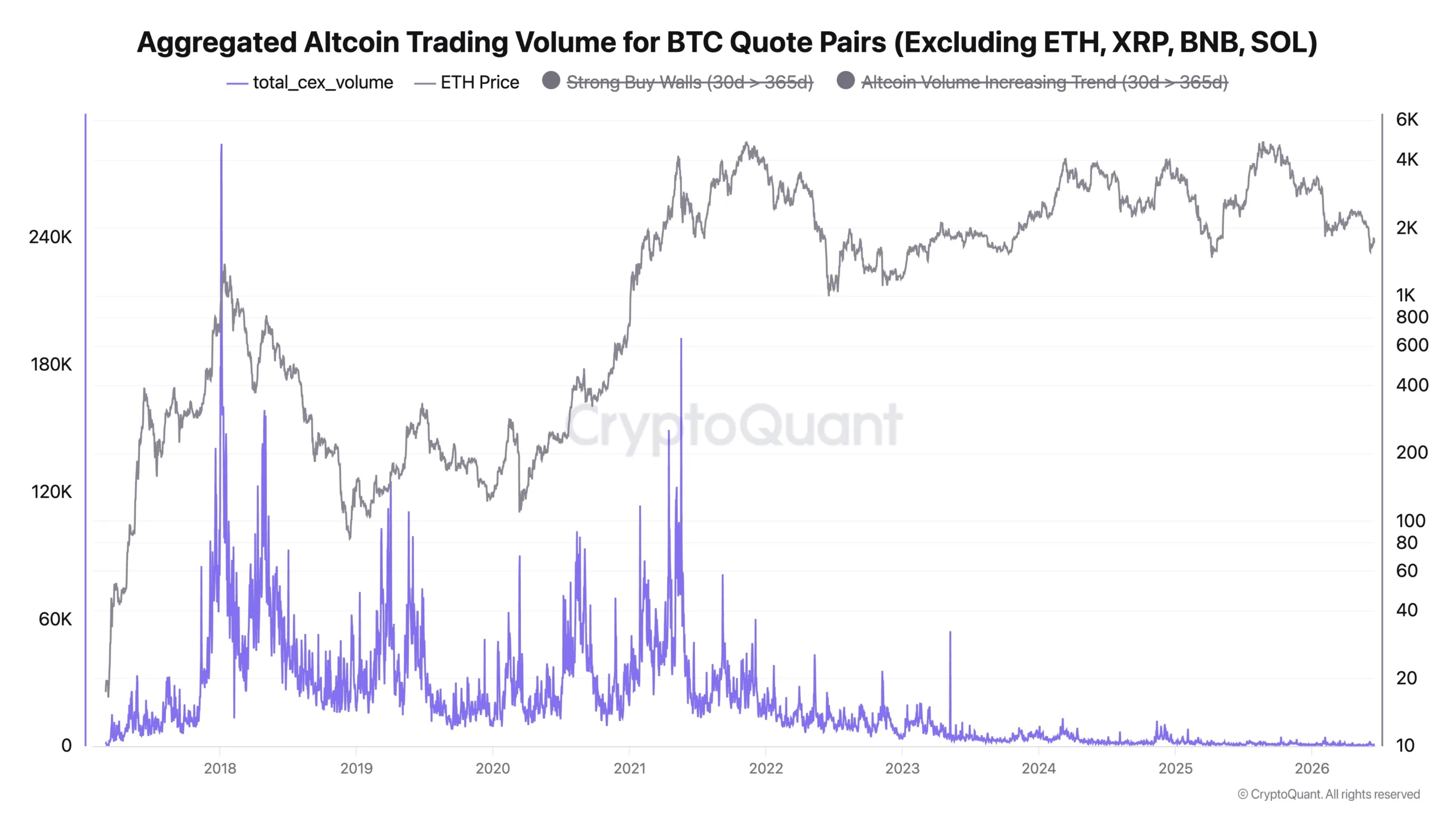
‘The era of alts pumping just because BTC pumps may be over,’ Ju said. That’s a striking statement from someone whose firm tracks on-chain flows for a living. It’s not a hot take — it’s backed by the volume data, and it lines up with what many active traders have quietly been observing: altcoin season hasn’t arrived despite Bitcoin pushing toward all-time highs in this cycle.
The mechanics behind this shift aren’t mysterious. In 2017 and 2021, retail participation was enormous, and Bitcoin was often the on-ramp into crypto. New money came in via BTC, profits accumulated, and traders — flush with gains and hungry for bigger percentage moves — rotated down the risk curve into smaller tokens. That cascade effect is what created altcoin season. Today’s market looks structurally different. More sophisticated institutional capital dominates, Bitcoin ETFs have created direct BTC exposure without forcing investors through the broader crypto ecosystem, and frankly, many retail investors got burned badly enough in the 2022 bear market that the appetite for low-cap altcoin speculation has diminished.
Capital Is Concentrating, Not Spreading
Here’s the other side of the story: the altcoin market hasn’t disappeared, but it’s getting smaller and more selective. As of mid-2026, the total non-Bitcoin, non-stablecoin crypto market sits at roughly $600 billion. That sounds substantial until you realize the top 10 altcoins account for about $483 billion of that — approximately 80.5% of the entire category. The rest of the market is splitting the remaining $117 billion.
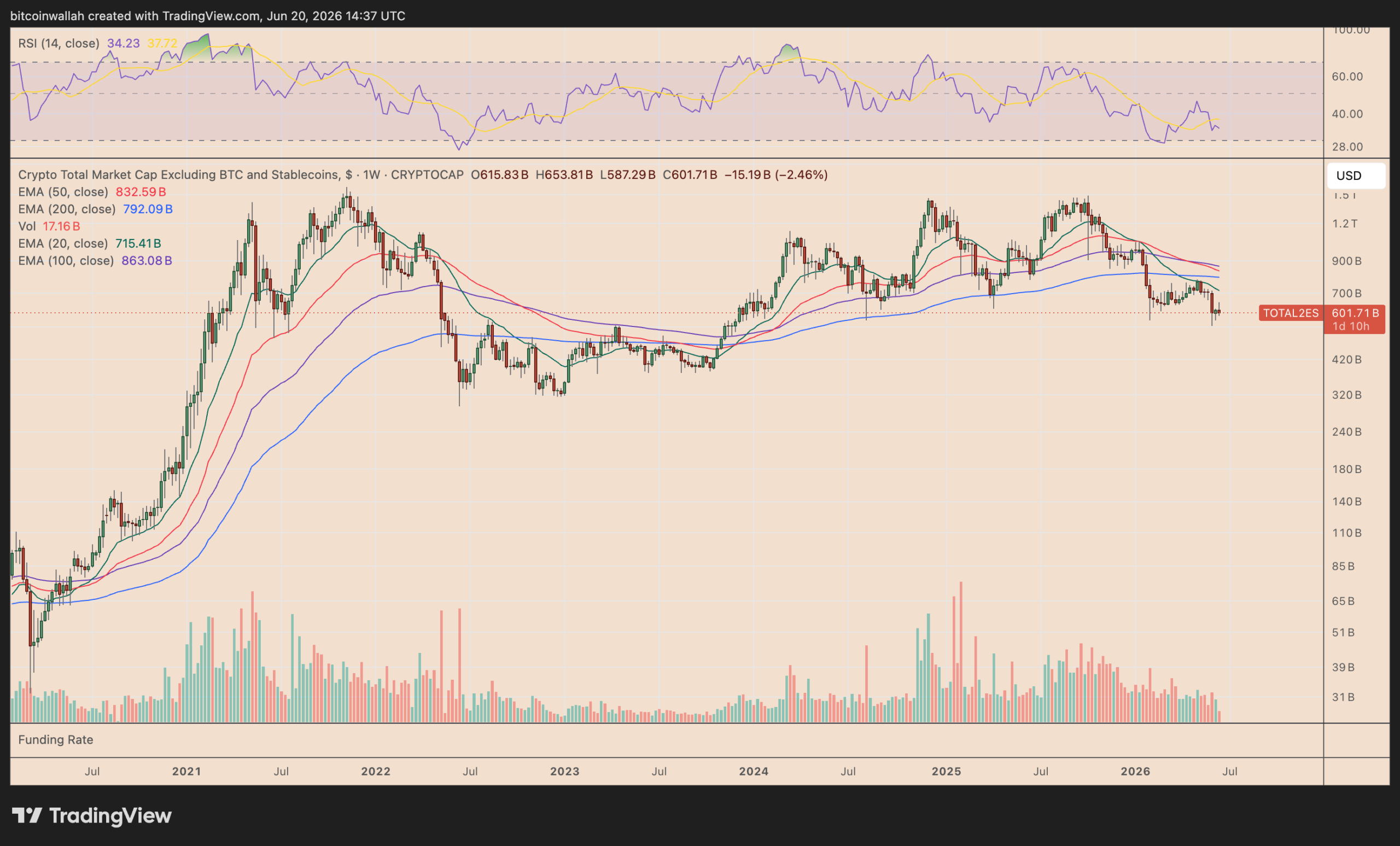
The shrinkage in the number of large-cap altcoins is equally telling. In 2021, CoinMarketCap data shows around 106 altcoins held market capitalizations above $1 billion. By June 2026, that figure had dropped to approximately 50. That’s more than a 50% decline in the number of tokens that most institutional and serious retail investors would even consider touching. The long tail of crypto — the thousands of smaller tokens — is getting thinner, not thicker.
What this amounts to is a barbell market. A handful of established tokens capture the lion’s share of non-BTC capital, while the middle and lower tiers struggle to attract meaningful liquidity. The democratized, rising-tide altcoin season of past cycles assumed that capital would spread broadly. That assumption no longer holds.
Narrative Tokens Are Losing Their Grip
Ju’s analysis goes beyond the numbers. In a separate thread, he argued that ‘narrative-only altcoins’ — tokens that ride a theme or hype cycle without underlying fundamentals — are losing relevance as the market matures. This is something worth sitting with for a moment, because it represents a genuine structural shift in what crypto investors are willing to pay for.
In 2021, a token could launch with little more than a whitepaper, a Discord server, and a catchy name tied to a trending narrative — metaverse, dog coins, whatever was moving — and see explosive gains. That playbook is getting harder to execute. According to Ju, the stronger areas in the current market are tied to real business activity: revenue-generating DeFi protocols, stablecoins, tokenized real-world assets, and AI agent infrastructure.
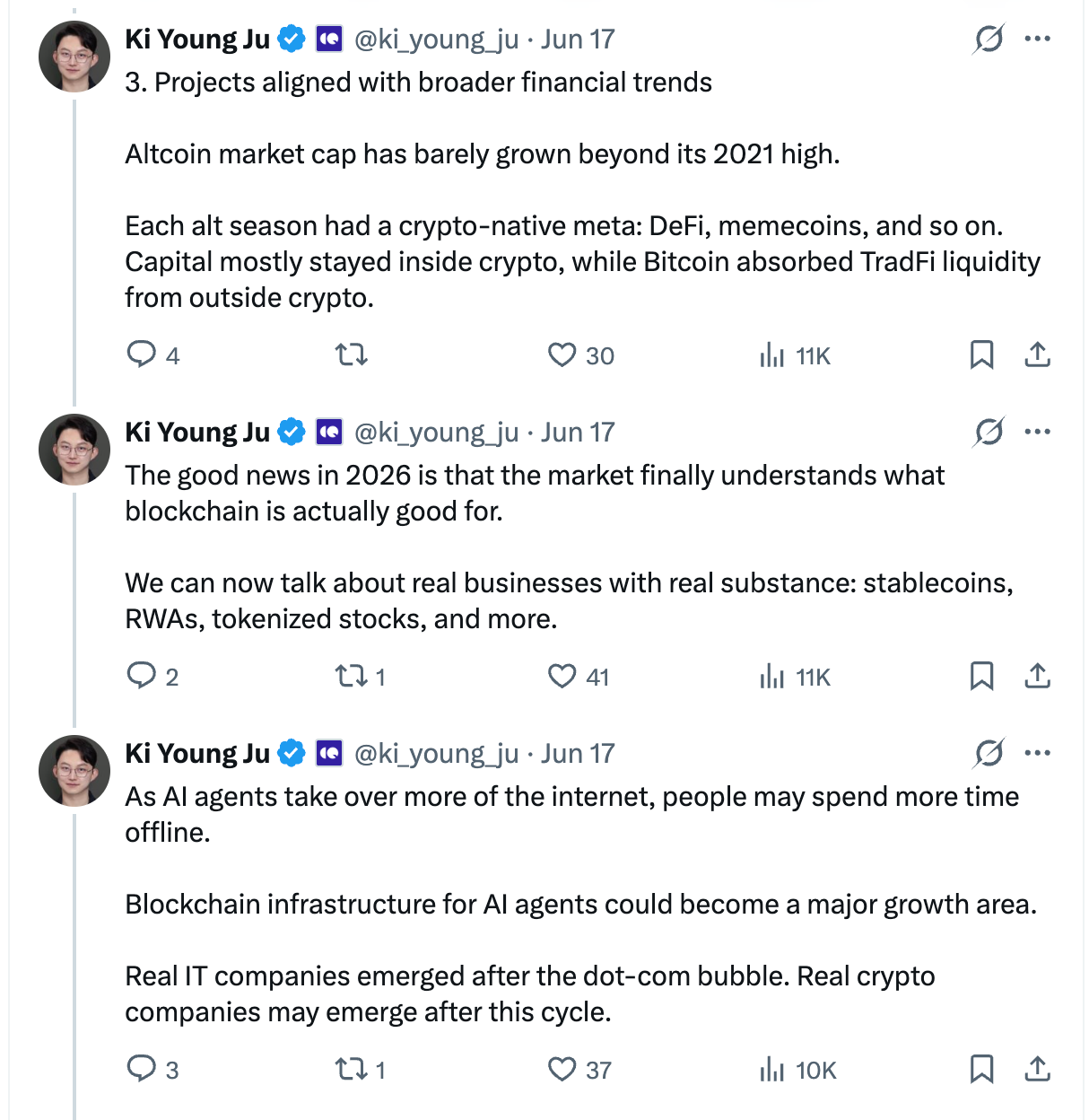
That list is telling. DeFi protocols with actual fee revenue, real-world asset tokenization (which is attracting serious interest from traditional finance players), and AI-adjacent crypto projects all share one thing in common: they have a story beyond the token itself. They’re solving something, or at least credibly trying to. The market is, slowly and imperfectly, beginning to apply something resembling fundamental analysis. If that trend holds, the next altcoin season — if it arrives — will look very different from previous ones. It’ll be about finding the ten tokens that matter, not rotating into three hundred of them.
Bitcoin Dominance Is Signaling More Pain Ahead for Altcoins
From a technical perspective, the picture doesn’t get much more encouraging for altcoin bulls in the near term. Bitcoin’s market dominance metric (BTC.D) — which measures BTC’s share of the total crypto market cap — has been a closely watched indicator for timing altcoin season. Historically, when BTC.D peaks and rolls over, capital begins flowing into altcoins. That rollover hasn’t convincingly arrived.
BTC.D recently bounced from its 100-week exponential moving average and the lower trend line of an ascending channel, both converging around the 58.75% level. That’s a meaningful technical support zone, and the bounce suggests Bitcoin could push its dominance toward 60% in the near term. A move to 60% would mean Bitcoin is absorbing an even larger share of total crypto capital — bad news for altcoin season timing.
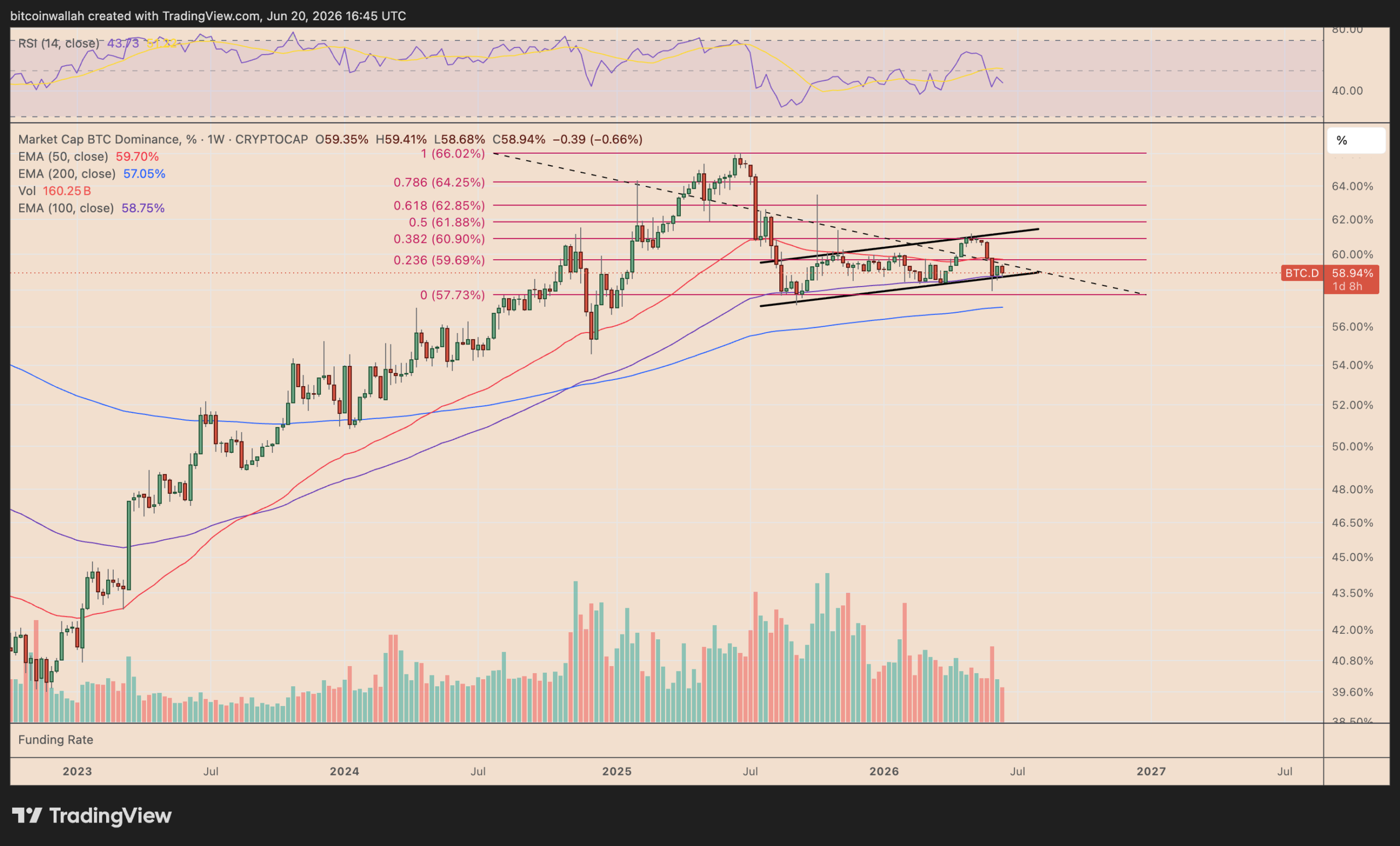
Analyst Rekt Capital flagged a bullish divergence on Bitcoin dominance, noting that BTC.D made lower lows while the RSI made higher lows — a classic setup that signals weakening downside momentum. His read: ‘altseason is postponed.’ That said, Rekt Capital also struck a note of caution about how far BTC dominance can actually run. He pointed out that the metric has already lost its macro uptrend, and what’s happening now may be a post-breakdown relief rally rather than the start of a sustained dominance surge. If that scenario plays out, Bitcoin’s dominance could eventually retreat toward its 200-week EMA at around 57% — which would finally give altcoins some room to breathe.
What This Means for Crypto Investors Right Now
The practical implication of all this is that traders waiting for altcoin season to act like 2021 are likely waiting for something that won’t come — at least not in the same form. The playbook of ‘buy Bitcoin, wait for it to pump, rotate profits broadly into altcoins, repeat’ appears to be broken, or at minimum significantly weakened.
That doesn’t mean there’s no money to be made in altcoins. It means the selection process matters far more than it used to. With capital concentrating in fewer tokens and narrative-only plays losing steam, the investors who do well in this environment will be the ones who can identify which protocols actually have users, revenue, and staying power — not just a trending hashtag and a charismatic founder on Crypto Twitter.
The broader takeaway is that crypto is undergoing a maturation that many in the space have predicted for years but that keeps arriving slower than expected and in unexpected ways. Bitcoin ETFs, institutional adoption, and the collapse of leveraged speculation are reshaping how capital moves through the ecosystem. If altcoin season does return in any meaningful sense, it’ll be a more selective, more fundamental-driven event — and the window for the old scatter-shot approach may already be closing.
Frequently Asked Questions
Is altcoin season still possible in the current crypto cycle?
It’s possible but increasingly unlikely in the traditional sense. CryptoQuant CEO Ki Young Ju says BTC-to-altcoin rotation has ‘basically disappeared,’ and capital is concentrating in fewer projects rather than spreading across the broader market the way it did in 2017 and 2021.
What does Bitcoin dominance have to do with altcoin season?
When Bitcoin’s market dominance rises, it signals capital is flowing into BTC rather than altcoins. Analysts including Rekt Capital note that BTC dominance is showing a bullish divergence, suggesting the altcoin season could be delayed further until dominance peaks and reverses.
Which types of altcoins are performing best if altcoin season is fading?
According to Ki Young Ju, tokens tied to real businesses, revenue-generating DeFi protocols, stablecoins, tokenized real-world assets, and AI agents are holding up best. Pure hype-driven or narrative-only altcoins are increasingly being ignored by serious capital.
How concentrated is the altcoin market right now?
As of mid-2026, the top 10 non-stablecoin altcoins account for roughly 80.5% of the approximately $600 billion non-Bitcoin, non-stablecoin market cap. The number of altcoins with over $1 billion in market cap has fallen from around 106 in 2021 to about 50 today.