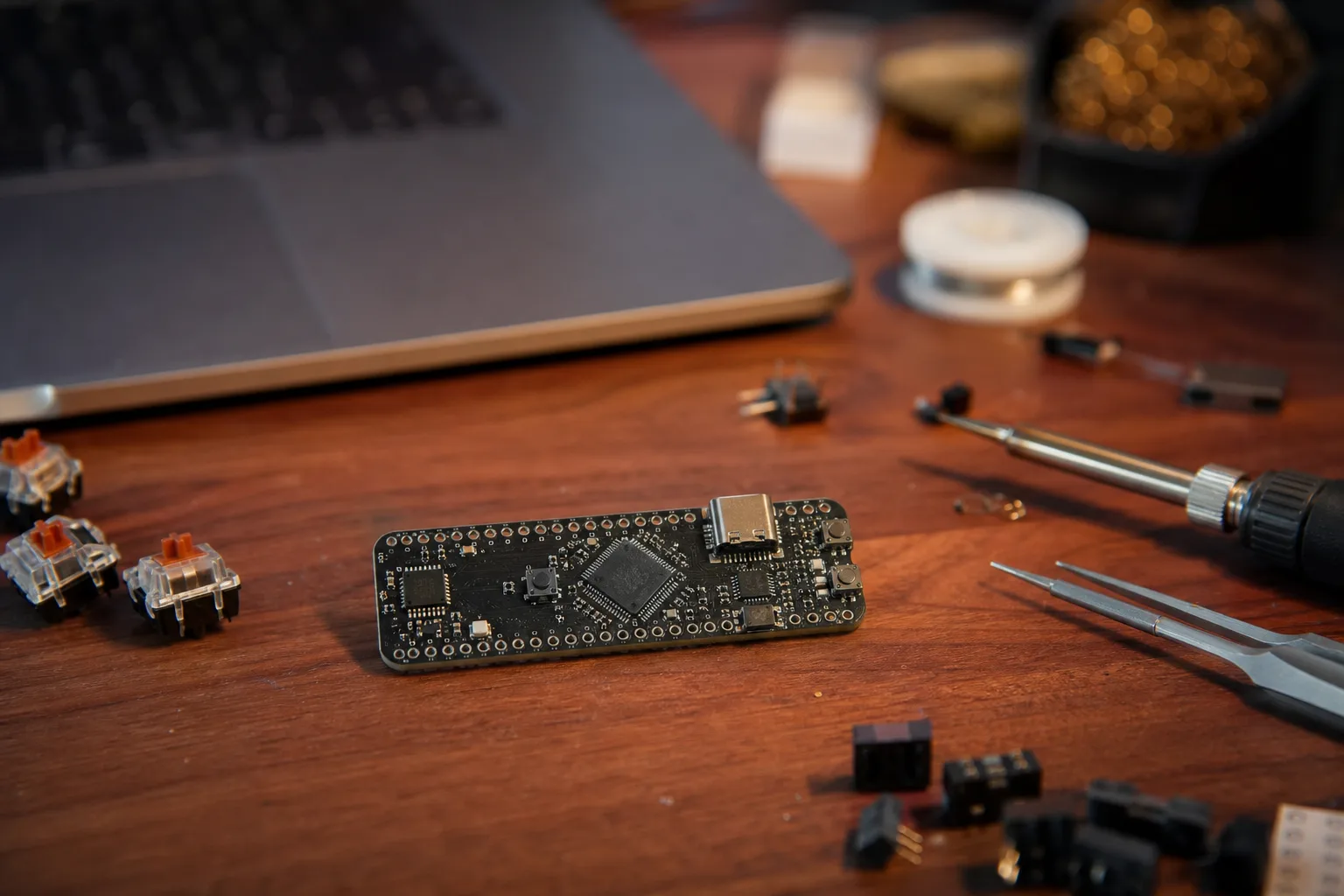
- The nice!nano wireless keyboard controller was designed in a single weekend by a college freshman using KiCad and Nordic chip datasheets.
- Nick Winans sold 1,000 nice!nano wireless keyboard units in under seven hours during a June 2020 group buy, with family helping to ship orders.
- The board delivered over 100x better power efficiency than its predecessor, lasting weeks on a 110mAh battery versus days on 2,500mAh.
- The project helped spark ZMK, a widely adopted open-source wireless keyboard firmware now powering thousands of custom builds.
Table of Contents
The Problem That Started Everything
The nice!nano wireless keyboard controller didn’t come from a business plan or a startup pitch deck. It came from frustration. During his first winter break at college, Nick Winans built what he called the Dissatisfaction65 — a wireless 65% mechanical keyboard inspired by the popular Satisfaction75. The name turned out to be prophetic. The keyboard looked great. It performed terribly.
Bluetooth latency made typing feel like wading through mud. Battery life was measured in days despite a 2,500mAh cell crammed inside — a battery large enough to charge a smartphone twice. Meanwhile, Logitech was shipping wireless mice with multi-month battery life. Apple’s Magic Keyboard connected instantly and lasted weeks. The gap between what commercial products could do and what the DIY keyboard community was working with was embarrassing.
Winans knew the hardware to close that gap existed. He just needed to find it — or build it himself. That search is what ultimately led to the nice!nano wireless keyboard.
Why the Existing Options All Fell Short
The DIY keyboard world in 2019–2020 had coalesced around a de facto standard: the Pro Micro form factor, a small Arduino-compatible board that dozens of popular keyboard PCB designs were built around. Swap in a different microcontroller that matches the Pro Micro’s footprint, and you could theoretically drop it into any of those existing keyboards. Simple idea. Harder in practice.
Nordic Semiconductor’s nRF52840 chip had already earned a reputation among hardware hobbyists as the right silicon for low-power Bluetooth — it’s what serious wireless wearables and peripherals were being built around. The challenge was finding a board that put the nRF52840 in a Pro Micro-compatible package without major compromises.
Three community projects were trying to solve this. The BlueMicro had a form factor problem — its physical size conflicted with many keyboard layouts, making it useless for a large chunk of existing designs. The BLE-Micro-Pro was close to what Winans needed but carried a steep price tag, was sold exclusively in Japan, and used proprietary firmware that limited flexibility. The nRFMicro came closest, but after spending time trying to modify it to suit his needs, Winans decided the modifications required were extensive enough that starting over made more sense. None of those options could deliver what the nice!nano wireless keyboard eventually would.
So he did.
Designed in a Weekend, Shipped in Weeks
The first version of the nice!nano wireless keyboard controller was designed over a single weekend. Winans describes barely leaving his desk — sleeping, eating cafeteria food three times, and otherwise living inside KiCad, Nordic’s technical documentation, the nRFMicro wiki, and an Adafruit schematic. He laid out the PCB, routed the connections, ripped them up, and re-routed them until he had something he believed in.
What came out the other side was the thinnest nRF52840-based board in a Pro Micro-compatible footprint anyone had produced. That thinness matters: mechanical keyboards are tight builds. A controller that adds even a millimeter of unexpected height can prevent a keyboard from closing properly. With the nice!nano wireless keyboard, Winans had solved the physical problem his competitors hadn’t.
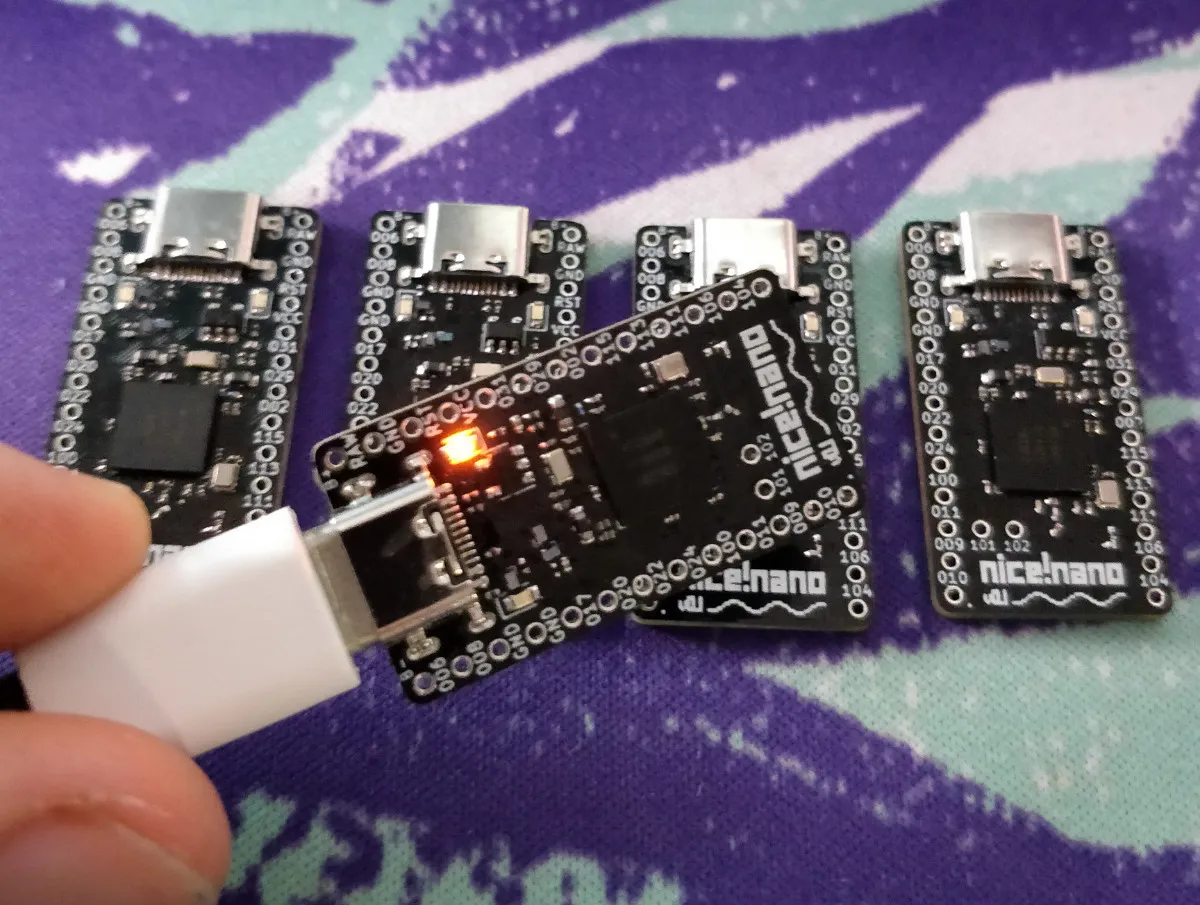
The name came from his online username, Nicell, with a nod to the metric naming convention of the Pro Micro. He stylized it in lowercase pixel font — the mark sits atop the antenna on the finished board. These are the kinds of small details that distinguish a product someone actually cares about from a pure commodity component.
Getting five prototype units manufactured cost around $100. Not a huge sum in absolute terms, but real money for a college student betting on a design that had never been physically tested. After days of re-checking every connection and component value, he paid. A few weeks later the boards arrived. He plugged one in, eyes half-closed, and it worked.
100x Better Battery Life — and a Reddit Post That Changed Things
The efficiency numbers Winans measured were striking. His original Dissatisfaction65 keyboard had drained a 2,500mAh battery in a few days. The nice!nano wireless keyboard, running on a 110mAh cell — roughly 23 times smaller — lasted several weeks. That’s not an incremental improvement. That’s the difference between a product that’s annoying to use and one that disappears into the background of your daily life.
He built the nice!nano wireless keyboard into a Lily58 split keyboard and got a modified version of the QMK firmware running on it. Then he posted his fully wireless Lily58 on Reddit.
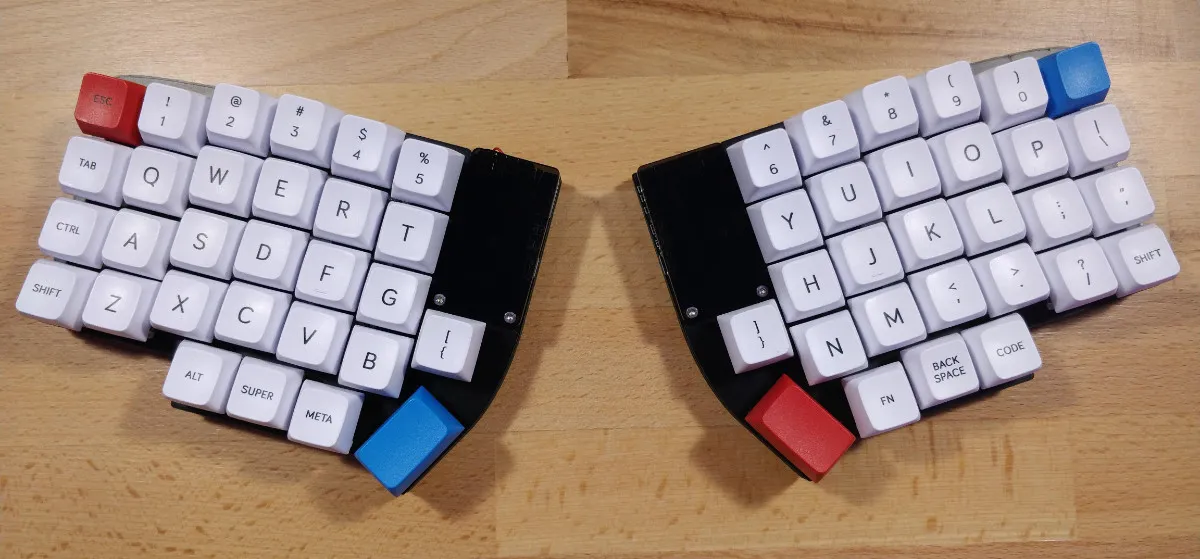
The response was immediate. A community formed on Discord, focused specifically on wireless keyboard innovation. Within weeks it had grown from a handful of followers to something substantial. Winans ran an interest check for a group buy, iterated on the hardware a few more times, and set a launch date: June 20, 2020.
nice!nano Wireless Keyboard Sells Out in Seven Hours
The group buy opened at 11am Central on June 20th, 2020. Winans had set a floor of 200 units — the minimum he needed to make the manufacturing economics work — and a ceiling of 1,000, which felt like about as much as he could manage to fulfill as a college student. He expected a few days, maybe a week, to sell through.
The minimum was hit within minutes.
Sitting in his childhood bedroom — COVID had sent students home by then — he watched the Shopify dashboard in real time as orders stacked up. By early evening, all 1,000 nice!nano wireless keyboard units were gone. The group buy that was supposed to run for a month lasted less than a day.
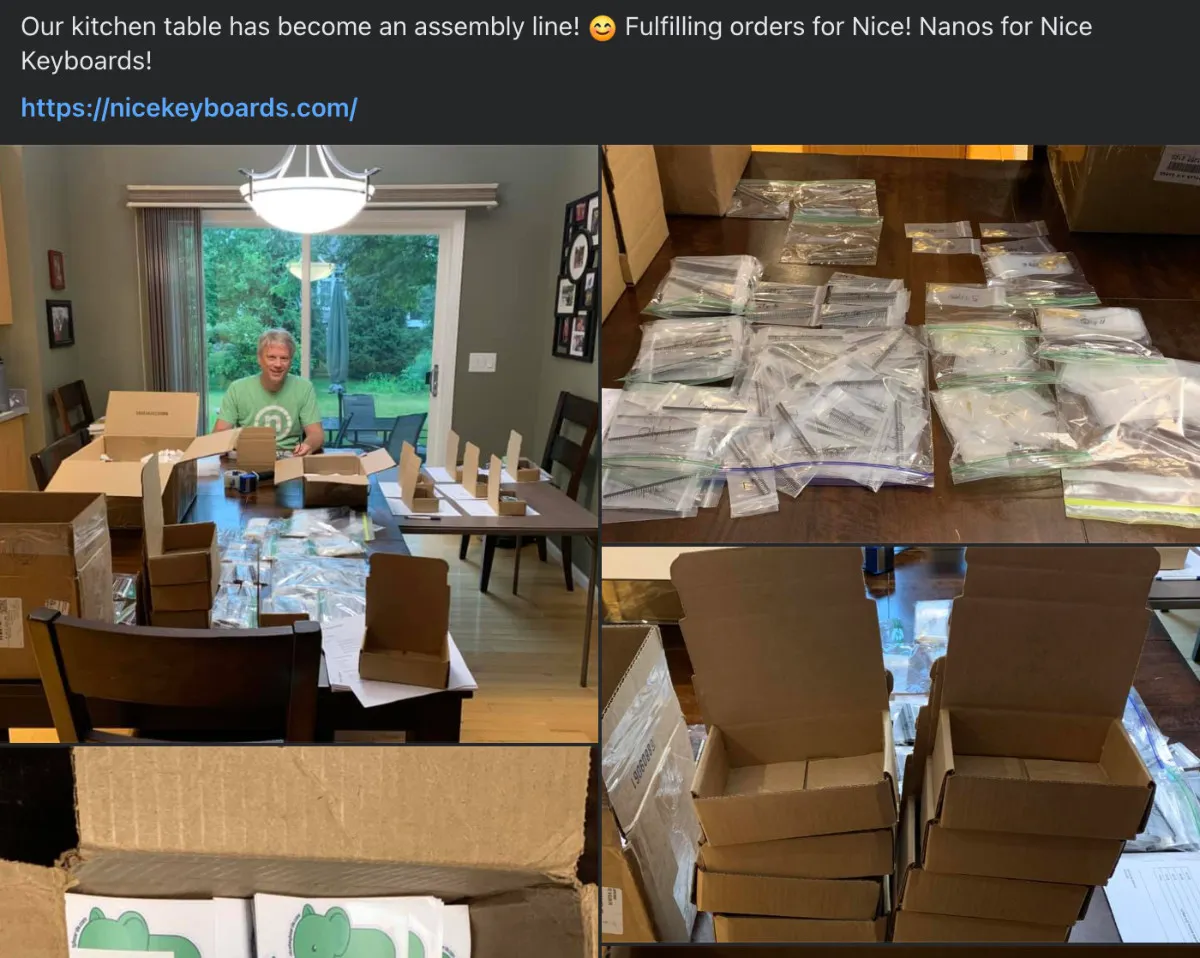
Over the next two months, Winans and his family packed and shipped more than 400 individual orders. His mom documented the fulfillment process on Facebook. It was, in the most literal sense, a family business operating out of a house.
Group buys are a fixture of the mechanical keyboard hobby, but Winans is candid about why he’ll never run one again. Holding thousands of dollars of customers’ money without a physical product to back it is genuinely stressful. PayPal froze a portion of the funds for a period, adding financial anxiety on top of operational chaos. And the broader keyboard community has been burned badly by group buys gone wrong — projects years overdue, organizers who disappeared with pre-order money. Winans wanted no part of that reputation.
ZMK and the Firmware That Made It All Click
Hardware is only half the story. The nice!nano wireless keyboard needed firmware that could actually exploit the nRF52840’s power efficiency — and when Winans was first shipping units, that firmware didn’t really exist in a satisfying form.
QMK, the dominant open-source keyboard firmware, has Bluetooth support but wasn’t designed from the ground up with wireless and power efficiency as priorities. It shows. Winans bounced between various options without finding anything that felt right for the nice!nano wireless keyboard.
Then he connected with Pete Johanson, who had independently started building a wireless keyboard firmware on top of the Zephyr RTOS — a modern, well-supported real-time operating system that’s become increasingly important in embedded development. Winans sent Johanson some pre-production units. Johanson got an early build running on the nice!nano wireless keyboard. The two hit the ground running.
By early 2021, a small community around Johanson had built ZMK Firmware into something genuinely impressive: performant, feature-rich, wireless-first, and designed around low power consumption from the start. ZMK has since become the default firmware recommendation for wireless custom keyboards — a complete ecosystem built, in part, because the nice!nano wireless keyboard gave it hardware worth optimizing for.
What This Story Actually Says About Hardware Startups
The nice!nano wireless keyboard is a useful counterpoint to the standard narrative about hardware being impossibly hard. Yes, hardware is hard. But Winans’s story also shows how much the barriers have genuinely dropped. KiCad is free and powerful. Contract manufacturers in China will assemble five prototype PCBs for $100. Shopify lets a college student run a global pre-order campaign. Discord builds communities overnight. Nordic’s documentation is public.
What Winans had that can’t be downloaded was a specific, lived frustration with a real product gap, the technical depth to design a solution, and the willingness to spend a weekend not leaving his desk. The nice!nano wireless keyboard now powers tens of thousands of keyboards worldwide. It spawned an open-source firmware project that’s become an industry standard in its niche. And it generated over a million dollars in sales — not from a venture-backed startup, but from a dorm room, a dining hall, and a family packing table.
The mechanical keyboard community is niche by most definitions, but it’s also a preview of how hardware markets increasingly work: small, passionate communities with high standards and genuine purchasing power, underserved by mainstream products, waiting for someone obsessive enough to build exactly what they need. The nice!nano wireless keyboard is proof that one weekend, the right chip, and a genuine itch to scratch can be enough to change an entire community’s trajectory. There are dozens of those communities out there. Most of them are still waiting.