Table of Contents
A kids’ smartwatch becomes a family communication device
The Fitbit Ace LTE is aimed at kids aged 7 and above, but its latest updates make clear that Fitbit sees the device as more than a wrist-worn activity tracker. Group chats, sibling messaging, Family Quests, new games and new watch faces all push the Ace LTE toward a broader role: a controlled digital space where children can move, play and stay in touch with the people their parents have approved.
That is a sensible direction for a connected kids’ watch. For many families, the appeal is not simply counting steps. It is the ability to give a child some independence without handing over a full smartphone and all the distractions, contact requests and open-ended internet access that can come with one. The Ace LTE’s updates concentrate on the part of that equation that can often feel awkward: letting children communicate naturally with their own family while retaining parental boundaries around everyone else.
The newly added group chats allow all members of a Google Family to participate, either through the Ace LTE itself or through its companion app. That matters because family communication tends to happen in groups, not as a series of isolated one-to-one calls. A parent can send a reminder, siblings can coordinate after-school plans, and the household has a shared channel without requiring every participant to be on the same kind of device.
Sibling communication is the more consequential change. Previously, the Ace LTE’s strict parental controls restricted sibling interaction. With this update, siblings can call and message each other directly, while parents retain control over external contacts. The distinction is important. A child-focused device should not treat a brother or sister like an unknown contact, yet it also should not turn into an unrestricted messaging platform. Fitbit is trying to thread that needle rather than choosing between total lockout and a looser system that may defeat the purpose of buying a kids’ watch in the first place.
Parents can add up to 20 trusted adults to the account, creating what Fitbit describes as a secure communication network. That limit reinforces the product’s central premise: this is communication within a defined circle, not social networking. Whether a particular family finds 20 trusted adults generous or excessive will vary, but the model itself is easy to understand. The useful question for parents is not whether a child can contact everyone, but whether the people they can contact are the right people.
Fitness features need a reason to keep kids engaged
Activity tracking for children has always had a basic problem. Adults may be satisfied with charts, streaks and long-term trends; kids generally need a more immediate reason to care. The Ace LTE answers that with Family Quests, daily challenges, virtual pets and games that are designed to be played while moving.
The current Family Quest, Turkey Berserky, is a Thanksgiving-themed activity in which families work toward a collective goal of 400,000 steps. The shared target is a smarter fit for a family product than a purely individual leaderboard. It gives parents and children a reason to participate together, and it avoids making a child’s progress feel like a personal test they have failed if they miss a day.
As the family advances in Turkey Berserky, children earn tickets that can be spent on digital items for their virtual pets, called Eejies. This is familiar game design: activity produces a reward, and that reward changes something a child cares about inside the device. The approach will not appeal to every parent. Some will see it as an unnecessary layer of screen-style incentives. Others will recognise that the watch is competing with games and phones for attention, and that movement has a better chance of winning when it comes with a playful payoff.
The key is that the reward is tied to activity rather than replacing it. Kids are not simply sitting still to collect digital items. The Eejies provide a reason to care about the steps that have already been taken. That is a more defensible use of gamification than a feature that encourages constant checking or passive engagement.
The Ace LTE also now includes 50 daily challenges. These activities cover health topics including sleep, nutrition and geography while encouraging movement. There is a risk in any educational feature of making exercise feel like homework, particularly when the information is presented too formally. The better version is one where a prompt about sleep or nutrition gives a child a small, usable idea and then gets them moving. Fitbit’s decision to mix health subjects with geography suggests an attempt to keep the challenges from becoming overly clinical.
Solar Sword makes movement part of play
Fitbit Arcade is another indication that the Ace LTE is not trying to be a miniature adult smartwatch. It offers games that can be played during walks or exercise, making physical activity part of the interaction rather than an interruption to it. The newest game, Solar Sword, asks players to defend their village from monsters. Its purpose is straightforward: combine movement with a game scenario that feels more exciting than watching a step counter rise.
This is where the product’s design is most revealing. A conventional fitness tracker asks a child to interpret data and build motivation from it. The Ace LTE instead turns data into progress inside an activity. That may be less pure in the old-school fitness-tracker sense, but it is likely closer to how many children actually engage with technology. Fun is not an optional extra here; it is the mechanism that makes the health feature usable.
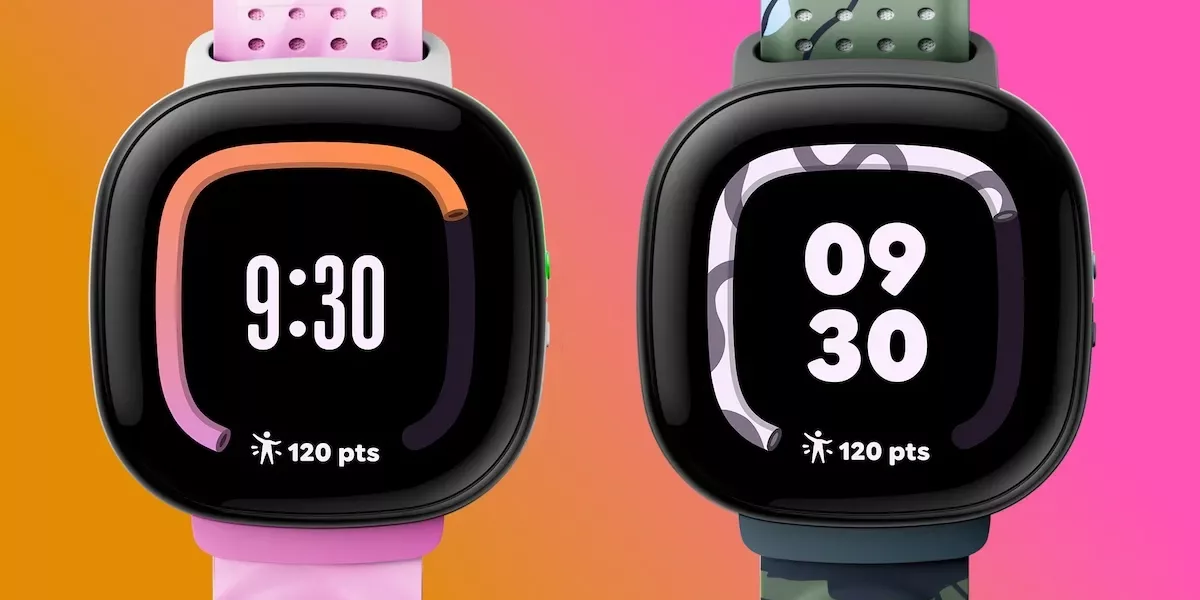
Two new watch faces round out the update. Watch faces are a small detail compared with calling features or Family Quests, yet personalisation has real value on a device worn every day. A child is more likely to keep a watch on if it feels like their own rather than an item imposed by a parent.
The subscription changes the value calculation
The Fitbit Ace LTE costs $230, matching the price of other Google devices such as the Fitbit Sense 2 and Pixel Watch 2. That price places it in an unusual category. Buyers are not paying a budget price for a basic pedometer with a bright strap; they are paying a premium-device price for a child-specific wearable with communication, activity and parental-control features.
To use its features, users must subscribe to the Fitbit Ace Pass plan, which costs $10 monthly or $119 annually. That ongoing fee is central to the buying decision, not a footnote. The watch’s appeal rests on its connected features, including communication within the approved family circle, so prospective buyers should evaluate the hardware and the plan together rather than treating the $230 price as the full cost.
A special promotion offers a 50% discount for sibling subscriptions until January 31. For households considering more than one Ace LTE, that offer directly addresses the most obvious concern: family-oriented hardware becomes expensive quickly when every child needs a device and a plan. The promotion does not remove the subscription question, but it makes the sibling use case more practical during that period.
The broader pitch is coherent. The Fitbit Ace LTE combines family contact, parental oversight, movement challenges, Eejies and games such as Solar Sword into one tightly managed experience. It will make most sense for parents who want a child to have a degree of connectivity without moving straight to a phone, and who believe structured incentives can help make activity feel less like a chore. For families that only want a simple step counter, it may be more device and more expense than necessary. For those looking for a kid-focused watch that treats communication and fitness as parts of the same daily routine, these updates make the Ace LTE considerably more compelling.
Check out a similar article: Oura Ring 4: The Ultimate Companion for the Apple Watch on Squared Tech.
For More Updates: Gadgets