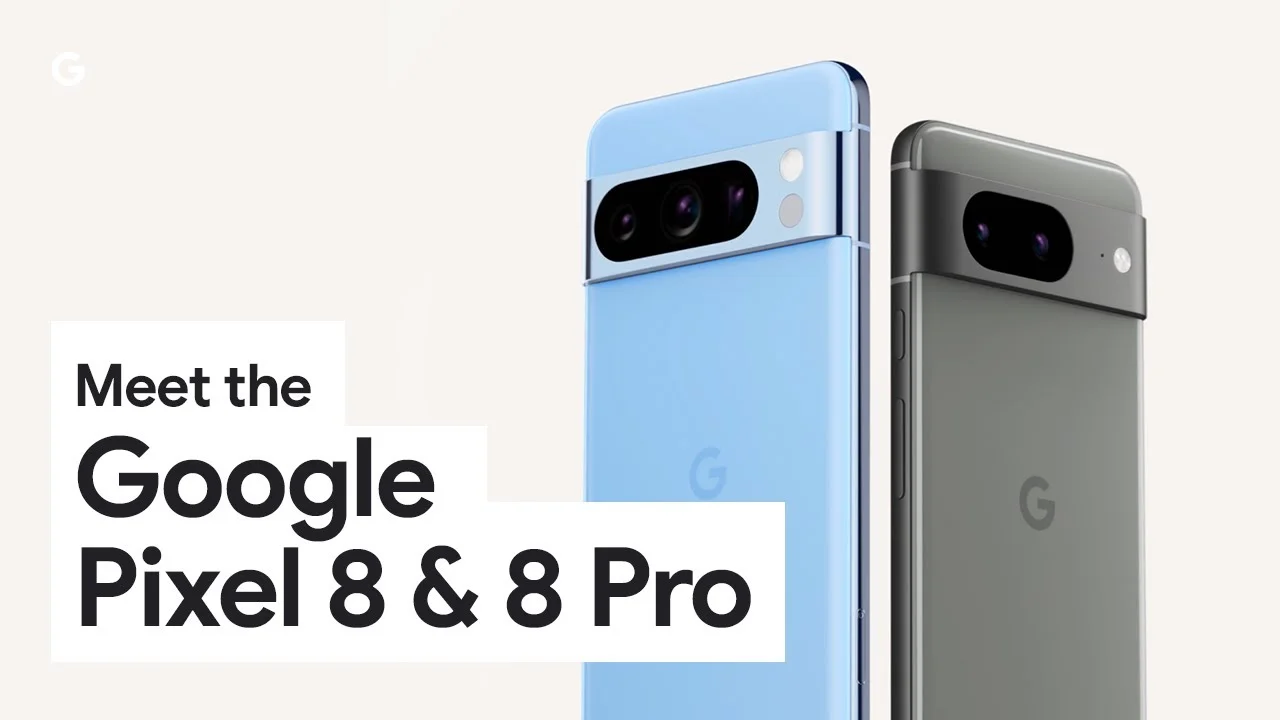
Google’s recent event delivered an unusual kind of surprise: the company unveiled the Google Pixel 8, Pixel 8 Pro, and Pixel Watch 2 without any prior leaks. In an industry where major hardware announcements are often picked apart long before executives step on stage, that alone gave the launch a different texture. The hardware matters, but Google’s real pitch remains familiar: Pixel phones are vehicles for software ideas that are meant to feel useful in everyday life rather than impressive only on a specification sheet.
The Pixel 8 and Pixel 8 Pro keep the design language that has made recent Pixels immediately recognizable. The camera visor is still there, and that continuity is sensible; Google has spent years establishing a visual identity in a market full of nearly interchangeable slabs of glass and metal. This time, the phones take on a more rounded look, softening the overall shape without abandoning the Pixel silhouette.
Color also does some of the work. Hazel, Rose, Obsidian, and Bay are the available options, with Bay arriving as a striking shade of blue. The Pro models receive a new matte finish, a small but meaningful refinement. Premium phones are handled constantly, and finishes that look good while making a device feel less clinical can matter as much as a modest design overhaul. Google appears to be polishing an established formula rather than trying to reinvent it.
Table of Contents
Displays and hardware set the baseline
Both phones have improved displays with thinner bezels, an expected but welcome direction for devices in this category. The Google Pixel 8 gets a 120Hz display, bringing smoother motion to a model that previously had a clearer divide from the Pro line. High refresh-rate screens have become one of those features that can be difficult to appreciate from a list of specifications but immediately noticeable in daily use, particularly while scrolling, switching between apps, or navigating the interface.
Brightness is another area where the numbers tell a practical story. The Pixel 8 reaches 2,000 nits of peak brightness, while the Pixel 8 Pro reaches 2,400 nits. Those figures are aimed squarely at visibility beyond the living room or office. Smartphones are used outdoors, in cars, and under harsh overhead lighting; a display that remains legible in those conditions is not a luxury feature so much as a quality-of-life one.
At the center of both phones is the Tensor G3 chip, Google’s third generation of custom silicon. The event did not spend much time on raw performance improvements, and that omission is revealing. Google is not presenting Tensor G3 chiefly as a conventional speed story. Its emphasis is on AI-related tasks, consistent with the company’s long-standing effort to make the Pixel experience feel differentiated through software intelligence rather than processor benchmarks alone.
That approach has always had a trade-off. Software features can make a phone feel distinctly more personal and capable, but they also need to be reliable enough to become habits. A clever demo is easy; a tool people trust with calls, messages, photos, and private information is much harder. The Pixel 8 generation is Google arguing that its software features are no longer side attractions. They are the reason to consider the hardware.
AI features move closer to everyday tasks
The new software additions are centered on that argument. Google Assistant can summarize webpages, speech-to-text is said to be faster and more accurate, and improved security features use the front-facing camera. The phones also include a built-in grammar and message proofreading tool. None of these ideas is meaningful simply because it uses AI. Their value depends on whether they remove friction without becoming another layer of automation that users must constantly correct.
Webpage summaries could be useful for people who encounter long articles, product pages, or information-heavy search results on a small screen. Better speech-to-text has a more direct and less flashy appeal: it can make dictation practical in moments when typing is inconvenient. Grammar and message proofreading brings the sort of assistance that has become common in productivity software into the conversational spaces where many people do a surprising amount of their writing.
The call-screening experience remains one of Pixel’s more distinctive software ideas. The new call screen voice is described as remarkably human and context-aware, with the goal of simplifying call screening. That distinction matters. Spam calls and unknown callers have turned answering the phone into a low-level nuisance for many people. A screening system is only useful if it gives the recipient enough confidence to ignore interruptions without missing something important.
Google is also extending its computational photography ambitions with Magic Editor, which lets users manipulate and alter photos with minimal effort. This is the kind of feature likely to spark both enthusiasm and discomfort. Easy editing can help users rescue a poorly framed picture or make a personal photo closer to what they intended. It also makes the boundary between a photograph and an edited image less obvious. Google’s framing here is convenience, but the broader implication is that image editing is becoming a standard part of taking a picture rather than a specialist skill.
The Pixel 8 and Pixel 8 Pro each receive upgraded camera systems, including 50-megapixel main cameras. The Pro adds additional lenses, preserving the more capable camera setup as a reason to step up to the larger model. Google has also revamped the camera app for better organization and ease of use. That may sound less exciting than a new sensor, but camera software succeeds or fails in the seconds before a photo is taken. A powerful camera mode buried in a confusing interface is not much help when the moment is already gone.
For a visual overview of the launch, MKBHD’s YouTube video provides the event coverage credited in the original report.
The Pro model leans into unusual extras
The Pixel 8 Pro includes a temperature sensor capable of measuring surface temperatures accurately. Human temperature measurement is still awaiting FDA approval, an important limitation that keeps expectations in check. The sensor is unusual enough to attract attention, but its usefulness will depend on how naturally it fits into real situations. For now, Google is introducing a capability with a defined boundary rather than claiming a medical role it has not yet received approval to fill.
Google says haptic feedback on the Pixel 8 Pro has also been greatly improved. This is another refinement that can sound minor until it is experienced. Haptics shape the feel of typing, gestures, alerts, and camera controls. Better feedback does not transform what a phone can do, but it can make repeated interactions feel more deliberate and less cheap.
Video Boost is perhaps the clearest example of Google pursuing imaging through processing rather than hardware alone. Exclusive to the Pixel 8 Pro, it processes video in the cloud to improve quality, promising better HDR and color grading. The feature will arrive at a later date, so it should be treated as a promise rather than a present-day buying reason. Cloud processing also raises an obvious question about convenience: users will need to decide whether the improvement is worth handing video off for processing. Still, it shows where Google sees the next camera battle taking place. Photos have long benefited from computational techniques; video is the harder frontier.
Price and support make the longer-term case
The Pixel 8 starts at $699, while the Pixel 8 Pro starts at $999. Google justifies the increase through upgrades in display, camera, and processing power. Whether that case lands will depend on how much buyers value the software experience, because the hardware improvements are not being presented in isolation. The Pixel proposition is increasingly that the device gets better through the intelligence layered on top of its components.
The strongest part of the announcement may be Google’s commitment to seven years of OS security and feature updates for the Pixel 8 and Pixel 8 Pro, with updates guaranteed until 2030. Long-term support has become one of the most meaningful measures of a phone’s value. It affects how long a device remains secure, how long it can receive new capabilities, and whether an expensive purchase feels disposable after only a few years. Google is setting a new standard for long-term support in the smartphone industry, and it is a particularly important signal from a company that wants its hardware to be taken as seriously as its software.
That pledge also gives the Pixel line a more coherent answer to the question of ownership. A phone that receives OS, security, and feature updates for seven years has a stronger claim to being a long-term device rather than a short upgrade cycle. It also offers a more reassuring contrast to the uncertainty around services, including the company’s decision to end Pixel Pass subscriptions.
The Pixel Watch 2 rounds out the launch with a new quad-core processor and redesigned apps. It promises 24 hours of battery life with an always-on display, alongside health and fitness monitoring features. Smartwatches live or die by whether they can keep pace with a full day without forcing users to rethink how they use them, so that battery claim is central to the product’s appeal.
Google’s announcement is not simply a collection of refreshed devices. The Pixel 8, Pixel 8 Pro, and Pixel Watch 2 represent a clearer expression of Google’s strategy: familiar hardware, targeted refinements, and a growing reliance on software to make the products feel different over time. The most persuasive upgrade may not be a visor, a brighter panel, or a new chip. It may be the commitment that these devices will continue receiving support long after the launch-day excitement has faded.