

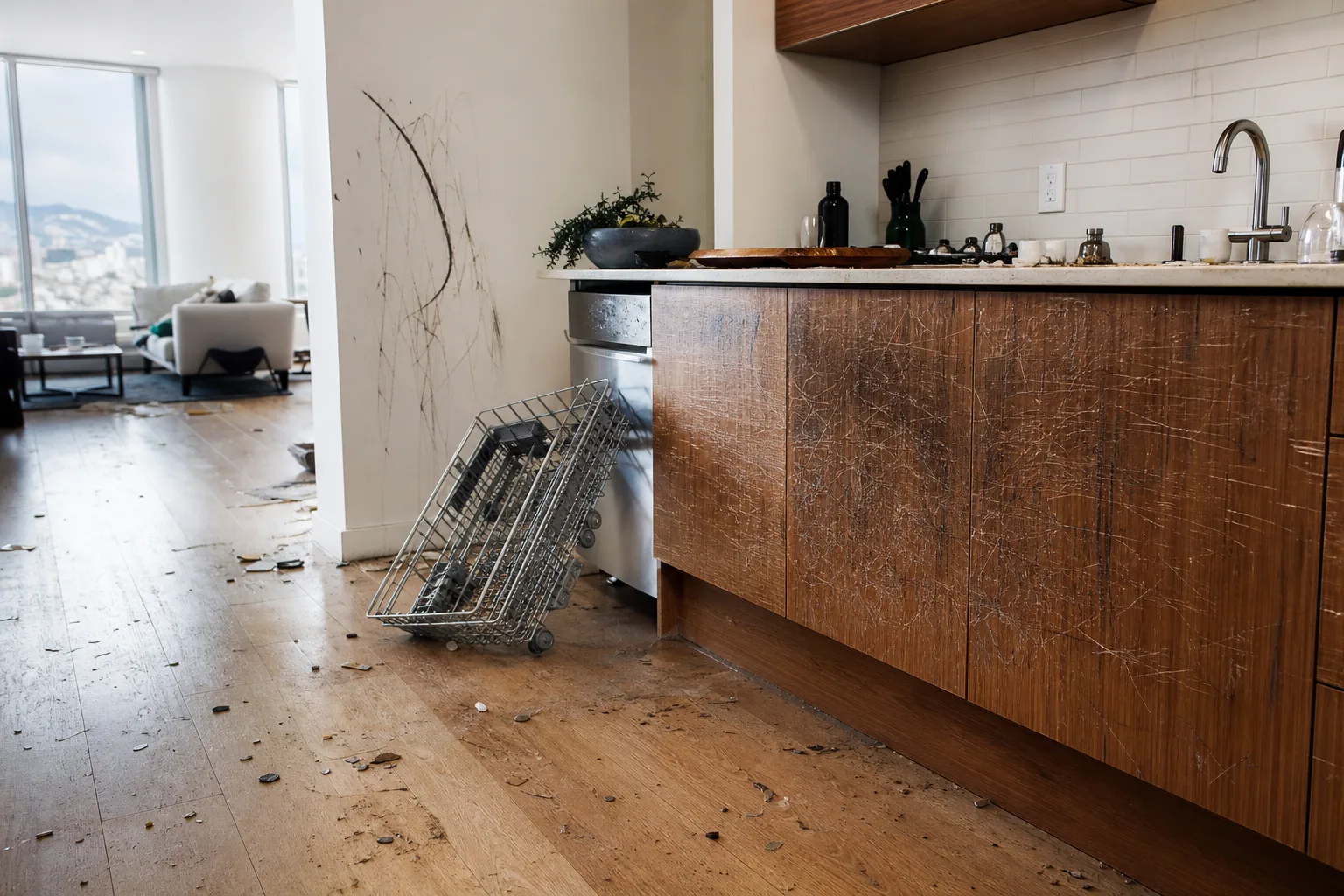
- A San Francisco host sued The Bot Company, alleging Airbnb robot testing caused over $12,000 in damage to his home.
- Airbnb robot testing appears to have hit at least a dozen Bay Area hosts, based on negative reviews tied to the same guests.
- The Bot Company, valued at $2 billion, has never publicly revealed a working prototype of its home robot.
- Hosts say they would have agreed to commercial rentals — the deception, not the robots, is what sparked legal action.
Table of Contents
A Suspicious Check-In and a Very Expensive Mess
When San Francisco homeowner Sean Donovan received a booking request from eight people claiming to be colleagues visiting the Bay Area for work, nothing seemed off. They needed reliable Wi-Fi. Standard request. But what unfolded over the next 11 days turned into one of the stranger tech-industry lawsuits the Bay Area has seen in a while — centered on Airbnb robot testing that Donovan says he never consented to, carried out in secret inside his own home.
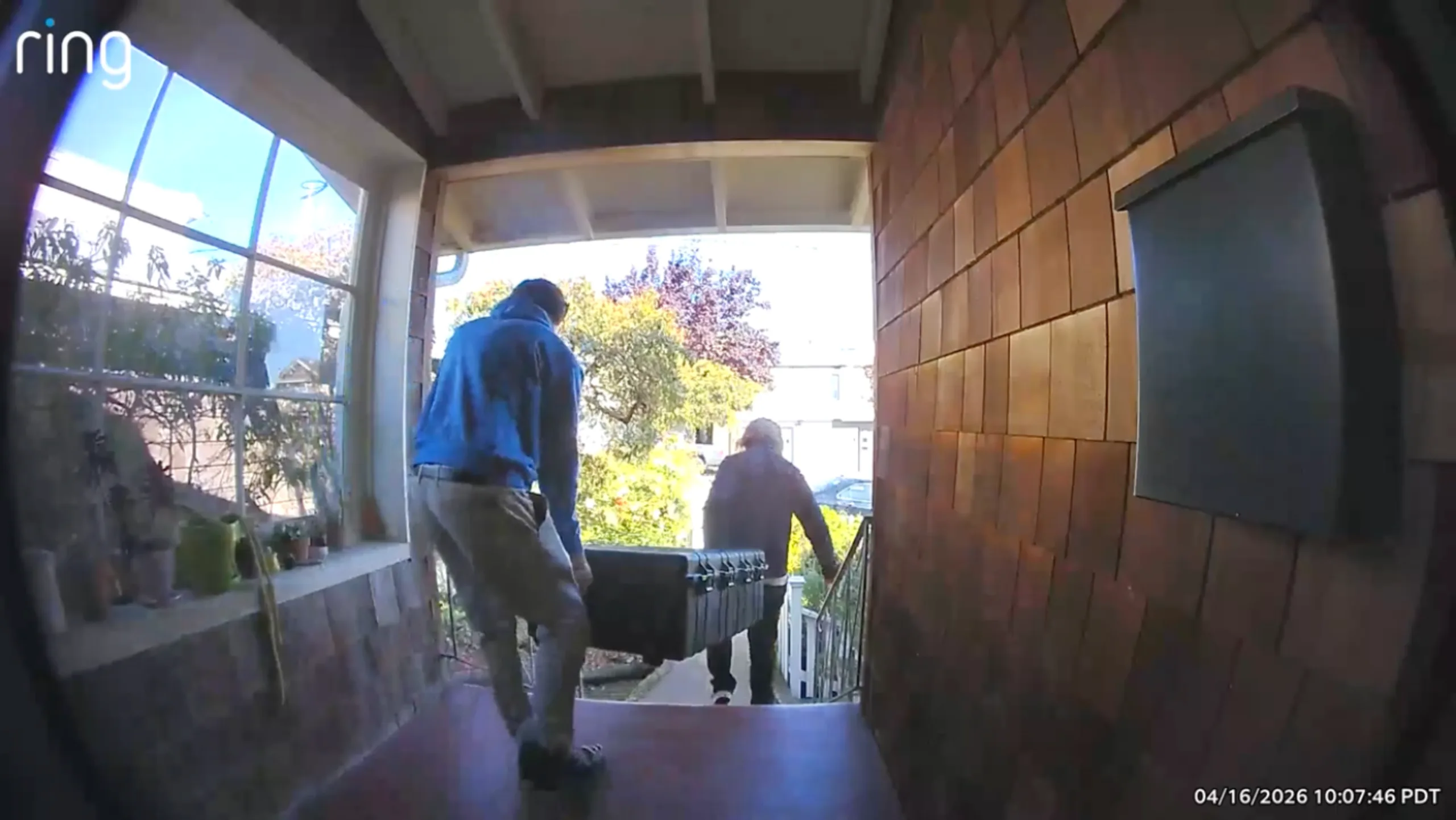
A Ring camera captured guests hauling large black cases through the front door on April 12. Later that night, the security system went dark. When Donovan swung by mid-stay to take out the trash, he peered through a window and saw black cables taped to his walls, a man on a laptop, and what looked unmistakably like a robot. When the guests finally checked out 11 days later, the house told the full story: scratched and stained wooden furniture, bent and removed dishwasher racks, chipped bathroom tiles, a cracked refrigerator, scratched appliances, dishes piled in the wrong places, and — perhaps most jarringly — a locked bedroom closet had been accessed and a shoe rack along with several pairs of shoes had vanished entirely.
“What the hell is going on here?” Donovan recalled thinking. A bit of online research later, he had a theory. He’s now filed suit in San Francisco Superior Court, alleging that employees of The Bot Company rented his property “under false pretenses” to conduct Airbnb robot testing on household robots. He’s seeking $12,383.50 in damages and lost income — the difference between what a standard residential booking costs and what a disclosed commercial booking would have commanded.
Who Is The Bot Company?
The Bot Company isn’t some scrappy two-person operation running experiments out of a garage. Founded by alumni of Tesla and autonomous vehicle firm Cruise, it’s a well-capitalized San Francisco startup that has pulled in hundreds of millions in venture capital and carries a reported valuation of $2 billion, according to tech research platform Sacra. That’s serious money for a company that hasn’t shown the world a working product.
Its website is deliberately sparse. The company says it’s “building a helpful robot for every home” capable of handling “all the little things that eat away at our time.” Sacra’s description of the prototype is more specific: something resembling a low coffee table on wheels, fitted with an articulated arm and dual grippers that can pick up and organize household objects autonomously. The target market, per the company’s own website, includes families, elder care providers, small office teams — and, with no apparent sense of irony, short-term rental operators.
That last point isn’t lost on Donovan. “This company is trying to build robots to make Airbnb turnovers more easy,” he said. “In the meantime, they are damaging Airbnb hosts’ houses.” The Bot Company did not respond to requests for comment.
Airbnb Robot Testing Wasn’t Limited to One House
Donovan’s case might be the one heading to court, but the pattern emerging around it suggests his home wasn’t a one-off. Three of the guests linked to the April booking at Donovan’s property have accumulated negative reviews from at least 12 other Airbnb hosts — a trail of complaints describing suspiciously similar damage: scratched kitchen cabinets, moved furniture, unexpected large black cases, exceeded guest limits, and general disarray. The consistency of these reports strongly implies that Airbnb robot testing was carried out across multiple properties over several months.
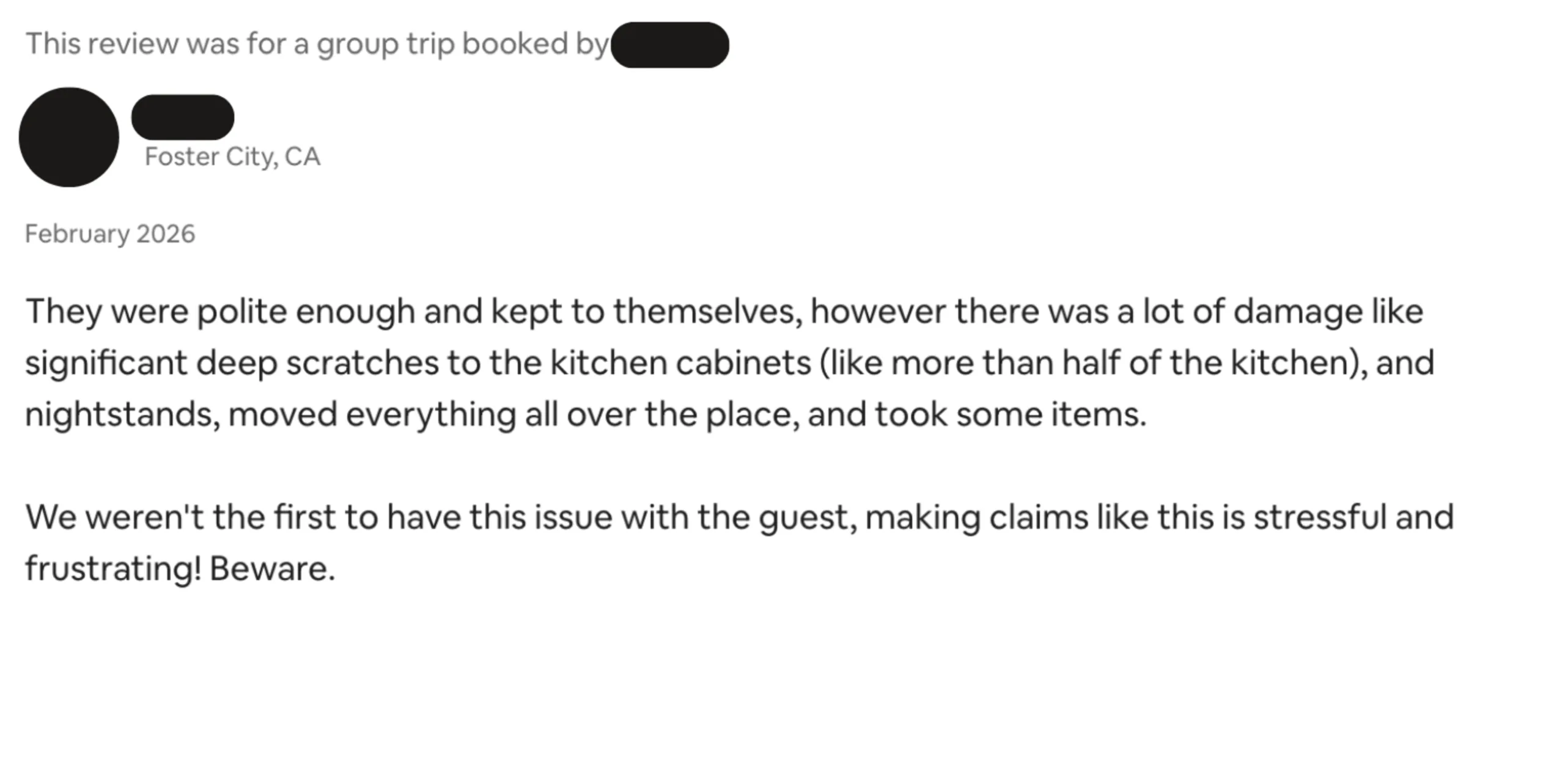
One host in Burlingame wrote in February: “Most of my hardwood kitchen cabinets were scratched/gouged after their stay. There were also some black streaks on my walls and baseboards. During their stay, they brought multiple large plastic cases and boxes at various times which I suspect caused the damage.” A Foster City host complained of “significant deep scratches to the kitchen cabinets (like more than half of the kitchen)” and noted the guests had moved everything around and taken some items.
The owner of an 1896 Victorian in the Ingleside neighborhood told the SF Standard he rented to three of the same guests in March. He came home to scuff marks on walls, nicked doorframes, a cracked refrigerator shelf, a broken glass left in the garbage disposal, and furniture that had clearly been rearranged. On his dining table, the group had left a whiteboard message: “Sorry 🙁 Did my best!” Reviewing the timeline of damage reports, it becomes clear that Airbnb robot testing at this property was part of the same broader pattern.
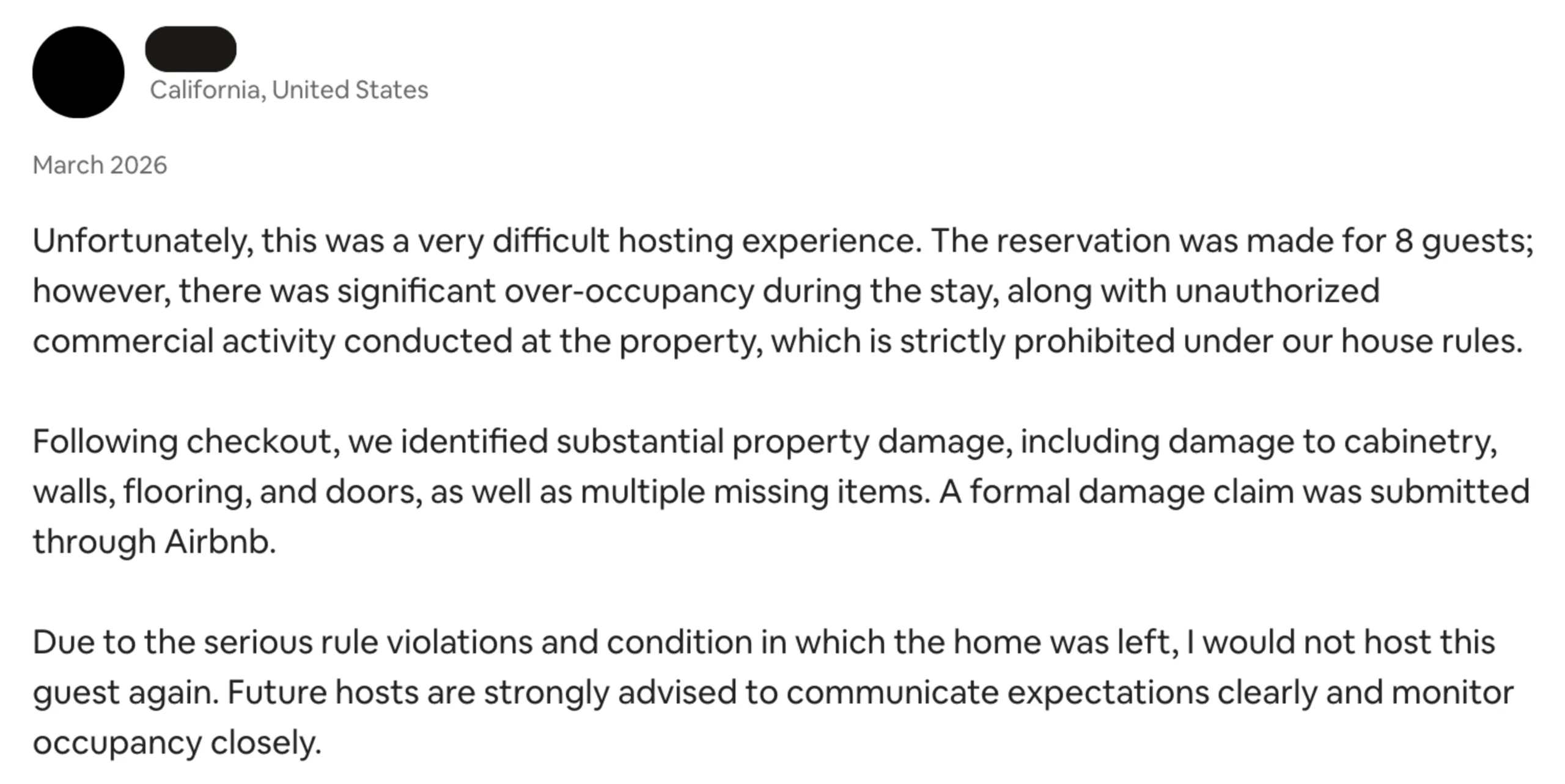
He initially assumed they’d thrown a party. Then a neighbor mentioned seeing people carry large black boxes inside. “The robot thing kind of makes sense now,” he said. He spent a week cleaning and making repairs, then filed a damage claim with Airbnb — which rejected it, citing a lack of before-and-after photos. The guests never responded to his messages. He asked to remain anonymous.
The Real Issue: Deception, Not Disruption
Here’s the thing that makes this story more than a property damage dispute: both Donovan and the Ingleside host independently said they’d have been fine with the arrangement if someone had just been honest about it. Hosts aren’t inherently opposed to Airbnb robot testing — they’re opposed to being deceived.
“The dishonesty is really what upsets me the most. If they had come straight up, ‘Hey, we would like to rent your house for testing of our robot,’ then we could have come to an agreement. But it’s the lying and the misrepresentation that makes me feel violated.” — Sean Donovan
The Ingleside host echoed that sentiment. “If they’re trying to better the lives of humans with robots, I’m all for that. I think there’s a good future in that, but they don’t need to be all sneaky about it.” These aren’t people opposed to tech. They’re people who feel they were used without consent — and that’s a different and much more damaging accusation for a startup to carry into its public debut.
What This Means for the Home Robotics Industry
The race to build a practical home robot is real and well-funded. Alongside The Bot Company, players like Figure AI, Physical Intelligence, and Amazon’s own robotics ambitions are all chasing the same prize: a machine that can navigate domestic chaos and actually be useful. Training these systems requires exposure to real home environments — the unpredictable layouts, the varying surfaces, the objects that don’t sit where you’d expect. A lab environment only gets you so far.
That’s presumably the logic behind Airbnb robot testing as a strategy. Real homes, real conditions, real friction. It’s not a crazy idea on its face. The execution, though, is a liability — legally, reputationally, and ethically. Booking residential properties under false pretenses to conduct commercial prototype testing almost certainly violates Airbnb’s terms of service, and depending on how a court reads it, could expose the company to claims well beyond one homeowner’s $12,000 repair bill.
There’s also a broader trust question. The Bot Company’s stated ambition is to put robots inside millions of homes. That pitch depends entirely on people being comfortable with the idea. Getting caught secretly using strangers’ homes as unlicensed Airbnb robot testing sites — and leaving them damaged in the process — is not the kind of brand-building that makes consumers eager to welcome a wheeled robot arm into their kitchen. Donovan’s shoes are still missing. The company’s public credibility may be harder to recover.

