

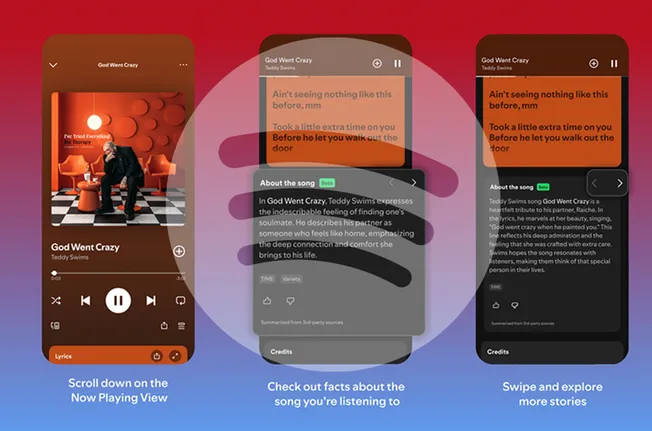
At SquaredTech.co, we see the Spotify About the Song feature as more than a decorative addition to the Now Playing screen. It is a deliberate change in how a streaming service frames the act of listening. Spotify About the Song feature places short editorial story cards directly inside the playback experience, giving listeners a route into a track’s background while the music is still playing. Rather than asking someone to leave the app, open a browser, search for an interview, or hunt through fan discussion, Spotify puts a small amount of explanation beside the song itself.
The cards summarize insights from third party sources and focus on inspiration, writing intent, and behind the scenes moments. Users can swipe through them and provide simple feedback signals. That sounds modest, but it addresses a familiar gap in streaming: services are very good at getting a listener to a song and much less effective at explaining why that song matters to the person who made it or the moment that produced it.
Music has always arrived with context. Radio presenters supplied some of it. Record sleeves, liner notes, magazines, interviews, music television, and artist websites supplied the rest. The streaming era made access nearly frictionless, but much of that surrounding material became scattered across platforms. A listener can move from a song to lyrics, clips, comments, social posts, and search results in seconds, yet that journey is fragmented and often unreliable. Spotify’s approach is to bring a curated version of the story back to the place where attention is already concentrated.
Table of Contents
Why Spotify Is Embedding Storytelling at the Track Level
Spotify About the Song feature focuses on individual tracks rather than albums or artists as a whole. That distinction matters. Listener curiosity usually begins with a specific moment: a lyric that lands differently, a production choice, a voice, or a song heard for the first time in a playlist. An artist biography can establish a career arc, but it does not necessarily answer the immediate question raised by one track. The track-level format meets that curiosity at its most useful point.
By attaching context to the exact moment of playback, Spotify can increase emotional engagement without formally interrupting the listening flow. The listener is not being pushed into a separate editorial destination or asked to choose between music and reading. The material sits alongside the music, available to anyone who wants it and ignorable for anyone who does not. That is a more intelligent use of a playback screen than treating it as a purely functional control panel.
Competing platforms still often place this kind of information in static artist pages or external editorial hubs. Those spaces have value, especially for deeper reporting or catalogue exploration, but they demand a different kind of intent. Spotify instead treats explanation as part of playback itself. The result is a tighter connection between discovery and understanding: a recommendation can lead not just to a song, but to a reason to stay with it.
For premium users in select English language markets, the feature already blends naturally with lyrics and visual elements. Spotify is using the same interface space to reinforce attention and reduce distraction. In practical terms, that means the company is trying to make the Now Playing screen feel less like a dead end. A song can now be a starting point for a short editorial encounter without requiring a jump to another service.
There is an important editorial constraint here. Context is only useful when it is accurate, relevant, and proportionate to the work. A simplistic anecdote can flatten a complicated song; an unattributed claim can turn a feature intended to inform into a source of confusion. Since these cards summarize insights from third party sources, Spotify’s choices about sourcing and presentation will matter as much as the interface design. The promise is not merely that more information is available. It is that the information appearing at the moment of listening deserves the listener’s trust.
How the Feature Fits Spotify’s Broader Platform Strategy
Spotify About the Song feature launched alongside several platform updates that signal a wider direction. Spotify recently expanded audiobook purchasing inside the app and introduced tools that connect physical books to audio playback. It also made lyrics translation and offline lyrics access available to all users. These changes involve different kinds of media and different user needs, but they share a common objective: Spotify wants to become a single destination for content and context.
That ambition is easy to understand from a product perspective. Streaming services compete for time, not only subscriptions. The more useful actions a listener can take without leaving an app, the stronger the service’s position becomes. A listener who can play music, read translated lyrics, access lyrics offline, purchase audiobooks, connect physical books to audio playback, and browse song background is spending less time handing their attention to search engines, social platforms, publishers, or separate retail services.
There is a trade-off. Keeping more of the experience inside one platform can be convenient, but it also gives that platform more influence over what context is surfaced, how it is summarized, and which paths remain visible. Spotify’s recent decision to restrict Developer Mode API access by limiting test users and requiring premium accounts fits that picture. Spotify restricted Developer Mode API access by limiting test users and requiring premium accounts. The move gives Spotify tighter control over how third party tools interact with its ecosystem.
Control is not automatically a negative; platforms need rules around access, user experience, and the services built around their products. But it does make Spotify’s broader direction clearer. The company is building value through both explanation and presentation. It wants to shape not only what people play, but the environment in which they discover, interpret, buy, and revisit audio.
That context also gives the About the Song feature more weight than a simple editorial experiment. Spotify is not just adding trivia. It is testing whether cultural information can become a recurring product surface, one that makes playback feel richer and potentially keeps people engaged for longer. The feature’s simple feedback signals are especially notable because they create a way for users to register whether the cards are useful. Spotify has not said that this feedback affects recommendations, but the possibility is significant enough to watch.
If listener feedback on story cards affects recommendation signals, context may become part of distribution strategy. Artists and labels could have a new incentive to ensure that background information is accurate, accessible, and compelling around a release. Playlist placement would still matter, but the story attached to a track could become another part of how it travels through the platform. That would be a meaningful shift from an era in which metadata was largely functional and editorial context lived elsewhere.
The risks are equally plain. Music history is often contested, personal, and culturally specific. A short card cannot carry every perspective, and it should not pretend to. Expansion beyond beta will require careful handling of sources, accuracy, and cultural relevance. Spotify will need to avoid treating songs as content units that can be fully explained by a few polished lines. The best version of this feature should prompt curiosity, not claim to settle interpretation.
Still, the direction is clear. Spotify wants music streaming to feel informed rather than passive. Spotify About the Song feature represents a step toward a platform where understanding music becomes part of listening itself, not an optional extra found elsewhere. Whether that becomes a genuine editorial benefit or another tightly controlled layer of the Spotify ecosystem will depend on the quality of the stories, the transparency of their sources, and whether listeners find that context worth returning to.
Stay Updated: Tech News

