- Apple WWDC 2026 will finally deliver the rebooted Siri that was promised two years ago but repeatedly delayed.
- At Apple WWDC 2026, Siri is expected to get a standalone app, agentic AI features, and Google Gemini integration.
- iOS 27 and other platform updates will focus on performance, battery life, and under-the-hood improvements over visual changes.
- New Apple TV 4K and HomePod mini hardware could appear, both reportedly waiting on the new Siri to be ready.
Table of Contents
Apple WWDC 2026 Has One Job: Fix Siri
Apple WWDC 2026 carries more weight than most developer conferences Apple has ever held — and that’s saying something for a company that treats its own keynotes like cultural events. When Apple announced a radically smarter Siri back at WWDC 2024, framed as the centrepiece of its broader ‘Apple Intelligence’ push, it felt like the company had finally woken up to the AI moment everyone else was already living in. Two years later, that Siri still doesn’t exist in any meaningful form. That’s the story dominating Apple WWDC 2026 before a single slide has been shown.
The original pitch was compelling enough: a Siri with genuine contextual awareness, meaning the assistant could read what was on your screen, pull relevant information from across your apps, and surface it without you having to go looking. Not just a smarter search box — an assistant that actually understood what you were doing and why. Apple promised it would ship in the fall of 2024 with the iPhone 16 lineup. It didn’t. Then came a string of delays that stretched through late 2024 and into spring 2025. At last year’s WWDC, senior vice president of software Craig Federighi acknowledged the obvious, saying the work ‘needed more time to reach our high-quality bar’ and that Apple looked forward to ‘sharing more in the coming year.’ That year is now, and Apple WWDC 2026 is where the promise finally has to be kept.
What the New Siri Actually Looks Like
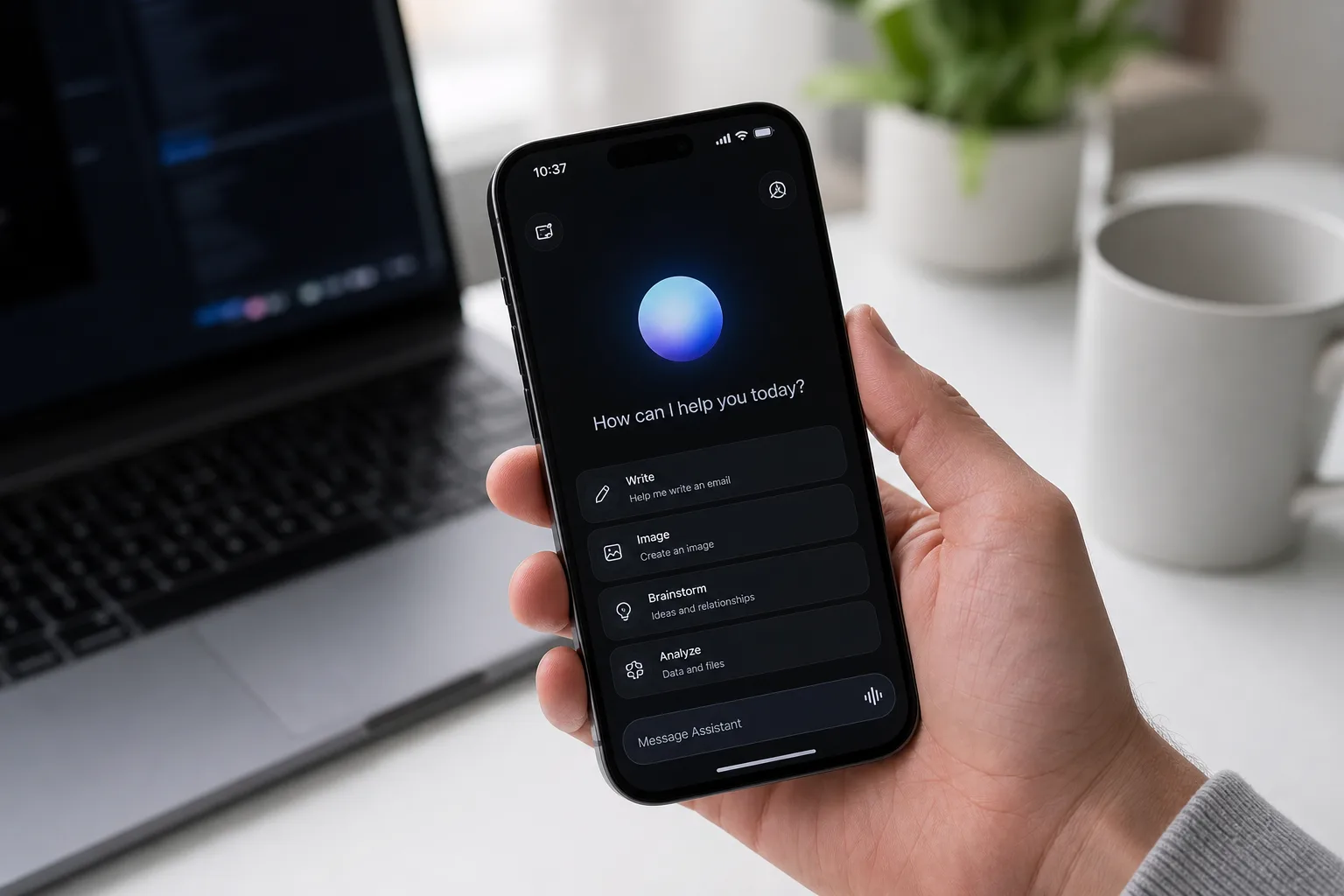
According to Bloomberg’s Mark Gurman, who has consistently been the most reliable source on Apple’s internal pipeline, the new Siri is getting a visual overhaul to match. Gone is the familiar multicoloured glow that pulses around the edges of your iPhone screen when you hold the side button. In its place: a darker, more focused interface that pops out from the Dynamic Island — which actually makes a lot of sense given that Apple WWDC 2026’s visual identity already leans into those darker tones. It’s a small detail, but it signals that Apple wants this to feel like a genuinely new product, not a warmed-over update to something that already felt dated.
More substantively, Gurman reports that Apple WWDC 2026 will introduce a proper standalone Siri app — something that functions more like a chatbot interface than the old ambient overlay most people either ignored or used to set timers. You’ll be able to type prompts, scroll through responses in a threaded conversation view, and have those exchanges saved for later reference. That’s table stakes in 2026 given that OpenAI’s ChatGPT app, Google’s Gemini, and Anthropic’s Claude have been doing this for years, but it represents a meaningful structural shift in how Apple thinks about the assistant.
What’s potentially more interesting is the reported openness to third-party AI models. If Gurman’s information holds, users will be able to choose which underlying AI powers certain Siri responses — and Google Gemini is said to be one of those options. Apple already struck a deal with OpenAI to integrate ChatGPT into Siri for certain queries, so adding Gemini follows the same logic: let external models handle the heavy lifting where Apple’s own infrastructure isn’t competitive, and position it as user choice rather than a limitation. Whether consumers will actually navigate those settings or just use whatever the default is remains an open question, but it does give Apple a hedge.
Agentic AI and Visual Intelligence: the Features That Actually Matter
Beyond the chat interface and cosmetic changes, the part of this Siri update that deserves the most attention is the reported push into agentic AI — the ability to chain together multiple steps across apps using a single voice command. Think ‘book me a table at the Italian place I went to with Sarah last month and add it to my calendar’ rather than asking Siri to open OpenTable, find the restaurant, check availability, and then separately creating a calendar event yourself. That kind of fluid, multi-app orchestration is what companies like Google with its Project Astra and various AI agent startups have been working toward. If Apple can deliver it reliably at Apple WWDC 2026 — and that ‘if’ is doing a lot of heavy lifting — it would represent a meaningful leap over what any other smartphone assistant currently does in practice.
Gurman also says Siri will be woven more tightly into the Camera app through Apple’s Visual Intelligence feature. Visual Intelligence — Apple’s computer vision layer that lets you point your camera at something and get AI-powered information about it — has been quietly improving since it debuted. Integrating Siri directly into that flow makes logical sense: you see something, you ask about it, you get a response without jumping between apps. It’s the kind of seamless experience Apple has always marketed itself on but has historically struggled to deliver in the AI space, and Apple WWDC 2026 is the clearest opportunity yet to prove that’s changed.
iOS 27 and the Platforms: Under the Hood, Not on the Surface
Outside of Siri, the broader picture for Apple’s software this year looks like a deliberate course correction. Every credible report points to iOS 27, macOS 27, iPadOS 27, and their counterparts being focused on performance, bug fixes, and security hardening rather than splashy new features or visual reinvention. That’s not necessarily a bad thing — the platform updates and the Liquid Glass redesign introduced at WWDC 2025 were genuinely polarising in terms of legibility and performance on older hardware, and there’s clearly a backlog of stability work to get through. Apple WWDC 2026 appears to be the year Apple prioritises getting the foundations right over chasing headline features.
Liquid Glass itself isn’t disappearing, but refinements are expected to improve contrast and readability for those transparent UI elements that some users found difficult to parse. Whether Apple will offer any user-facing control over how aggressively the effect is applied — say, a slider to dial it back — remains to be seen. There’s a reasonable argument that Apple should offer this, particularly for accessibility reasons, though the company has historically been reluctant to let users significantly alter its core visual design language. Battery life improvements are also on the list, with Gurman suggesting at least some platforms could see gains through software optimisations alone.
Don’t Hold Your Breath for Major Hardware
Apple has occasionally used WWDC as a hardware stage — the cylindrical Mac Pro in 2013 and the modular ‘cheese grater’ tower in 2019 are the obvious examples — but Apple WWDC 2026 doesn’t look like one of those years. The foldable iPhone, which has been the subject of sustained rumour for years, is expected to arrive in September alongside the iPhone 18 Pro and 18 Pro Max. The Vision Pro spatial computer is reportedly on hold as Apple shifts engineering attention toward smart glasses — both camera-equipped and screen-equipped variants — targeting 2027 launches. The MacBook Pro was refreshed in late 2024, and the MacBook Air and iPad Air got updates in March 2025.

The most plausible hardware surprise at Apple WWDC 2026 — if there is one — would be updated versions of the Apple TV 4K and HomePod mini. Gurman has said both are ‘ready to go and just waiting on the new Siri,’ which actually tells you something important about Apple’s internal architecture: these devices apparently need the new assistant baked in before they’re worth releasing, rather than shipping now and getting Siri later via software. An improved chip to handle on-device AI processing would be the headline spec change, and the Apple TV remote may also see a refresh — a move that would be welcomed by anyone who has lost one between sofa cushions.
Two Years Is a Long Time in AI
The context Apple walks into at Apple WWDC 2026 is genuinely difficult. When the original Siri reboot was announced in 2024, the AI landscape was already crowded. Now it’s overwhelming. OpenAI has shipped GPT-4o with real-time voice capabilities. Google’s Gemini is deeply integrated into Android and Workspace. Meta is deploying its AI assistant across WhatsApp, Instagram, and Ray-Ban smart glasses. Microsoft has Copilot embedded in Windows. Meanwhile, Apple’s flagship AI assistant is still, essentially, the version that couldn’t tell you what was on your own screen.
That’s not a comfortable position for a company that sells premium devices partly on the promise of a seamlessly intelligent experience. Apple’s saving grace has been that most of its customers — the vast majority who don’t attend developer conferences or read tech blogs — largely didn’t notice the delay, and iPhone sales held steady regardless. The strategy of dazzling with Liquid Glass while Siri stayed broken worked better than it had any right to. But that goodwill has a shelf life. If Apple WWDC 2026 delivers a Siri that’s genuinely capable, contextually aware, and reliable in daily use, the last two years become a footnote. If it doesn’t — if the agentic features are limited, the Gemini integration is half-baked, or the standalone app is just a rebranded search field — the narrative becomes much harder to manage heading into an iPhone 18 launch cycle.
Frequently Asked Questions
What is the biggest announcement expected at Apple WWDC 2026?
The headline at Apple WWDC 2026 is expected to be the long-delayed Siri overhaul — including a dedicated Siri app, agentic multi-step task support, Visual Intelligence integration, and access to third-party AI chatbots.
Will Apple release new hardware at WWDC 2026?
Major hardware launches aren’t expected at WWDC 2026. The foldable iPhone is pencilled in for the fall alongside iPhone 18 Pro. The most likely hardware updates are a refreshed Apple TV 4K and HomePod mini, both said to be ready and waiting on new Siri.
What happened to the Siri reboot Apple announced at WWDC 2024?
Apple announced a smarter, context-aware Siri at WWDC 2024 alongside the iPhone 16 launch window. It missed that deadline, was delayed multiple times, and at WWDC 2025 Craig Federighi admitted the work needed more time to meet Apple’s quality standards.
What is Liquid Glass and will it change in iOS 27?
Liquid Glass is Apple’s translucent UI design language introduced across its platforms at WWDC 2025. In iOS 27, changes are expected to be subtle — mainly contrast and legibility refinements — rather than a visual overhaul, as Apple shifts focus to performance and reliability.