

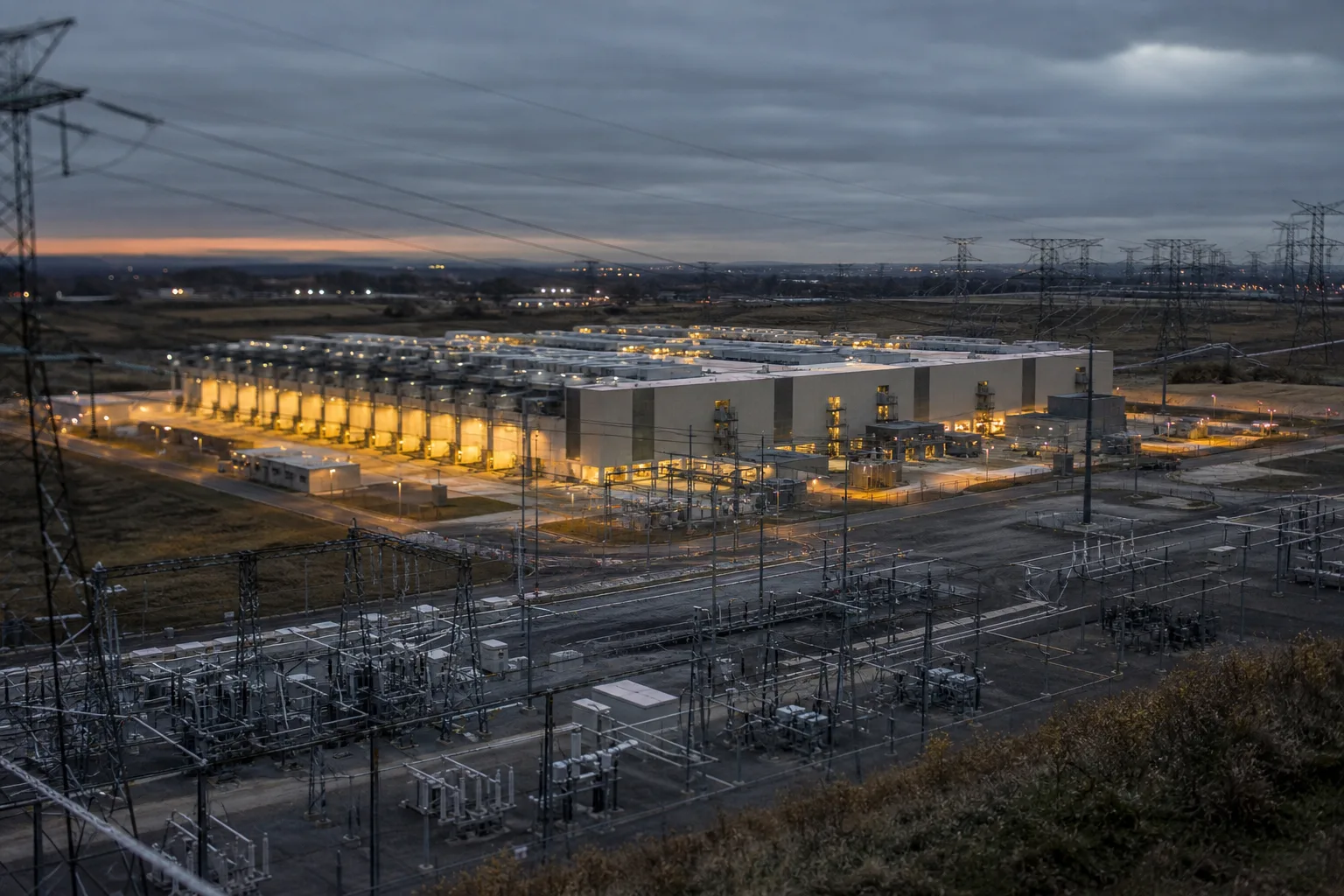
- Data-center power constraints are increasingly threatening the infrastructure needed to sustain the broader AI investment rally.
- The S&P 500’s AI-driven gains depend heavily on hyperscalers expanding capacity, but data-center power constraints are slowing that expansion.
- Electricity grids in key US markets are struggling to keep pace with the explosive growth in AI compute demand.
- Analysts warn that without major energy investment, power bottlenecks could cap AI deployment timelines and weigh on tech valuations.
Table of Contents
The AI Rally Has a Physics Problem
The S&P 500’s remarkable run over the past two years has been turbocharged by one narrative above all others: artificial intelligence. But data-center power constraints are now emerging as one of the most concrete, unglamorous obstacles standing between Wall Street’s AI ambitions and actual delivery. It turns out that intelligence — artificial or otherwise — needs a lot of electricity.
We’re not talking about incremental load increases here. Training a single large language model can consume as much electricity as hundreds of US homes use in a year. And that’s before you factor in the continuous, round-the-clock inference workloads that run every time someone fires a query at ChatGPT, Copilot, or Gemini. Scale that across millions of simultaneous users and the numbers get uncomfortable fast.
The result is a collision between two very different timelines: the speed at which the tech industry wants to build AI infrastructure, and the speed at which power grids — constrained by aging transmission lines, lengthy permitting processes, and finite generation capacity — can actually support it. Data-center power constraints sit at the center of that collision, and they are not going away quietly.
Why Data-Center Power Constraints Are Getting Worse
The geographic concentration of data centers makes the problem especially acute. Northern Virginia — often called ‘Data Center Alley’ — hosts more data center capacity than anywhere else on the planet. Dominion Energy, the primary utility serving the region, has been open about the fact that interconnection queues for new large-scale power customers stretch years into the future. Similar stories are playing out in Phoenix, Dallas, and suburban Chicago.
There are a few compounding factors at play. First, the shift from traditional cloud workloads to AI compute is dramatic. A rack full of CPUs running a standard web application draws perhaps 5–10 kilowatts. A rack dense with Nvidia H100 or Blackwell GPUs can draw 60–100 kilowatts or more. That’s not a modest uptick — it’s a fundamental change in what a data center actually demands from the grid, and it makes data-center power constraints significantly harder to solve with existing infrastructure.
Second, the permitting and construction timelines for new power generation are genuinely slow. A new substation can take three to five years to bring online. Transmission line upgrades face regulatory hurdles that make software development cycles look nimble by comparison. The US Department of Energy’s Grid Deployment Office has flagged transmission bottlenecks as one of the defining infrastructure challenges of the decade — and AI is accelerating the urgency considerably.
Third, the major hyperscalers are all chasing the same finite pool of available power simultaneously. Microsoft, Amazon, Google, and Meta have each announced capital expenditure plans running into the tens of billions for 2024 and 2025. They’re not just competing on AI capability — they’re competing for megawatts.
How This Connects to the S&P 500 AI Trade
The link between data-center power constraints and stock market performance isn’t abstract. A significant portion of the S&P 500’s gains over the past 18 months can be traced directly to a handful of mega-cap tech companies whose valuations rest on AI growth projections. If those companies can’t actually build out the capacity they’ve promised — because there’s no power to run the hardware — those projections become questionable.
Investors have largely priced in an optimistic trajectory: massive capex, rapid capacity expansion, accelerating AI revenue. What the market hasn’t fully priced in is the execution risk embedded in infrastructure bottlenecks. Power isn’t a software problem you can patch. It’s a physical constraint with long lead times and limited shortcuts.
Nvidia’s position in all of this is particularly interesting. The company’s GPU order books are reportedly full, and demand shows no signs of softening. But if hyperscalers can’t get the power to run what they’re buying, you end up with expensive hardware sitting in warehouses — or operating at reduced utilization because the facility simply can’t draw enough electricity. Neither outcome supports the earnings story the market has been told. Data-center power constraints, in this sense, represent a ceiling on the entire AI revenue ramp.
The Nuclear Bet and Other Stopgap Strategies
The industry hasn’t been idle. Tech companies are pursuing a range of strategies to get ahead of data-center power constraints, some more credible than others in the near term.
The most headline-grabbing has been the pivot toward nuclear power. Microsoft reportedly signed a power purchase agreement with Constellation Energy to restart the Three Mile Island nuclear plant in Pennsylvania — specifically to supply its data centers with carbon-free baseload power. Google has reportedly signed agreements to develop small modular reactors (SMRs). Amazon is reportedly backing next-generation nuclear development. The enthusiasm is real, but the timelines are long: most SMR projects are not expected to come online for many years.
In the shorter term, companies are turning to on-site generation, large-scale battery storage, and bilateral deals with renewable developers. Some are getting creative with location — siting new facilities in markets with more available grid capacity, even if those markets aren’t ideal for latency or talent. Iceland and the Nordic countries, with abundant geothermal and hydroelectric power, have seen increased interest for this reason. Even so, none of these approaches fully resolves data-center power constraints at the scale the AI buildout demands.
There’s also been a quieter but significant push in hardware efficiency. Nvidia and its competitors are under real pressure to deliver more compute per watt with each successive architecture. The Blackwell platform promises meaningful efficiency gains over Hopper, and that matters when the bottleneck is measured in kilowatts rather than transistors.
What Investors and the Industry Are Watching
For anyone tracking the AI trade in equity markets, data-center power constraints deserve to sit alongside chip supply, regulatory risk, and model commoditization as a genuine variable in the investment thesis. It’s the kind of risk that doesn’t show up dramatically in a single quarter but accumulates quietly — in construction delays, in missed capacity targets, in guidance that gets quietly trimmed.
Utility stocks have actually been one of the more interesting beneficiaries of this whole dynamic. Constellation Energy, Vistra, and NRG Energy have all seen significant institutional interest from investors who reasoned — correctly, so far — that whoever sells the power to train AI stands to benefit regardless of which AI model ultimately wins. It’s a picks-and-shovels logic applied to electrons rather than silicon.
The broader point is that the AI buildout is no longer purely a technology story. It’s an energy story, a land use story, a permitting story, and a grid infrastructure story. The companies that figure out how to navigate those physical-world constraints — not just the algorithmic ones — will be the ones that actually convert the current hype cycle into durable infrastructure. And the S&P 500’s AI rally, to a greater degree than most investors currently appreciate, depends on exactly that happening on schedule.
Frequently Asked Questions
Why are data-center power constraints such a problem for AI right now?
AI model training and inference require massive, continuous electricity. Modern GPU clusters running 24/7 draw far more power than traditional server workloads, and utility grids in many markets weren’t built for that load. Permitting delays and grid upgrade timelines mean supply can’t keep pace with demand.
Which companies are most exposed to the data-center power constraints problem?
Hyperscalers with the largest AI buildouts face the most direct exposure, as they compete for constrained grid capacity in high-demand markets.
How are tech companies trying to solve the power bottleneck?
Strategies range from building dedicated on-site generation and signing long-term power purchase agreements to investing in alternative energy sources. Some of the most high-profile efforts involve partnerships aimed at bringing additional generation capacity online to meet surging data-center demand.
Could power shortages actually halt the AI rally on Wall Street?
Not immediately — but analysts argue that if capacity expansion timelines slip significantly, earnings growth projections for hyperscalers could be revised down, which would apply real pressure to the AI-heavy tech stocks propping up the S&P 500’s recent gains.

