

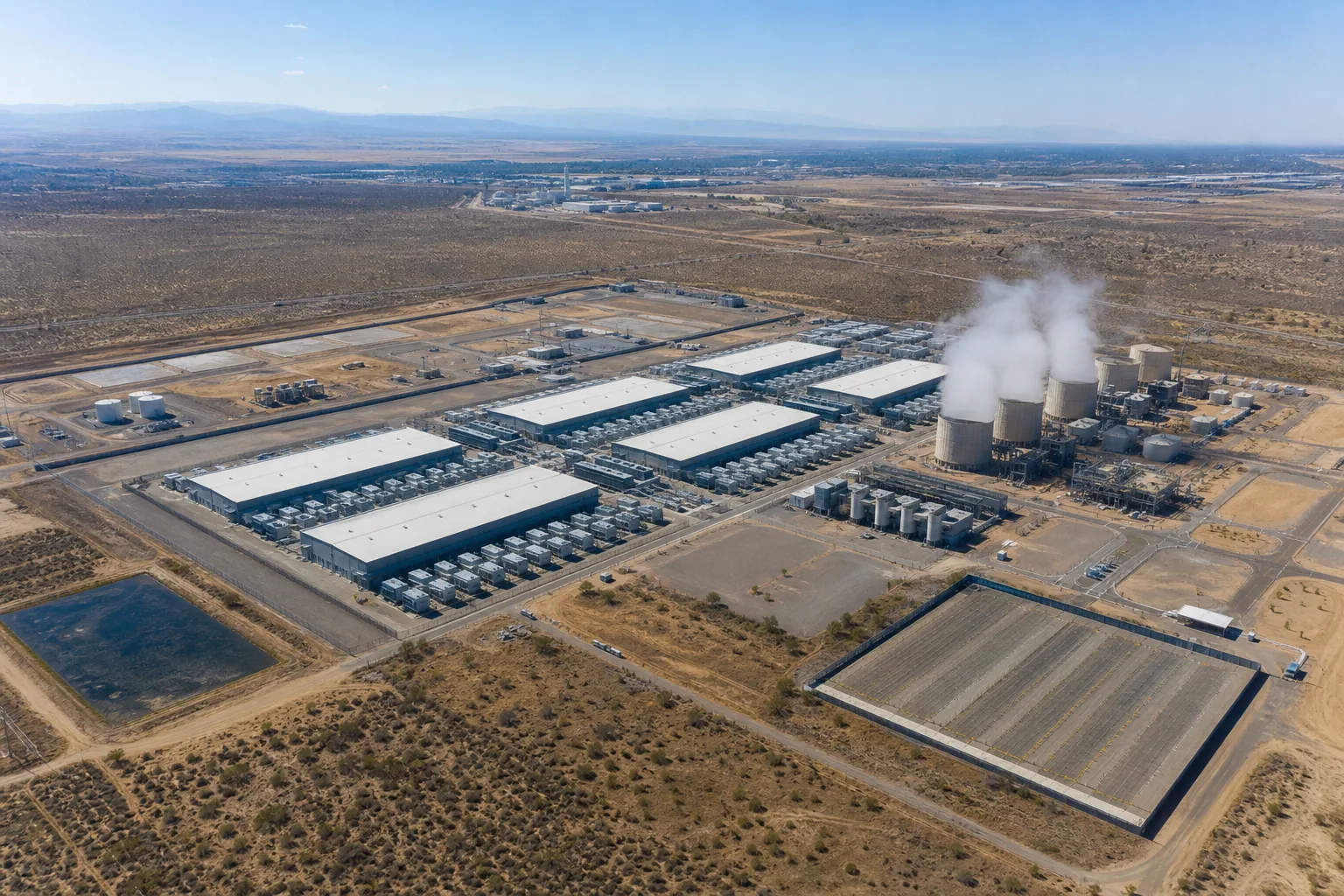
- AI data center water consumption could reach the annual drinking needs of 1.3 billion people by 2030, a new report warns.
- The AI data center water crisis is driven by cooling demands as GPU clusters run hotter and longer than traditional server infrastructure.
- Tech giants including Microsoft, Google, and Amazon are under growing pressure to disclose and reduce their water footprints.
- Without major changes to cooling technology or data center siting, water scarcity in key regions could worsen significantly.
Table of Contents
The Number That Should Make Every AI Company Uncomfortable
AI data center water consumption is on course to hit a figure that’s genuinely hard to process: by 2030, the global network of data centers powering artificial intelligence could drain an amount of water equivalent to the entire annual supply needed by 1.3 billion people. That’s the finding from a newly circulated report tracking the environmental footprint of the AI infrastructure boom — and it lands at a moment when the industry is already fielding hard questions about its energy appetite.
Water, though, has always been the quieter half of the data center sustainability conversation. Energy gets the headlines because it maps neatly onto carbon emissions, grid strain, and electricity bills. AI data center water use is trickier — it evaporates, it’s local, and its scarcity is uneven. A data center chugging through millions of gallons in rainy northern Virginia is a very different problem from one doing the same in drought-prone Arizona or drought-stressed northern Chile. But the aggregate picture, when you scale it to the size of the current AI buildout, is stark.
Why AI Data Center Water Demand Is Different
To understand why AI data center water use has become a genuine concern rather than a footnote, you need to understand what’s changed inside these buildings. Traditional cloud servers — the kind that ran web apps and streamed video for the past decade — were relatively modest in their thermal output. The shift to AI inference and, especially, model training changes the equation entirely.
Training a large language model like GPT-4 or Google’s Gemini requires clusters of thousands of high-end GPUs — NVIDIA’s H100s and the forthcoming Blackwell-architecture chips being the current workhorses — running at near-maximum power draw for weeks or months at a stretch. These chips generate enormous amounts of heat. Cooling that heat away efficiently is non-negotiable; let the temperature creep too high and you get throttling, hardware failures, and wasted compute.
Most large-scale data centers still rely heavily on evaporative cooling, where water absorbs heat and then evaporates, carrying that heat away. It’s effective. It’s also thirsty. Research published in Nature Computational Science estimated that training GPT-3 alone consumed around 700,000 litres of fresh water — and that was a single training run on older hardware. Scale that across the dozens of frontier models now being trained concurrently by OpenAI, Google DeepMind, Meta, Anthropic, and others, and the AI data center water figures climb fast.
Where the 1.3 Billion Figure Comes From
The 1.3 billion people figure is a projection, not a measured current reality — and it’s worth being clear about that. It assumes continued aggressive AI infrastructure investment, which, given the capital commitments already announced, isn’t a fringe scenario. Microsoft alone has pledged over $80 billion in data center investment for 2025. Amazon Web Services, Google Cloud, and Meta have made comparable commitments. The buildout is real, and it’s accelerating.
Projections like these typically model AI data center water usage intensity — how many litres per kilowatt-hour of compute — against projected power demand for AI workloads, then translate that into a human-consumption equivalent using standard figures for per-capita water needs (roughly 50 litres per person per day for basic needs, higher for comprehensive usage). The methodology isn’t perfect, but the order of magnitude is sobering regardless of where exactly the numbers land.
What makes AI data center water consumption particularly tricky to govern is that it’s geographically dispersed and largely unregulated at a systemic level. There’s no global body monitoring how much water a hyperscaler draws from a municipal supply in Quincy, Washington or a borehole in County Dublin. Disclosure is voluntary, inconsistent, and often buried in sustainability reports that few outside the ESG analyst community actually read.
Big Tech’s Water Pledges vs. Big Tech’s Expansion Plans
Microsoft, Google, and Amazon have all made high-profile water commitments. Microsoft pledged to be ‘water positive’ by 2030 — replenishing more water than it consumes globally. Google has a similar target. These aren’t empty PR moves; both companies have invested in water recycling infrastructure and have explored closed-loop cooling systems that dramatically reduce evaporative loss.
But there’s an uncomfortable tension at the centre of these pledges. The same companies making water-positive commitments are also the ones signing the biggest AI infrastructure contracts, opening new data center campuses at a pace the industry hasn’t seen in years, and competing aggressively for power grid access in markets worldwide. You can’t fully square ‘we’re reducing our water footprint’ with ‘we’re also building 10 new gigawatt-scale campuses simultaneously.’ The math doesn’t work unless efficiency improvements outpace capacity growth — and historically, in tech, capacity growth wins.
To be fair, there is genuine innovation happening. Immersion cooling and direct liquid cooling — where chips are submerged in dielectric fluid or cooled by liquid running through cold plates — can reduce or eliminate the need for evaporative AI data center water use. NVIDIA’s latest Blackwell GPUs are designed with liquid cooling as the primary thermal solution rather than an add-on. Microsoft has experimented with underwater data centers. These are real advances. But they’re not yet the default, and retrofitting existing facilities is expensive and slow.
The Local Impact Problem
Aggregate figures like ‘1.3 billion people’s water needs’ are useful for grabbing attention, but the real harm from AI data center water use is intensely local. A data center drawing heavily from a water-stressed aquifer in Mesa, Arizona, or competing with agricultural users in a dry Spanish valley, has a direct, traceable impact on communities and ecosystems. Several US municipalities have already clashed with data center operators over water permits, and those disputes are going to multiply as the buildout continues.
Ireland is an instructive case. The country has become a major European data center hub partly due to its cool climate — which reduces cooling demands — and its corporate tax environment. But Irish grid and water authorities have raised concerns about the concentration of large-scale facilities around Dublin, to the point where planning restrictions have been introduced. It’s an early signal of the regulatory friction around AI data center water withdrawals that will likely spread to other jurisdictions as AI infrastructure demand keeps growing.
What Needs to Change — and Who Has to Drive It
The optimistic read is that the industry knows this is a problem and has the engineering talent and capital to solve it. Liquid cooling is maturing fast. Site selection is increasingly factoring in water availability alongside power costs. Some hyperscalers are exploring regions with abundant renewable energy and low water stress simultaneously — the Nordic countries being the obvious example.
The pessimistic read is that voluntary commitments and efficiency improvements won’t move fast enough given the scale of investment already locked in. If that’s the case, regulation becomes the forcing function — mandatory AI data center water disclosure, limits on data center water withdrawals in stressed watersheds, or requirements to use recycled water for cooling. The EU’s Corporate Sustainability Reporting Directive already nudges in this direction for European operations, but it’s far from a global standard.
The broader point is that AI’s resource demands — energy, water, land, rare materials for chips — are becoming too large to treat as externalities. The industry built its reputation on dematerialisation, on doing more with less. The data center reality is the opposite: doing more requires vastly more, and the planet’s finite resources are the constraint that no amount of software optimisation fully escapes. How the industry, regulators, and investors respond to that constraint over the next five years will say a lot about whether the AI boom has a sustainable second act.
Frequently Asked Questions
Why does AI data center water consumption keep rising?
AI workloads, especially training large language models, require dense clusters of high-power GPUs that generate intense heat. Cooling these systems — whether through evaporative cooling towers or direct liquid cooling — demands vast quantities of water, far more than traditional cloud or enterprise server infrastructure.
How does AI data center water use compare to other industries?
By 2030, AI data centers alone could consume water equivalent to the yearly needs of 1.3 billion people, according to a recent report. That puts them in the same conversation as sectors that have long faced scrutiny over large-scale water consumption.
What are tech companies doing to reduce their water footprint?
Some major tech companies have made public commitments to reduce or offset their water consumption. Critics argue, however, that these pledges may not keep pace with the rapid growth in AI infrastructure.
Which regions are most at risk from AI data center water demands?
Data centers are often built in already water-stressed areas, which can amplify local scarcity risks. Concentrating AI infrastructure in such regions raises significant concerns for communities and ecosystems that already face water pressures.

