

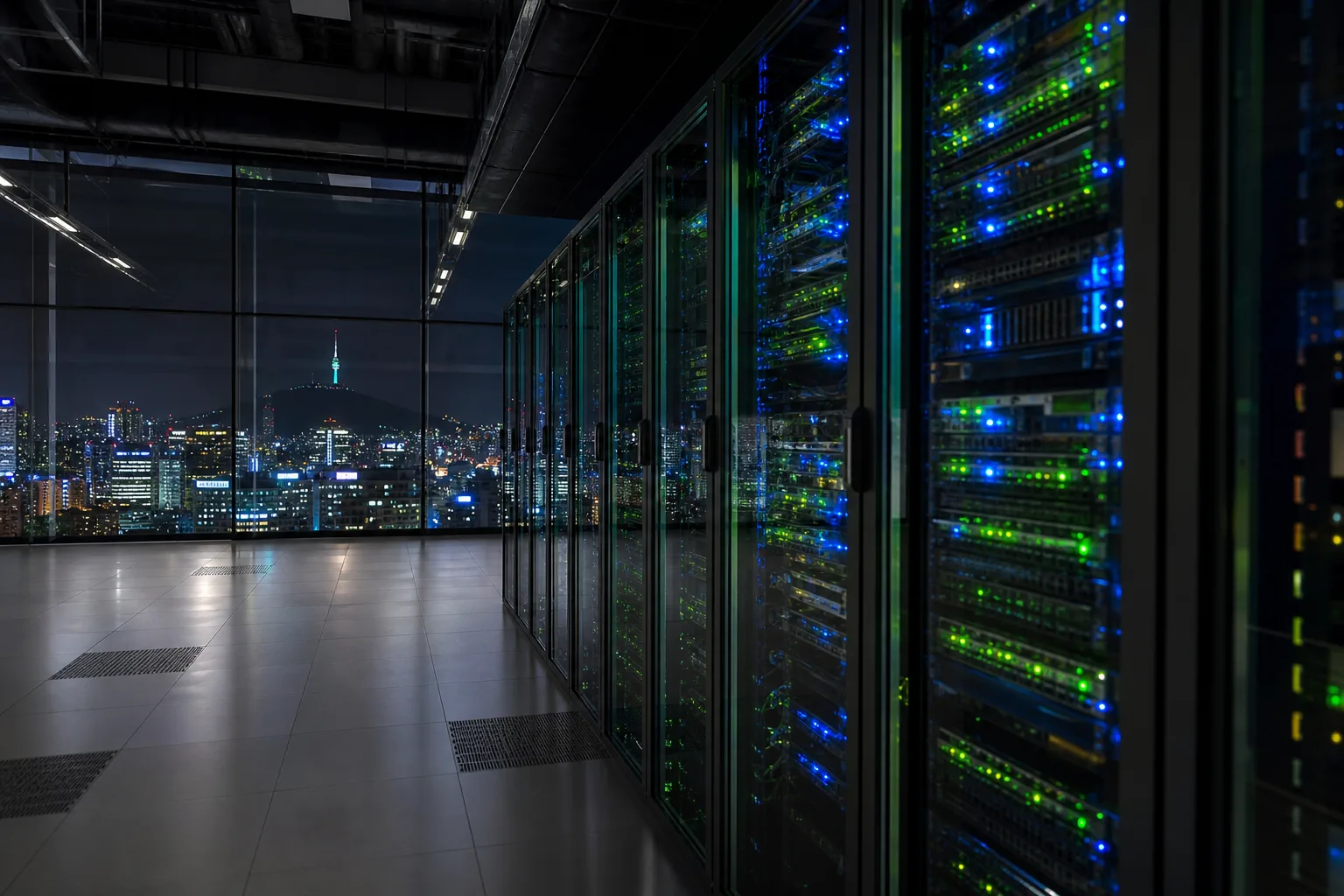
- Nvidia AI infrastructure in South Korea is expanding through three separate deals with SK Hynix, Naver, and Doosan.
- SK Hynix will deepen its HBM memory supply for Nvidia AI infrastructure, cementing South Korea’s role in the global AI chip supply chain.
- Naver is set to deploy Nvidia hardware to build out its own sovereign AI cloud platform for Korean businesses and developers.
- Doosan’s involvement signals that industrial and energy sectors are now active players in the South Korean AI buildout.
Table of Contents
Nvidia AI Infrastructure Comes to South Korea in a Big Way
Nvidia’s Jensen Huang has spent the better part of 2024 and 2025 touring the world and signing deals, and South Korea just became one of the most consequential stops on that itinerary. The company has announced a cluster of partnerships — with memory giant SK Hynix, internet and cloud heavyweight Naver, and industrial conglomerate Doosan — that collectively represent one of the most serious national-level commitments to Nvidia AI infrastructure outside the United States.
Each deal is distinct in what it covers, but they share a common thread: South Korea is not content to sit on the sidelines of the AI buildout. The country already punches above its weight in semiconductor manufacturing, and these agreements are a deliberate attempt to translate that hardware advantage into a full-spectrum AI ecosystem. Taken together, they make South Korea one of the most important international anchors for Nvidia AI infrastructure in the Asia-Pacific region.
SK Hynix and the HBM Memory Connection
The SK Hynix partnership is arguably the most strategically significant of the three, even if it’s also the least surprising. SK Hynix is already one of Nvidia’s most critical suppliers — it produces High Bandwidth Memory, the specialist stacked-chip memory that sits inside Nvidia’s H100 and H200 GPUs and makes them capable of the throughput that large AI models demand. Without HBM, you don’t get the AI accelerator performance that’s been driving Nvidia’s extraordinary revenue growth.
The deepened partnership signals that both companies want to lock in that relationship for the next generation of products. Nvidia is reportedly working toward its Blackwell Ultra and Rubin architectures, and securing HBM supply early is essential. For SK Hynix, the association with Nvidia’s continued dominance is enormously valuable — SK Hynix has been investing heavily in HBM3E production capacity, and a tighter Nvidia tie-up justifies that capital expenditure.
It’s also a geopolitical story. The US has been restricting advanced chip exports to China, and South Korea’s semiconductor industry has had to navigate that carefully. Aligning more closely with Nvidia — an American company whose products are central to the Western AI buildout — is, at least implicitly, a statement about which side of that divide SK Hynix is on. Securing a privileged position within Nvidia AI infrastructure supply chains gives SK Hynix significant long-term leverage.
Naver’s Sovereign AI Ambitions
The Naver deal is where the story gets interesting from a consumer and enterprise perspective. Naver is South Korea’s dominant search and internet platform — think Google, but with a heavier e-commerce and cloud services layer baked in. It has been building out Naver Cloud, its enterprise cloud division, with serious intent. Deploying Nvidia AI infrastructure at scale is a logical next step for a company that wants to offer local businesses a credible alternative to AWS, Microsoft Azure, or Google Cloud.
The concept of ‘sovereign AI’ — the idea that countries and regions should have AI compute capacity they control domestically, rather than funnelling all workloads through US hyperscalers — has been gaining real traction globally. France has pushed it with Mistral AI. The UAE has backed it with G42. South Korea, through Naver, is now making its own move.
For Korean enterprises, the appeal is straightforward: data sovereignty, lower latency, regulatory compliance in a market that has its own distinct data protection landscape, and the ability to run Korean-language AI models tuned for local needs without sending sensitive data offshore. Naver already has strong Korean NLP capabilities — pairing that with Nvidia AI infrastructure gives it a genuine platform story to sell to domestic and regional customers alike.
Doosan and the Industrial AI Angle
The Doosan partnership is the one that most people outside South Korea will find hardest to place immediately. Doosan is a sprawling conglomerate with interests spanning power generation, heavy machinery, and robotics — not the typical profile of an AI cloud partner. But that’s exactly what makes it notable.
Industrial AI is one of the fastest-growing segments of enterprise technology right now. Predictive maintenance, energy grid optimisation, robotic process automation in manufacturing — these applications require substantial AI compute, and they’re increasingly running on Nvidia hardware. Doosan Robotics, for instance, has been expanding its collaborative robot lineup, and AI-driven control systems are central to where that market is heading. Nvidia AI infrastructure is becoming the default foundation for exactly these kinds of industrial workloads.
The partnership likely also has an energy dimension. AI data centres are power-hungry at a scale that’s starting to alarm grid operators worldwide. Doosan’s power systems division produces gas turbines and hydrogen energy equipment. Bringing Doosan into the Nvidia ecosystem could reflect a practical need: as South Korea scales up AI infrastructure, it needs companies that can help design and power the facilities that will run it.
What This Means for the Broader AI Race
Zoom out, and what you’re watching is the systematic way Nvidia has turned its GPU dominance into geopolitical and economic influence. Every major economy wants AI capability. Nvidia controls the hardware that makes modern AI possible. So Nvidia walks into capitals, signs deals that span the supply chain from memory to cloud to industrial applications, and deepens its moat in every direction simultaneously.
South Korea is a particularly smart target. It has world-class semiconductor manufacturing via SK Hynix and Samsung, a large and sophisticated technology sector, a government that has made AI a national priority, and consumer internet platforms — like Naver and Kakao — that are already AI-forward. It’s not a developing market trying to bootstrap AI capability from scratch. It’s a mature tech economy that wants to ensure it’s building on its own terms, not just consuming what the US hyperscalers offer.
For Nvidia, that’s an ideal partner profile. Jensen Huang has spoken publicly about the idea that every country will need its own AI infrastructure, and these South Korean deals are the clearest illustration yet of what that looks like in practice. The question now is whether South Korea can translate these partnerships into genuine AI industry leadership — producing models, applications, and services that compete globally — or whether it remains primarily a hardware and infrastructure play. Given the talent and capital being deployed around Nvidia AI infrastructure here, the former seems increasingly plausible.

