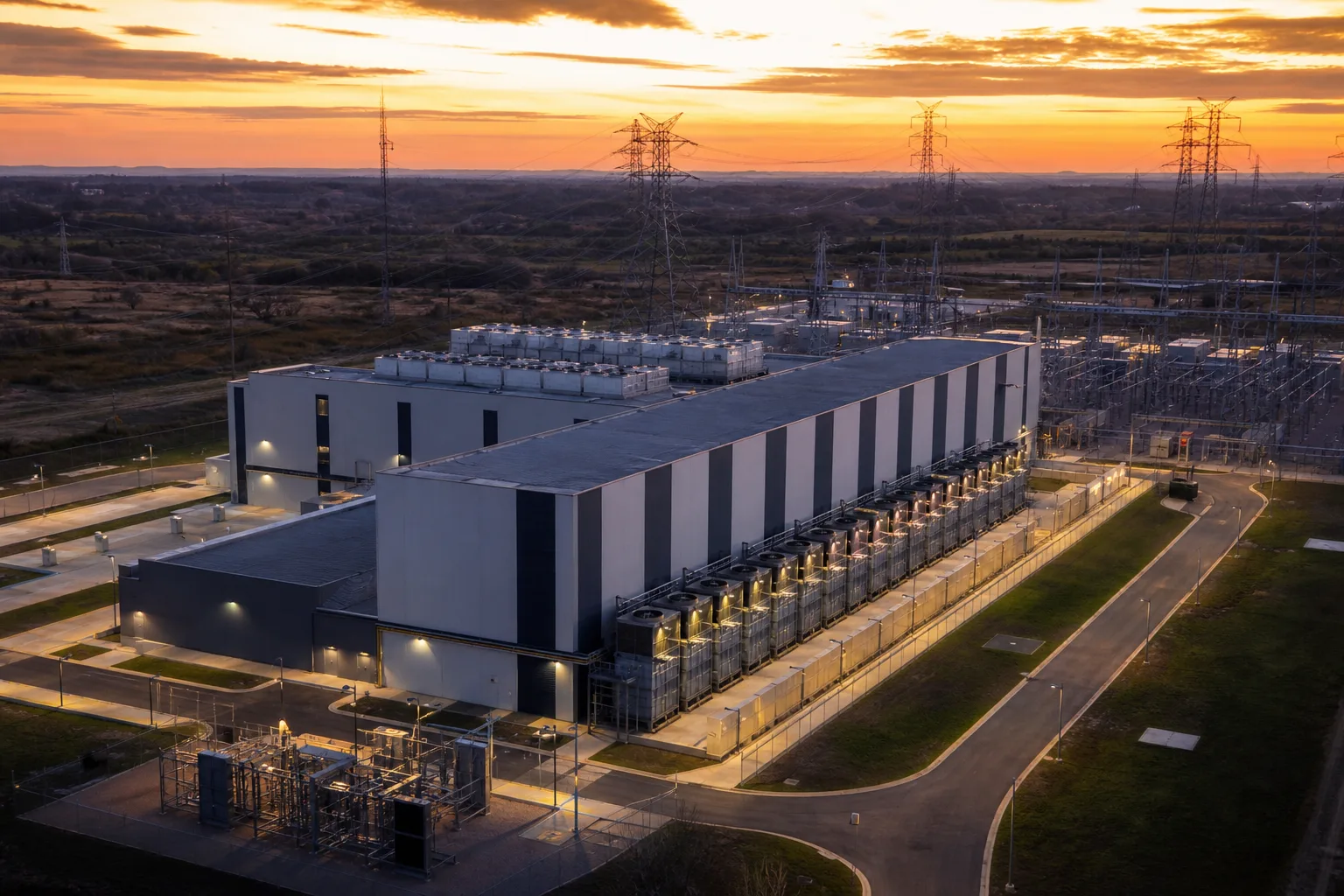
For years, the defining constraint on artificial intelligence was silicon. Get enough GPUs, the thinking went, and you could build anything. That logic made NVIDIA one of the most valuable companies on earth. But AI power demand has quietly become the industry’s most pressing bottleneck — and it’s turning an entirely different set of companies into the unexpected power brokers of the AI era. Literally.
- AI power demand is now growing faster than US grid capacity, making electricity the critical bottleneck for the entire industry.
- AI power demand has handed enormous pricing leverage to utilities, grid operators, and independent power producers — not chipmakers.
- Texas and New York are already tightening grid access rules as hundreds of large data center projects compete for limited megawatts.
- Residential electricity prices have risen 5% in 2026, with the sharpest increases hitting the East Coast as grid strain intensifies.
Table of Contents
When GPUs Stop Being the Bottleneck
The shift happened gradually, then all at once. Through the early 2020s, every conversation about scaling AI centred on chip supply — TSMC fab capacity, NVIDIA’s H100 allocation queues, the geopolitics of advanced semiconductors. Those constraints were real and they mattered. What changed is that the companies now deploying AI at scale have largely secured their silicon pipelines. What they can’t secure is the electricity to run it.
AI power demand in the US is accelerating at a pace that makes grid planners nervous. Goldman Sachs projects that US data centre power consumption will jump from 31 gigawatts in 2025 to 41 gigawatts in 2026, and then to 66 gigawatts in 2027. That last figure represents data centres alone claiming 8.5% of total US peak summer demand — up from 4.1% today. To put that in perspective, the grid is being asked to absorb in roughly two years what would historically take a decade to integrate.
The International Energy Agency sees the same trajectory at the global level, projecting that data centre electricity use will roughly double by 2030, while demand from AI-specific facilities will triple. The IEA’s analysis flags a cascade of physical constraints: tightening supply chains for gas turbines and high-voltage transformers, connection queues stretching years into the future, and a rush toward on-site generation that remains mostly theoretical rather than operational. AI power demand, in the IEA’s framing, is not a future risk — it is an active planning emergency.

AI Power Demand Is Reshaping Who Holds the Cards
Here’s the dynamic worth paying attention to: a utility company doesn’t care whether OpenAI, Google, or Microsoft wins the race to build the most capable AI model. It collects a cheque regardless. Every megawatt consumed by a hyperscaler training a frontier model flows through infrastructure owned and operated by entities that are, in many cases, regulated monopolies with government-approved returns on capital.
That structure is quietly extraordinary. Regulated utilities earn their returns on approved capital spending — meaning that a wave of grid upgrades triggered by AI power demand doesn’t hurt them. It helps them. More infrastructure investment equals a larger rate base equals more revenue, all sanctioned by state regulators. Independent power producers, operating outside that regulatory umbrella, benefit differently: a tighter electricity market means higher prices, and they’re selling into it.
Grid operators occupy perhaps the most powerful position of all. They hold a finite stock of interconnection capacity. That makes them the gatekeepers who decide, in effect, which AI projects are viable and which ones die in a queue. That’s not a metaphor — it’s the literal mechanism by which some data centre campuses get built and others don’t. As AI power demand continues to outpace available capacity, that gatekeeping authority only grows more consequential.
Texas and New York Draw Their Lines
The political and regulatory fallout from runaway AI power demand is already arriving in tangible ways. On June 2, the Electric Reliability Council of Texas — ERCOT — voted to overhaul how it admits large power users to its grid. The backstory is staggering: in just the first months of 2026, nearly 200 large load applicants filed interconnection requests totalling a combined 438 gigawatts. The entire state of Texas currently draws less than 90 gigawatts at peak. That’s not a queue; that’s a fantasy list.
Texas’s response, codified under Senate Bill 6, is a ‘pay your own way’ framework. Large customers bear their own interconnection costs directly, must agree to stand down during grid emergencies, and have to post steep deposits upfront — a deliberate friction designed to weed out speculative claims from serious ones. It’s a blunt instrument, but given the scale of the problem, it may be the only one that works quickly enough.
New York took a different approach. Lawmakers in Albany were racing in the same week to pass a one-year moratorium on new large-scale data centres — which would make New York the first US state to formally pause AI infrastructure buildout. The political framing there is explicit: data centre growth is being weighed against household electricity bills, water consumption, and grid reliability for ordinary residents. These aren’t abstract concerns. Residential electricity prices in the US have already risen 5% so far in 2026, with the sharpest increases concentrated along the East Coast — a direct consequence of AI power demand straining regional grids that were never designed for this load profile.
Bitcoin Miners Already Learned This Lesson
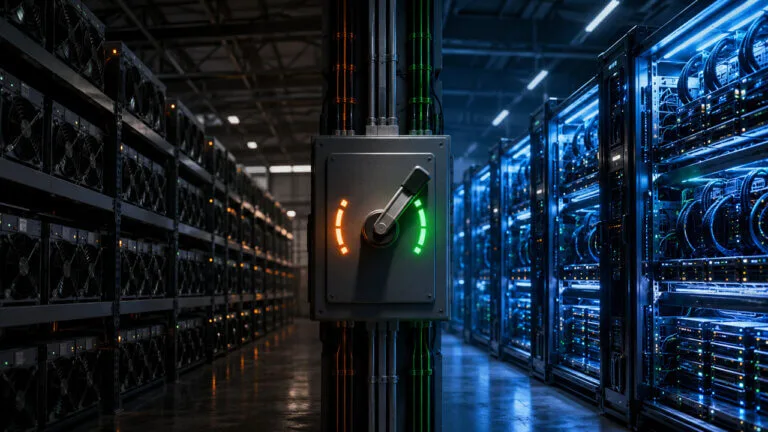
There’s a group of companies that understands this dynamic better than anyone: Bitcoin miners. They lived the electricity bottleneck years before AI made it a mainstream conversation. Mining built its entire economic logic around finding cheap, interruptible power — the kind that could be switched off instantly when grid stress spiked and ramped back up when prices cratered. Miners followed stranded energy into the wind-swept plains of West Texas, into hydroelectric spillways in the Pacific Northwest, and into decommissioned industrial sites wherever cheap watts sat unused.
Texas actually designed its demand-response programmes with miners in mind, recognising that a load which can curtail in seconds has genuine value to a grid operator managing instantaneous frequency balance. Some analysts argue the grid should be paying for that flexibility as a service — and there’s a reasonable economic case for it.
But AI wants the opposite of everything miners offer. Hyperscalers running inference workloads or training runs need steady, always-on power with long-term supply certainty. You can’t interrupt a six-week model training run because the wind dropped in the Panhandle. The computational work is sequential, continuous, and unforgiving of outages. That’s a fundamentally different energy profile — and it’s one that commands a premium in a tightening market. AI power demand is, in this sense, structurally incompatible with the interruptible, opportunistic model that miners perfected.
BlackRock warned in January that AI data centres could consume as much as 24% of all US electricity by 2030. If that number lands anywhere close to reality, the cheap-power truce that miners relied on is definitively over. AI firms are now bidding aggressively for firm supply, and miners are getting squeezed out of markets they once dominated.

Who Actually Pays for All This New Infrastructure?
The unresolved question hanging over every grid operator and state regulator right now is deceptively simple: when a hyperscaler demands a new transmission line, a new substation, or a new generating plant, who writes the cheque?
The answer matters enormously for ordinary households. If regulators allow utilities to spread those infrastructure costs across their entire customer base — the standard approach for ‘societal benefit’ investments — then every residential ratepayer in the service territory is effectively subsidising Amazon’s or Microsoft’s data centre expansion. Some states are pushing back on that model, demanding that large loads cover their own interconnection costs in full, as Texas has now mandated. Others haven’t settled the question yet. The longer that ambiguity persists, the more AI power demand functions as a hidden tax on households who have no direct stake in whether the next frontier model trains faster.
The EIA already expects US electricity consumption to set fresh records in both 2026 and 2027. Goldman Sachs noted that only about 50–60% of the generation capacity scheduled to come online over the next year or two will arrive on time, due to delays and cancellations across the supply chain. That gap between what’s needed and what’s available is precisely what gives power companies their current leverage — and gives grid operators their gatekeeping authority.
The Infrastructure Bet Nobody’s Talking About Enough
AI power demand has exposed something that was always true but easy to ignore when the industry was mostly software: intelligence at scale is a physical phenomenon. It requires land, water, copper, steel, and a continuous flow of electrons. The companies that control those inputs — not the ones writing the most elegant transformer architecture — are the ones with structural pricing power right now.
That’s a significant reframing. The narrative around AI investment has centred almost entirely on model developers, chip manufacturers, and cloud platforms. The less glamorous story — the one happening in utility boardrooms, FERC proceedings, and state legislative chambers — is arguably just as consequential for how the technology actually develops. A hyperscaler that can’t secure 500 megawatts of firm power doesn’t build its data centre, no matter how good its models are. AI power demand is the variable that determines whether any of those models ever reach production at scale.
What comes next is likely a period of genuine negotiation between AI companies, utilities, regulators, and ratepayer advocates — with real money and real political capital on all sides. The companies that navigate that landscape most effectively, securing long-term power purchase agreements before the market tightens further, will have a structural advantage that no amount of model fine-tuning can replicate. Meanwhile, the utility sitting at the end of that wire keeps collecting, whoever wins.
Frequently Asked Questions
Why is AI power demand growing so fast?
Training and running large AI models requires enormous amounts of continuous electricity. Goldman Sachs projects US data center power draw will climb from 31 gigawatts in 2025 to 66 gigawatts by 2027, a pace the existing grid infrastructure simply wasn’t designed to absorb in such a short timeframe.
How does AI power demand affect ordinary electricity bills?
When utilities invest in grid upgrades to serve hyperscalers, regulators sometimes allow those costs to flow through to all ratepayers. US residential electricity prices have already risen 5% in 2026, with the steepest increases on the East Coast.
What is Texas doing to manage AI and data center load on the grid?
Under Senate Bill 6, ERCOT has adopted a ‘pay your own way’ model that shifts interconnection costs directly onto large power users, requires them to curtail during grid emergencies, and demands steep deposits to filter out speculative connection requests clogging the queue.
Are Bitcoin miners competing with AI companies for electricity?
Yes. Miners built their business on cheap, flexible, interruptible power — the opposite of what AI hyperscalers want. As AI firms bid aggressively for firm, always-on supply, miners face rising costs and shrinking access to the cheap electricity their economics depend on.