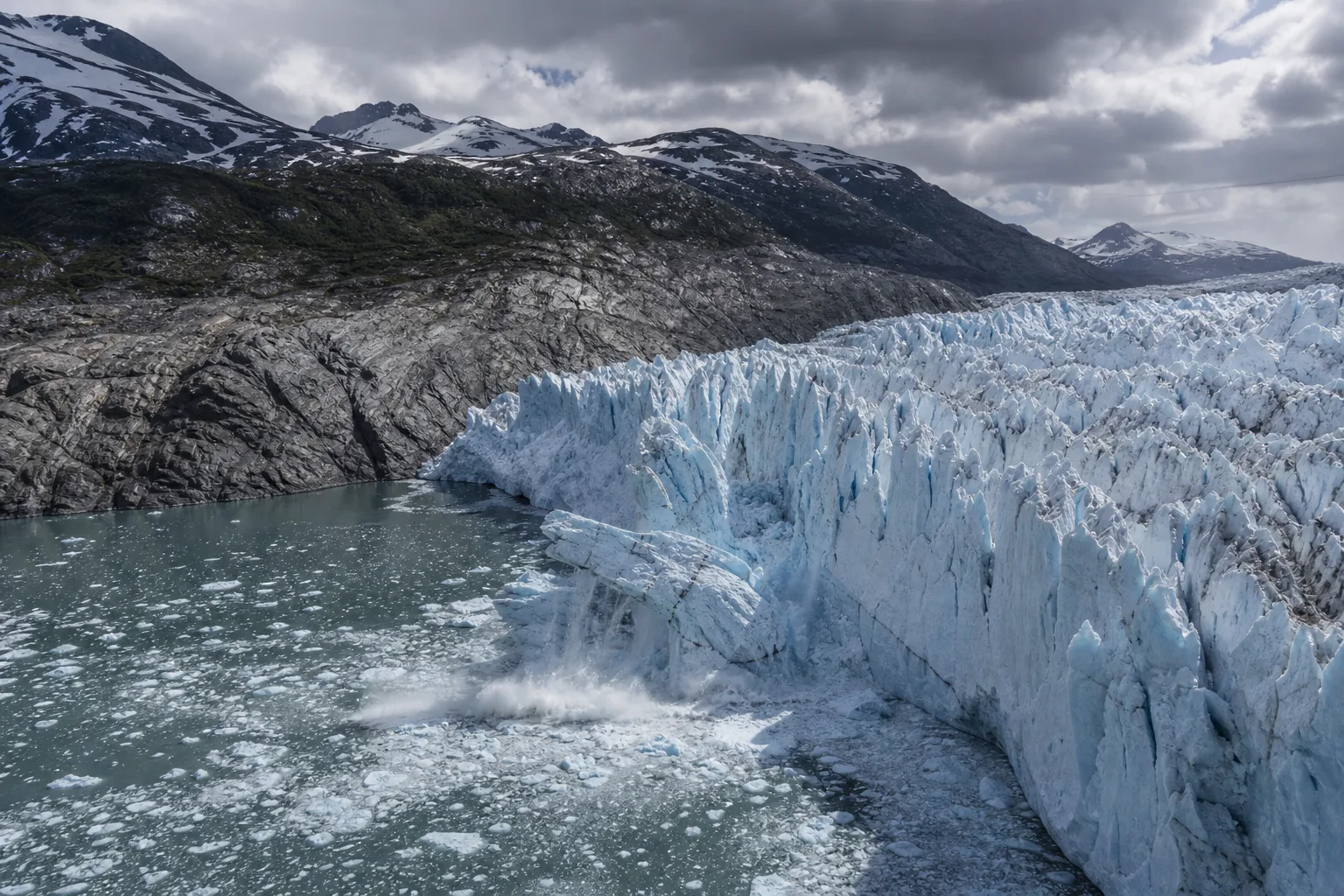
- The Tyndall Glacier retreat is now visible from orbit, with ISS astronauts photographing chunks calving into Lago Geikie in Chile.
- New ISS imagery confirms the Tyndall Glacier retreat has accelerated — the glacier lost 1.4 miles in length in just four years.
- The world’s glaciers have shed over 300 tons of ice in the last 20 years, contributing directly to rising sea levels globally.
- Retreating ice at Tyndall has unexpectedly exposed ancient bedrock, where scientists have discovered ichthyosaur fossils.
Table of Contents
The Tyndall Glacier Retreat, as Seen from 250 Miles Up
There’s something sobering about watching a glacier die from space. A new photograph taken by astronauts aboard the International Space Station shows the Tyndall Glacier retreat in stark, almost clinical detail — jagged chunks of ice calving away from the glacier’s edge and drifting out across the cold surface of Lago Geikie in southern Chile. No graph or data table captures the reality of accelerating ice loss the way a single orbital image can.
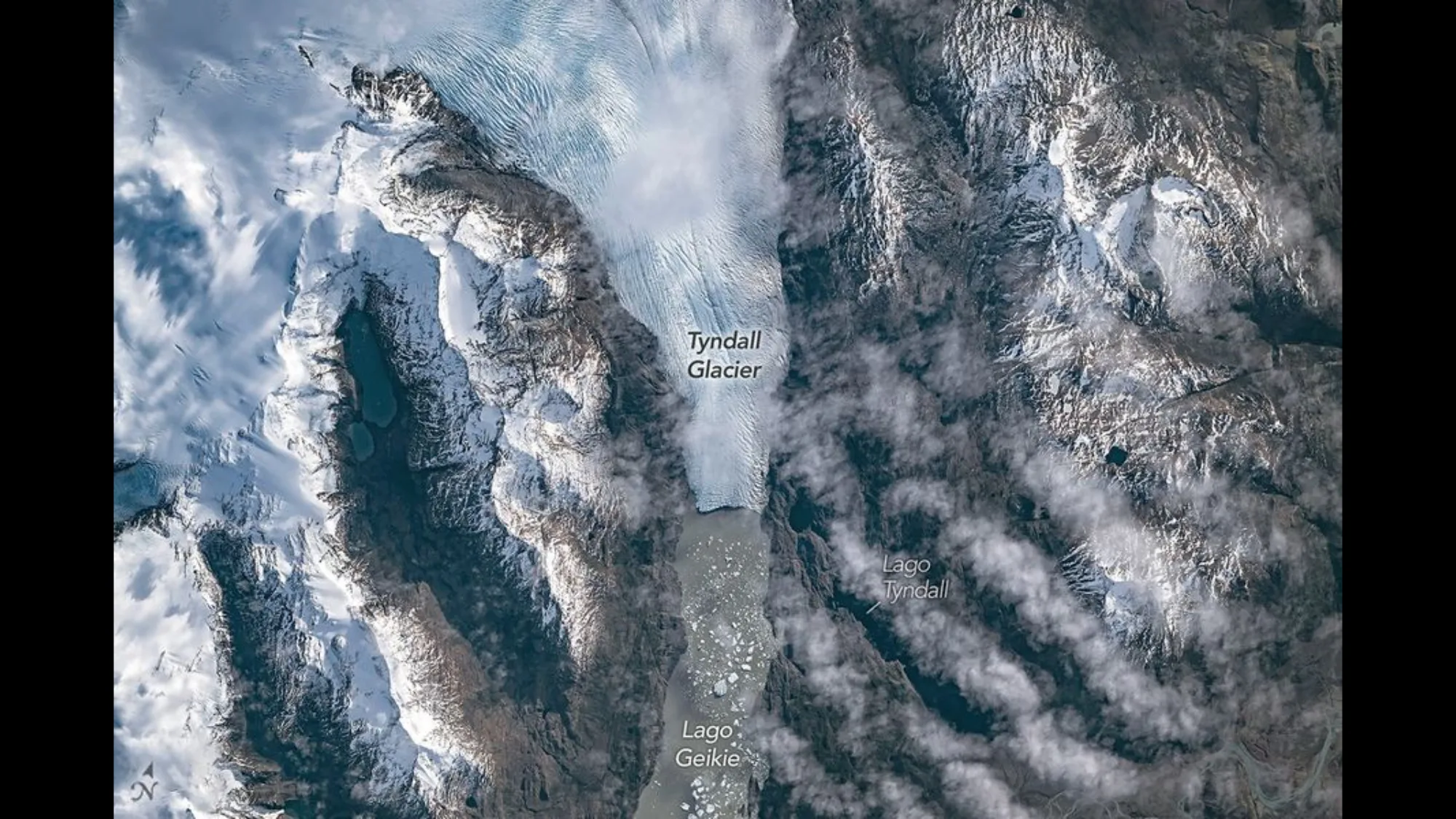
The Tyndall Glacier sits within the Southern Patagonian Icefield, a sprawling frozen expanse that straddles the border of Chile and Argentina. At over 5,000 square miles (13,000 square kilometers), it’s the second-largest continuous icefield of its kind in the world — the larger surviving fragment of the ancient Patagonian Ice Sheet, which once blanketed southern Chile in an almost incomprehensible volume of ice more than 20,000 years ago. What remains today is still vast by any ordinary measure. But it’s shrinking, and the ISS photo makes that undeniable.
150 Years of Shrinkage, and It’s Getting Worse
The Tyndall Glacier retreat isn’t a new story — the ice has been pulling back for roughly 150 years. What’s changed is the pace. Glaciologist Mauri Pelto of Nicholas College has tracked the numbers closely, and they’re not encouraging: in just the past four years, the glacier has lost 1.4 miles (2.2 kilometers) in length. That’s not a geological timescale. That’s within the span of a single U.S. presidential term.
As the glacier contracts, Lago Geikie — the proglacial lake at its snout — keeps growing to fill the void. The ISS image captures exactly that dynamic in real time: splintered ice fragments bobbing across water that simply didn’t exist a few decades ago. It’s a feedback loop that reinforces itself. The more the glacier retreats, the more lake surface is exposed, and open water absorbs far more solar heat than reflective ice, further accelerating the melt.
Why Tyndall Glacier Retreat Matters Beyond Chile
Global glacier loss is accelerating at a rate that should concentrate minds. Research published in Science has estimated that mountain glaciers worldwide lost more ice between 2000 and 2019 than at any point in the observational record. The figures behind the Tyndall Glacier retreat fit squarely into that broader pattern: as of 2025, the world’s glaciers have collectively shed over 300 tons (273 tonnes) of ice in just the past two decades.
The downstream consequences are direct and measurable. Glacial meltwater is a primary driver of sea level rise, and coastal communities from Bangladesh to Miami are already dealing with the early effects. The Southern Patagonian Icefield alone holds enough frozen water that its continued decline contributes meaningfully to that global total — not as an abstraction, but as real centimeters added to ocean levels over time.

What the ISS photo does, perhaps better than any report, is put a human face on data that can feel remote. Astronauts looking down at Earth aren’t seeing a model or a projection — they’re watching the process happen in real time, and then sharing it with the rest of us. That kind of direct observation has a way of cutting through the noise in a way that a spreadsheet simply can’t.
An Unexpected Discovery in the Ice’s Wake
There’s a strange footnote to the Tyndall Glacier retreat story — one that sits uneasily alongside the bad news. As the glacier has pulled back over the decades, it has gradually uncovered bedrock that hasn’t seen sunlight in tens of thousands of years. Scientists working in those newly exposed areas have found ichthyosaur fossils buried in the rock: ancient marine reptiles that swam the seas during the age of dinosaurs, long before the ice arrived to seal them away.
It’s a genuinely odd juxtaposition. The same retreat that’s threatening sea levels and reshaping the hydrology of Chilean river systems has opened a window into deep prehistoric time. Researchers have catalogued several significant ichthyosaur specimens from Patagonia in recent years, and the retreating ice is part of what’s making those discoveries possible. Science, it turns out, doesn’t always arrive in neat packages.
What Space-Based Observation Adds to the Picture
The ISS has become one of the most valuable platforms humans have for monitoring planetary-scale environmental change. Astronauts routinely photograph glaciers, deforestation, urban expansion, and storm systems — building a decades-long visual archive that climate scientists actively use. The Tyndall image is the latest in a long series of orbital dispatches that document how quickly the planet’s surface is being reshaped.
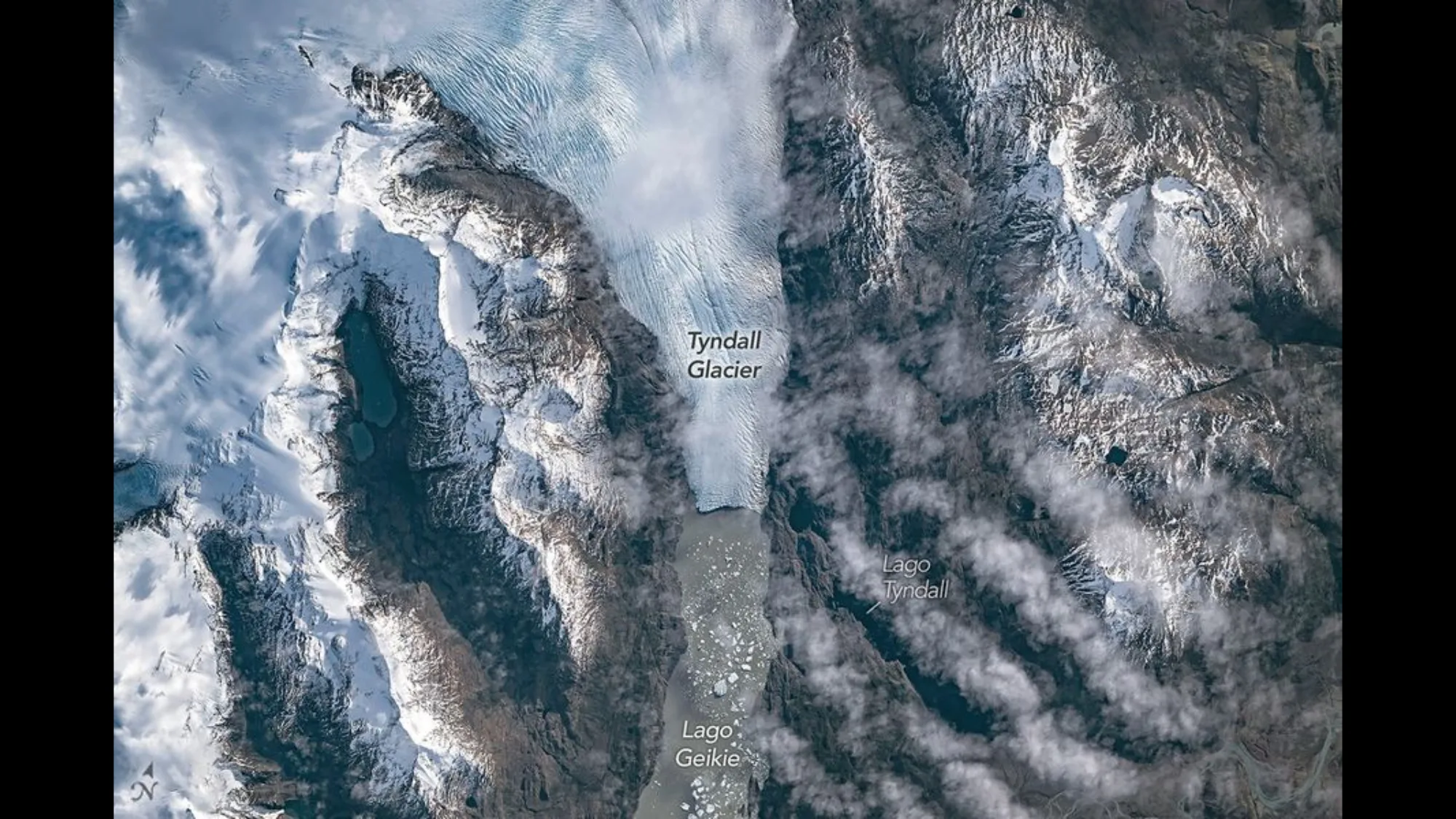
This kind of overhead perspective also has a political dimension. Images from space have historically been powerful tools for environmental advocacy — from the ‘Blue Marble’ photograph taken by Apollo 17 in 1972 to the ISS crew’s ongoing documentation of shrinking ice sheets today. Seeing the Tyndall Glacier retreat captured from orbit isn’t just scientifically useful. It’s a reminder of what’s actually at stake, rendered in high resolution and broadcast to anyone paying attention.
The Tyndall Glacier retreat isn’t going to stop because we photographed it from 250 miles up. But as monitoring technology improves — from the ISS to dedicated Earth observation satellites like ESA’s Sentinel fleet — our ability to track these changes in near-real-time is getting sharper. The data will get more precise, the images more detailed, and the pressure on policymakers more difficult to ignore. Whether that translates into action at the speed the ice is disappearing remains, unfortunately, an open question.