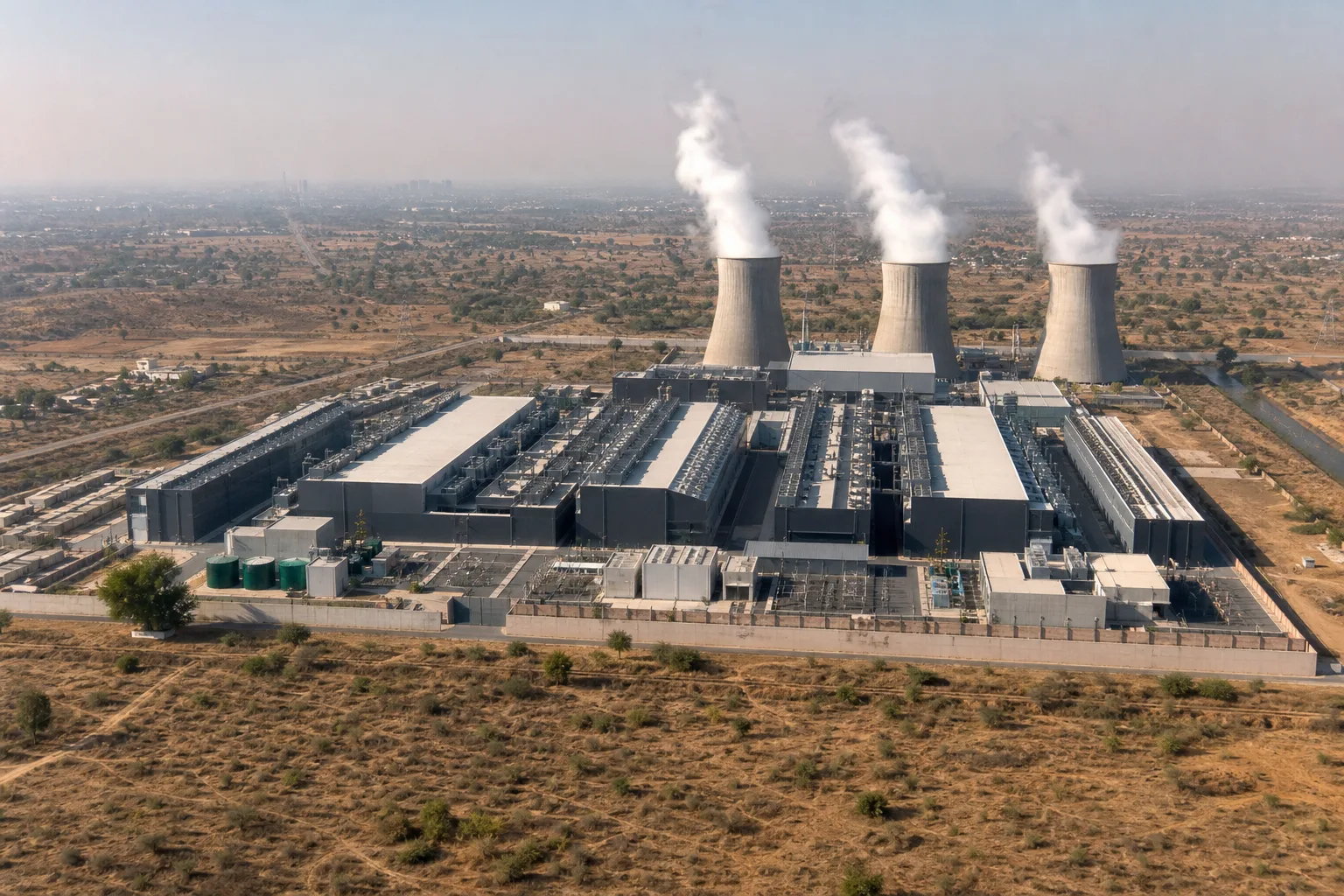
India AI water consumption is shaping up to be one of the most uncomfortable conversations in the country’s tech ambitions. As New Delhi pushes hard to position India as a global AI powerhouse — with billions being committed to data centre infrastructure — a staggering figure is emerging from the numbers: up to 150 billion litres of water consumed every single year. For a country that already struggles with chronic water scarcity across vast regions, that’s not a footnote. It’s a crisis waiting to be named.
- India AI water consumption could reach 150 billion litres per year as the country scales up its data centre ambitions.
- India AI water consumption is driven by cooling systems in data centres, which are among the most water-intensive infrastructure on Earth.
- India is already one of the world’s most water-stressed countries, making the environmental cost of AI expansion a serious policy question.
- Global tech giants including Microsoft and Google have already reported sharp rises in water usage tied directly to AI workloads.
Table of Contents
The Hidden Cost of Running AI at Scale
When most people think about AI’s environmental footprint, they think about electricity — the carbon emissions from powering thousands of GPUs running inference and training jobs around the clock. Water rarely enters the conversation. But it should. India AI water consumption is a direct consequence of how data centres are built and operated, and understanding that link is essential.
Data centres, the physical backbone of any AI operation, generate enormous amounts of heat. The most common way to manage that heat is evaporative cooling — systems that circulate water to absorb heat and then release it into the atmosphere. The more computational work a facility does, the more heat it produces, and the more water it needs. AI workloads are particularly brutal on this front. Unlike serving a webpage or processing a database query, running a large language model or training a neural network pushes chips to sustained high loads for extended periods. The water bill multiplies accordingly.
Microsoft disclosed in its 2023 sustainability report that its global water consumption jumped sharply in a single year, a rise it directly attributed to AI development. Google reported similar trends. These aren’t small operational fluctuations — they’re structural shifts driven by the architecture of modern AI systems. India, by choosing to build at scale, is signing up for the same dynamics, and India AI water consumption will scale in lockstep with every new facility that comes online.
India AI Water Consumption: Putting 150 Billion Litres in Context
One hundred and fifty billion litres sounds abstract. Here’s a frame that makes it concrete: that figure is roughly equivalent to the annual drinking water needs of a city of several million people. It’s water that would otherwise flow into agricultural irrigation in a country where farming still employs a substantial portion of the population. It’s water drawn from aquifers and rivers in states that already face seasonal drought. India AI water consumption at that scale isn’t a marginal issue — it competes directly with human and agricultural needs.
India’s water stress isn’t a future risk — it’s a present reality. The World Resources Institute’s Aqueduct Water Risk Atlas consistently places large parts of India in the ‘extremely high’ water stress category, meaning that more than 80% of available water supply is already being withdrawn annually. There’s almost no slack in the system.
Into this picture, the government and private sector are planning to pour investment into data centres at a pace not seen before. India has added significant data centre capacity in recent years, and analysts expect that figure to double or more by the end of the decade as AI demand accelerates. Each new megawatt of capacity brings with it a corresponding demand for water that the country’s stressed hydrological systems will need to absorb. The trajectory of India AI water consumption therefore tracks almost perfectly with the trajectory of AI investment itself.
Why India Is Pushing Ahead Anyway
The economic and geopolitical logic driving India’s AI ambitions is hard to argue with, even if the environmental costs are real. Prime Minister Narendra Modi’s government has made digital infrastructure a centrepiece of its economic strategy. The IndiaAI Mission, launched in 2024 with substantial government funding, aims to build domestic computing capacity, develop homegrown AI models, and reduce dependence on foreign platforms for critical AI services.
The fear isn’t irrational. Countries that control AI infrastructure control significant economic leverage in the decades ahead. India watched what happened when it became dependent on foreign semiconductor supply chains — the vulnerability that exposed during the global chip shortage was a wake-up call. Building domestic AI capacity is partly about economic growth and partly about strategic autonomy. Yet India AI water consumption represents a hidden cost embedded in every percentage point of that strategic ambition.
But strategic autonomy built on an unsustainable resource base is fragile. That’s the tension at the heart of India’s AI expansion — and it’s one the government hasn’t fully reckoned with publicly.
Tech Giants Are Already Feeling the Heat
India won’t be alone in navigating this. The global tech industry is already under growing scrutiny for its water footprint, and regulators in the European Union, the United States, and parts of Asia are beginning to ask data centre operators for detailed disclosures on water usage — similar to how carbon reporting has evolved over the past decade.
Microsoft, Google, Meta, and Amazon have all made public commitments to become ‘water positive’ — meaning they intend to return more water to local watersheds than they consume — by 2030. Whether those commitments will hold as AI scaling pressures intensify is an open question. Early signals aren’t encouraging: water consumption at major AI labs has risen faster than their conservation programmes have been able to offset. India AI water consumption risks following exactly the same pattern if comparable accountability mechanisms aren’t put in place early.
For India, the question is whether it will learn from those trajectories before the infrastructure is already built, or after.
Can India Build AI Infrastructure More Sustainably?
The good news — and there is some — is that the technology exists to build data centres that use dramatically less water. Direct liquid cooling, where coolant is piped directly to the chips rather than cooling the ambient air, can significantly cut water consumption compared to traditional evaporative systems. Immersion cooling, where servers are submerged in non-conductive liquid, goes even further. Deploying these technologies at scale would materially reduce India AI water consumption even as the number of facilities grows.
The catch is cost. These systems are more expensive to design, build, and operate, which creates a real tension for a country that’s also trying to make AI infrastructure economically viable at national scale. Cheaper facilities built with conventional cooling today will lock in their water consumption profiles for 15 to 20 years.
Location choices matter too. Siting data centres near coastlines where seawater cooling is possible, or in cooler climates where air cooling is more effective, can meaningfully reduce freshwater demand. India has coastline and it has cooler regions in the north — but it also has enormous concentration of tech infrastructure around Hyderabad, Bangalore, and Mumbai, cities that sit in already water-stressed zones. Redirecting future investment toward better-suited locations is one of the most practical levers available to manage India AI water consumption at a systemic level.
The Policy Gap India Needs to Close
What’s largely missing from India’s AI infrastructure conversation is a serious regulatory framework around water use. Electricity requirements for data centres have received policy attention — there are discussions about renewable energy mandates and power purchase agreements. Water has been treated as a secondary concern, something to be addressed later.
‘Later’ is a dangerous timeline when you’re talking about infrastructure that will operate for two decades. The decisions being made right now about cooling technology, facility siting, and water sourcing will define India AI water consumption trajectory for a generation. Retrofitting a fleet of data centres built to the wrong standard is vastly more expensive than getting the standards right in the first place.
If India wants to be a credible AI superpower — not just a large one — it needs water governance for its digital infrastructure to match the ambition of the investment going into it. That means mandatory water use efficiency standards for new data centre permits, independent reporting requirements, and genuine incentives for operators to adopt low-water cooling systems from day one. Without those guardrails, India AI water consumption won’t be a warning — it’ll be a baseline.
Frequently Asked Questions
Why does India AI water consumption matter so much right now?
India is aggressively expanding its data centre capacity to compete as an AI superpower, but it’s also one of the world’s most water-stressed nations. The combination means AI infrastructure growth directly competes with agriculture, drinking water, and industrial use for a resource already in short supply.
How do data centres consume water?
Most large data centres use evaporative cooling systems that draw enormous volumes of water to keep servers from overheating. AI workloads, which run processors at much higher sustained loads than traditional computing, require significantly more cooling and therefore consume far more water per hour of operation.
How does India’s water situation compare to other AI-building nations?
India ranks among the most water-stressed countries globally, according to the World Resources Institute. Nations like the US and China face similar data centre water pressures, but India’s combination of rapid AI ambition, high population density, and climate vulnerability makes the stakes particularly acute.
Are there alternatives to water-intensive cooling for data centres?
Yes. Liquid cooling directly applied to chips, air-cooled facilities in cooler climates, and immersion cooling technologies can dramatically cut water use. However, these alternatives are more expensive to build and operate, which is why evaporative cooling remains dominant in emerging markets like India.