

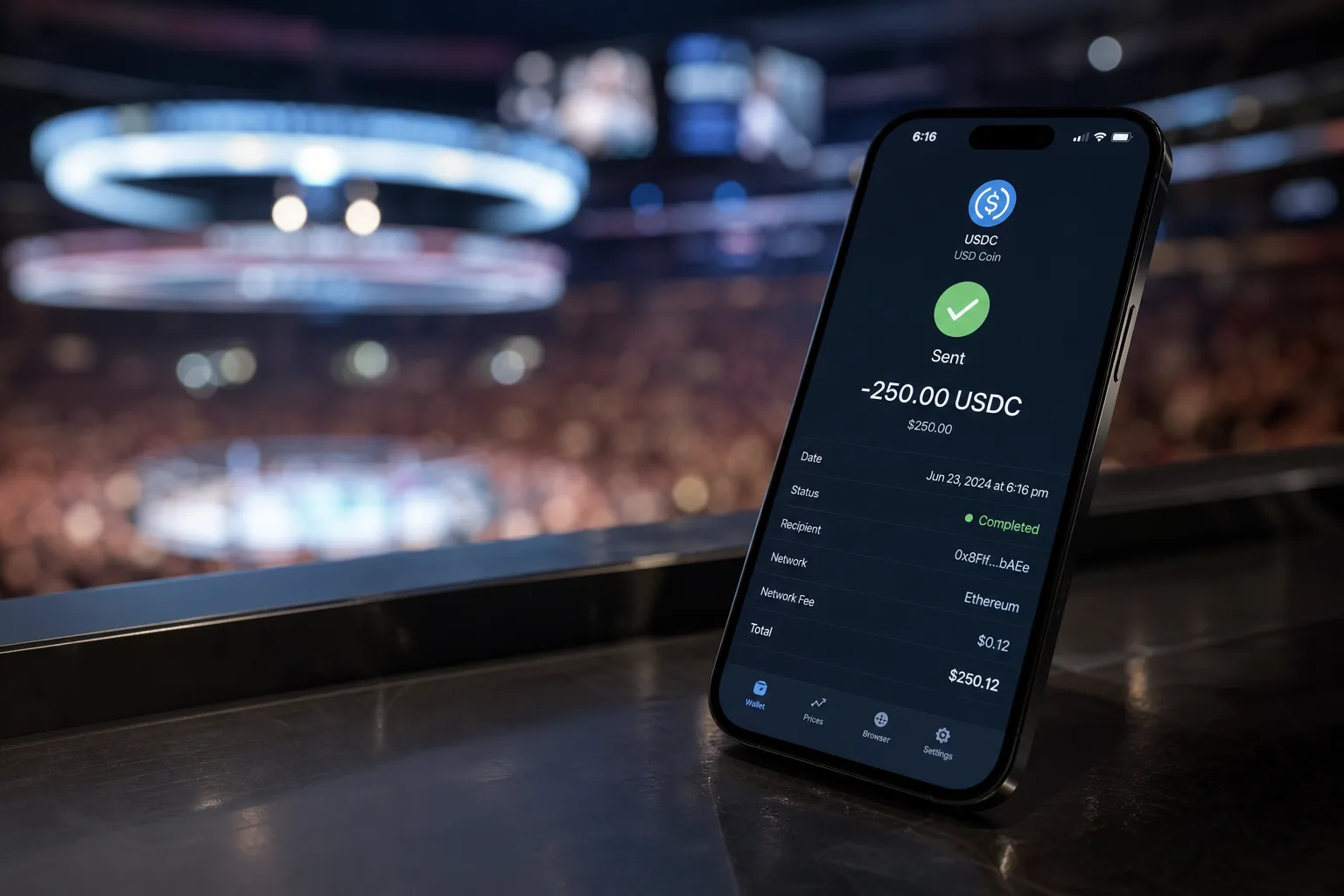
The line between American politics and cryptocurrency just got a lot blurrier. World Liberty Financial, the crypto venture publicly backed by President Donald Trump, has struck a deal to pay UFC fighter performance bonuses in its USD1 stablecoin at an event scheduled for the White House South Lawn — timed, almost cinematically, to fall on Trump’s 80th birthday.
Table of Contents
What the USD1 Stablecoin Deal Actually Means
On the surface, this looks like a straightforward sponsorship: a crypto brand buys visibility at a high-profile sporting event. But the details make it something considerably more loaded. The USD1 stablecoin won’t just get a logo on a banner — it’s being written directly into the prize structure. Fighters who earn performance bonuses, the kind handed out for knockouts, standout submissions, or the night’s best overall bout, will receive those payouts in USD1. That’s a live, public demonstration of a stablecoin being used as it was always intended: as a practical medium of exchange.
For World Liberty Financial, that’s enormously valuable. Crypto projects, and stablecoins in particular, have spent years fighting the perception that they’re speculative instruments rather than real-world payment tools. Getting your USD1 stablecoin on the paycheque of a UFC fighter, in front of a global audience, at the White House no less, is the kind of marketing you simply can’t manufacture in a press release.
The UFC and Crypto: A Relationship That’s Been Building
This isn’t the UFC’s first venture into digital assets. The organisation signed a landmark partnership with Crypto.com back in 2021, putting the exchange’s branding on fighter kits globally. At the time it was one of the biggest sports sponsorship deals in crypto history. Since then, the industry’s fortunes have swung wildly — the Crypto.com deal survived the 2022 crash, but plenty of other sports-crypto arrangements did not.
What makes the World Liberty Financial arrangement different is its proximity to political power. UFC president Dana White has reportedly been a strong Trump supporter, a personal relationship that clearly greases the wheels here. A UFC event on the White House lawn isn’t something that happens through a standard sponsorship pitch deck.
A Birthday Party With a Branding Agenda
Hosting a UFC event on the South Lawn for Trump’s 80th birthday is, objectively, an unusual move for a sitting president. But Trump has never been conventional in his use of presidential imagery and real estate for personal and business adjacency. The birthday framing gives the event a celebratory cover, but the commercial mechanics underneath it — specifically, the USD1 stablecoin getting prime placement inside the Octagon — are deliberate and calculated.
The timing also isn’t politically neutral. The U.S. Congress has been grinding through stablecoin legislation for months, with the GENIUS Act representing one of the most serious attempts to create a federal regulatory framework for dollar-pegged digital assets. Having the president’s own stablecoin project — World Liberty Financial’s USD1 stablecoin — front and centre at a White House event, while that legislation is still being debated, is the kind of optics that crypto critics and ethics watchdogs will flag immediately.
And they won’t be wrong to. The conflict-of-interest questions practically write themselves: a president who stands to benefit financially from a stablecoin project, hosting that project at the official residence of the U.S. government, while the regulatory rules governing that same class of assets are being shaped in Congress. It’s a tension that won’t be resolved by pointing out that the event is, technically, a birthday party.
What This Signals for Stablecoin Adoption
Strip away the politics for a moment, and there’s a genuinely interesting story here about where stablecoins are heading. The USD1 stablecoin entering the sports sponsorship space — particularly in a payment role rather than a pure branding role — reflects a broader push by stablecoin issuers to demonstrate utility beyond crypto-native trading.
Tether and Circle, the issuers behind USDT and USDC respectively, have spent years building institutional credibility. World Liberty Financial is trying to compress that credibility-building timeline by attaching USD1 to high-visibility moments. Whether it works depends entirely on execution: if fighters receive their bonuses smoothly and the transaction is visible and verifiable, it’s a data point. If anything goes wrong — delays, confusion, conversion friction — it becomes a cautionary tale that critics will repeat for years.
The broader stablecoin market is at an inflection point regardless. Federal Reserve research has consistently flagged stablecoins as a potential systemic risk if they scale without proper oversight, and the current legislative push in the U.S. reflects a recognition that the status quo — where large stablecoin issuers operate largely outside the banking framework — can’t hold indefinitely.
The Bigger Picture Nobody’s Quite Saying Out Loud
There’s a version of this story where World Liberty Financial is simply a crypto startup that happens to have a famous backer, and the UFC deal is just smart marketing. There’s another version where a U.S. president is using the trappings of office to build commercial momentum for a financial product he personally profits from. The truth, as usual, sits somewhere in the uncomfortable middle.
What’s not debatable is that the USD1 stablecoin is now operating at a level of visibility that most crypto projects spend years and hundreds of millions trying to reach. The White House South Lawn, a UFC Octagon, and a presidential birthday are not typical launch venues. Whether that visibility translates into genuine adoption — or whether it becomes a symbol of everything regulators want to crack down on — is the question that will define World Liberty Financial’s trajectory over the next twelve months.

