

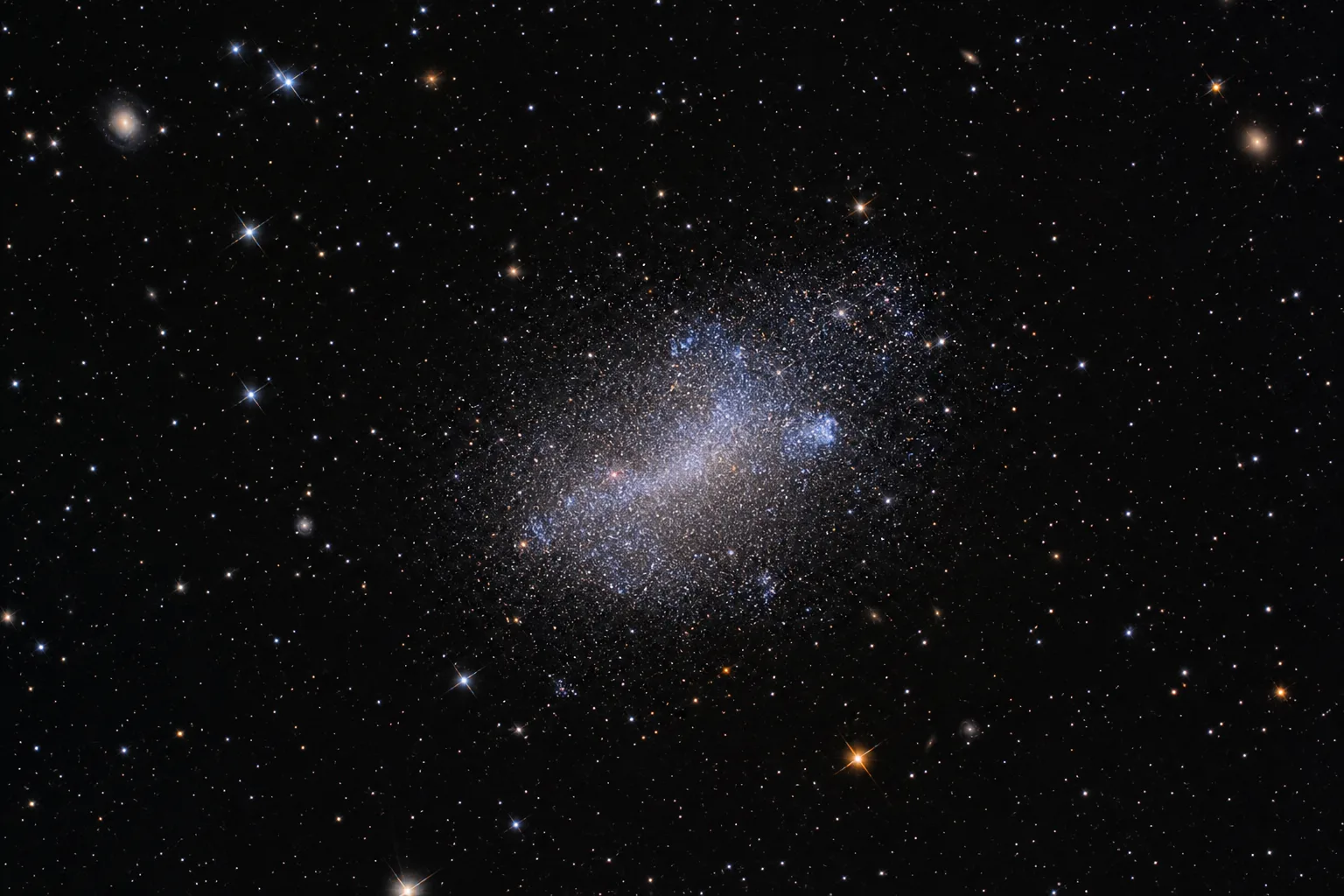
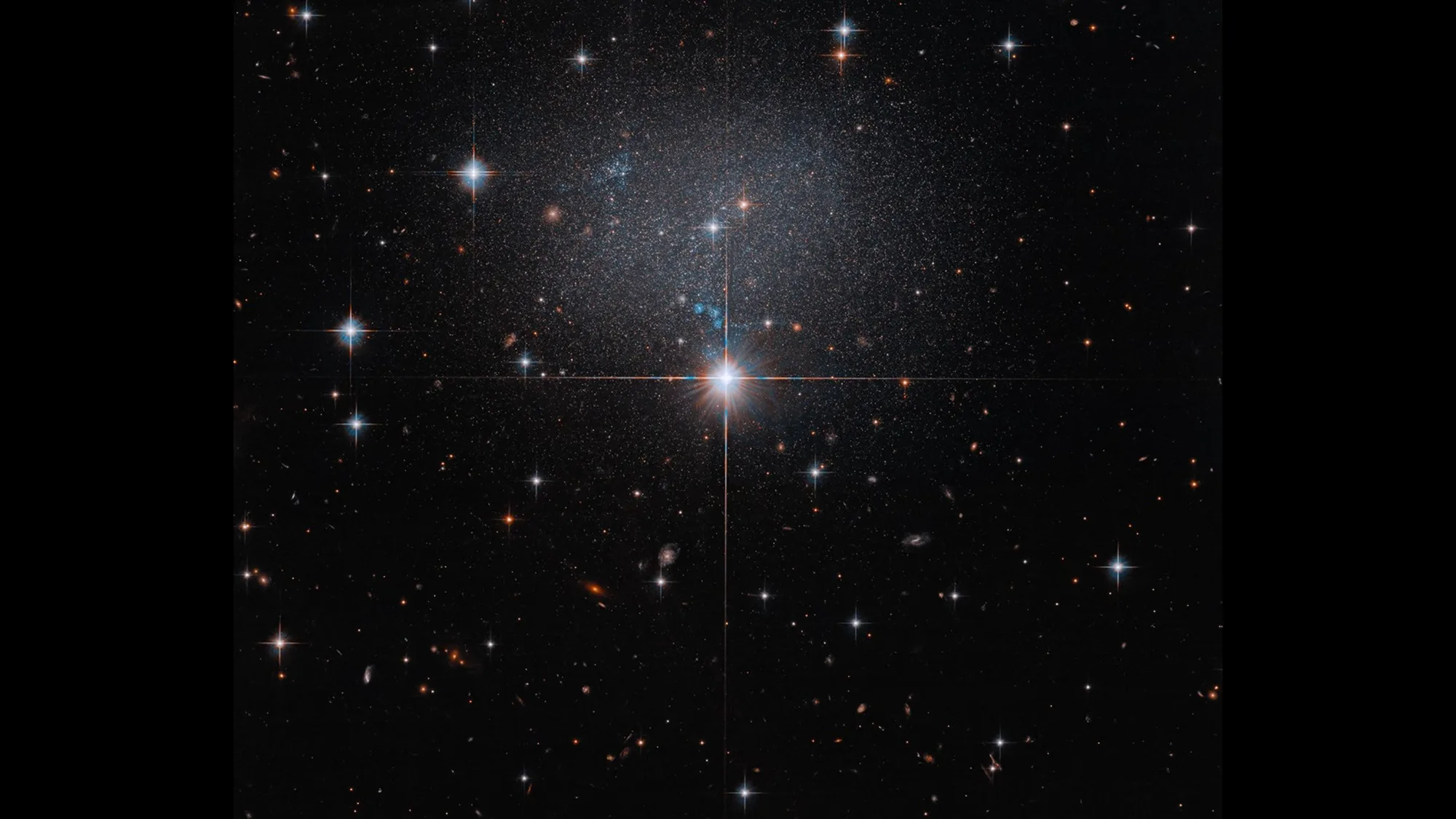
The Hubble Space Telescope has delivered another remarkable window into deep space, this time turning its gaze on a faint, oddly shaped collection of stars roughly 23 million light-years away. The resulting portrait of the Hubble dwarf galaxy ESO 490-017 is the kind of image that quietly reminds you how much universe is out there — and how much of it Hubble is still uncovering, decades into its mission.
- Hubble dwarf galaxy ESO 490-017 sits 23 million light-years from Earth and spans just 12,000 light-years across.
- The Hubble dwarf galaxy image was captured as part of a broader program studying how galaxies move through the universe.
- Despite its low surface brightness, ESO 490-017 reveals foreground stars with sharp diffraction spikes in the image.
- Red, orange, and beige smudges visible in the background are not stars — they are entire distant galaxies.
Table of Contents
Meet ESO 490-017: A Small Galaxy With a Big Presence
At just 12,000 light-years across, ESO 490-017 sounds modest by galactic standards. And it is. Our own Milky Way stretches at least 100,000 light-years from edge to edge, making ESO 490-017 roughly one-eighth the diameter of our cosmic home. But raw size isn’t the whole story here. What makes this particular Hubble dwarf galaxy interesting is its classification: it’s irregular, meaning it doesn’t fit neatly into the familiar spiral or elliptical categories that dominate most astronomy textbooks.
Irregular dwarf galaxies like ESO 490-017 are thought to be among the most primitive galactic structures in the universe. Many astronomers believe they represent early-stage galaxy formation — or in some cases, the remnants of larger systems that were gravitationally disrupted over billions of years. Either way, they’re scientifically valuable, offering a glimpse at conditions that larger, more evolved galaxies have long since moved past. Each Hubble dwarf galaxy of this type serves as a natural laboratory for studying the early universe.
The galaxy sits within the constellation Canis Major — famous for hosting Sirius, the brightest star in the night sky as seen from Earth. It’s a fitting neighbourhood. Even in this region of sky, where one of the most eye-catching stars in the heavens blazes, a tiny, faint Hubble dwarf galaxy has been quietly sitting 23 million light-years behind it all along.
What the Hubble Dwarf Galaxy Image Actually Shows
The image itself is layered in ways that aren’t immediately obvious. In the foreground, ESO 490-017 appears as a loose, speckled collection of stars without much defined structure — exactly what you’d expect from an irregular dwarf. Its low surface brightness means that most of the galaxy blends into a faint haze, almost as if it’s dissolving into the background of space.
That low brightness does something interesting visually: it makes the sharper, closer foreground stars pop dramatically. You can see Hubble’s characteristic diffraction spikes radiating from the brightest of these stars — those crisp, cross-shaped light artifacts that Hubble produces due to its mirror support structure. They’re technically an optical side-effect, but they’ve become one of the telescope’s most recognisable visual signatures.
Then there’s the background. And this is where the image gets genuinely interesting. What looks like a handful of faint, colourful smudges scattered across the frame aren’t stars at all. Those red, orange, and even beige blobs are entire galaxies — each one home to billions of stars — sitting far beyond ESO 490-017 in the deep universe. The colour variation tells a story too: redder objects tend to be either older, dust-obscured, or shifted toward the red end of the spectrum due to the expansion of the universe carrying them away from us. A single Hubble dwarf galaxy image, in other words, contains multiple layers of cosmic history.
The Science Behind the Shot: Mapping Cosmic Flow
This image wasn’t taken on a whim. It’s part of a structured Hubble observing program focused on galaxies and galaxy clusters — and specifically on how they move. The term astronomers use for this is ‘cosmic flow’: the large-scale, gravitationally-driven motion of massive structures through the universe. It’s distinct from the expansion of the universe itself, and understanding it requires mapping the velocities and trajectories of large numbers of galaxies across significant distances.
That’s a substantial scientific undertaking. The Hubble Space Telescope has been one of the primary instruments used to build this kind of map, partly because of its ability to observe faint, distant objects with the resolution needed to distinguish individual properties. ESO 490-017 is one data point in a much larger dataset — but it’s a data point that also happens to make a visually compelling photograph. Studying each Hubble dwarf galaxy in this survey adds another piece to the cosmic flow puzzle.
Cosmic flow research matters more than it might first appear. The way galaxies cluster and move reflects the underlying distribution of dark matter and dark energy throughout the universe. If astronomers can get a precise enough picture of how galaxies are streaming relative to each other, it gives them a more accurate model of what the large-scale structure of the universe actually looks like — and how it got that way.
Hubble’s Enduring Value in a New Telescope Era
It’s easy, in the era of the James Webb Space Telescope, to think of Hubble as yesterday’s instrument. Webb’s infrared capabilities have produced images that surpass Hubble in certain categories, and NASA has made no secret of the fact that JWST represents the next generation of space-based astronomy. But images like this one make the case for Hubble’s continued relevance pretty clearly.
Hubble has been operational since 1990, and the fact that it can still produce scientifically useful, visually striking portraits of objects 23 million light-years away says something meaningful about both its engineering and the ongoing work of the teams that maintain it. The telescope has undergone five servicing missions, the last in 2009, and it continues to operate — albeit with some instrument limitations — more than three decades after launch. Every Hubble dwarf galaxy portrait it captures in this period adds to a legacy that spans generations of astronomical discovery.
For the specific kind of optical-wavelength, wide-field imaging that programs like this cosmic flow study require, Hubble still delivers. JWST operates primarily in infrared, which makes it exceptional for peering through dust clouds and studying the earliest galaxies — but it doesn’t replace Hubble wholesale. The two telescopes are, in practice, complementary tools, each suited to different kinds of questions.
A Faint Galaxy, a Sharper Picture of the Universe
ESO 490-017 will never be the most famous galaxy in astronomical literature. It’s faint, it’s small, and it sits in a relatively quiet corner of the sky. But the Hubble dwarf galaxy image it has produced is a reminder of something worth holding onto: the universe is not a collection of spectacular highlights surrounded by empty space. It’s dense with structure at every scale, and most of it is waiting patiently in the background of images we’re only just beginning to gather and interpret properly.
As programs like this cosmic flow survey accumulate more data, the picture they’re assembling becomes increasingly detailed. Each Hubble dwarf galaxy observation — including ESO 490-017 — is one of the pixels in a much larger image, one that, when fully developed, should tell us something fundamental about the forces that have shaped everything we can see.
Frequently Asked Questions
What makes the Hubble dwarf galaxy ESO 490-017 unusual?
ESO 490-017 is classified as an irregular dwarf galaxy, meaning it lacks the defined spiral or elliptical structure of larger galaxies. At just 12,000 light-years across, it is tiny compared to the Milky Way, and its low surface brightness makes it particularly faint and difficult to observe.
Where in the sky is ESO 490-017 located?
ESO 490-017 sits within the constellation Canis Major — the same constellation that contains Sirius, the brightest star visible from Earth at night. The galaxy itself is around 23 million light-years from our solar system.
Why is Hubble studying the movement of galaxies?
The observing program that captured this image is focused on understanding ‘cosmic flow’ — the large-scale motion of galaxies and galaxy clusters through the universe. Mapping this movement helps scientists build a clearer picture of how the universe’s structure has evolved over time.
What are those colourful blobs visible in the background of the ESO 490-017 image?
Those red, orange, and beige patches are not stars. They are entire background galaxies, scattered across the deep field behind ESO 490-017.

